

If your business lost access to its systems for a full day tomorrow, how confident are you that you could fully recover without data loss, finger-pointing, or unpleasant surprises?
For many SMB and mid-market organizations, the honest answer is: not very. Backups exist somewhere, a disaster recovery (DR) plan might live in a folder, and everyone assumes things will work if they’re ever needed. But in real incidents, like ransomware, hardware failure, accidental deletion, or a cloud outage—those assumptions are often proven wrong.
That’s why more organizations are shifting to Managed Backup and Disaster Recovery (managed BDR). Instead of hoping that complex backup systems, scripts, and storage policies are configured correctly, they’re partnering with specialists who:
- Design a modern, compliant backup and disaster recovery architecture
- Operate and monitor it 24×7
- Regularly test restores to prove it works
- Commit to SLA-backed recovery times
Outsourced BDR combines expert process with proven tooling to drive faster, verifiable recovery outcomes. In this article, we’ll walk through the top five benefits of a managed backup and disaster recovery plan, why it delivers faster recovery, lower risk, and clearer accountability—and how to measure BDR ROI in terms your leaders will care about.
What Managed Backup & Disaster Recovery Actually Covers
Before we get into the benefits, it’s important to align on terminology.
- Managed backup: Your data is backed up according to defined policies—what’s protected, how often, how long it’s retained, and where it lives (on-prem, cloud, immutable storage, etc.)—and those backups are monitored and managed by a third-party provider.
- Managed disaster recovery: Goes beyond backup. It defines how and how quickly your business can restore critical systems after an incident. This includes failover procedures, DR runbooks, testing, documentation, and support during an actual event.
Two key metrics govern whether your backup and disaster recovery strategy is effective:
- RPO (Recovery Point Objective) – How much data loss is acceptable? Measured in time (e.g., 15 minutes, 4 hours, 24 hours).
- RTO (Recovery Time Objective) – How long can systems be down before it significantly impacts the business?
A managed BDR partner designs and runs your environment specifically to meet defined RPO/RTO goals—and proves it through testing and reporting.
Why Managed BDR Delivers Faster Recovery, Lower Risk, & Clearer Accountability
Most internal IT teams are highly capable but spread thin. They’re asked to handle everything: user support, projects, security, cloud migrations, and more. Backup and DR often become background tasks: “set it and forget it” jobs that only get attention when an error pops up—or worse, when something fails.
Managed BDR changes that dynamic:
- Recovery becomes someone’s day job, not a side task.
- Process and playbooks replace ad-hoc heroics.
- SLAs and metrics replace assumptions and gut feel.
Let’s dig into the five biggest benefits you gain by putting managed experts in charge of your backup and disaster recovery strategy.
Benefit 1: Faster, More Reliable Recovery Times You Can Prove
You don’t invest in backup to store data—you invest in it to recover data quickly when something goes wrong.
Unfortunately, many organizations only discover their true RPO and RTO capabilities during their first major outage. Common surprises include:
- A critical server wasn’t included in the backup job.
- Backups were failing quietly for weeks.
- Restores are painfully slow because they were never tested.
- The team doesn’t know which systems to prioritize.
- The DR “plan” is outdated and doesn’t match the current environment.
A managed BDR provider is built to prevent these surprises.
How Managed BDR Improves RPO/RTO
A strong managed BDR program typically includes:
- Continuous monitoring of backup jobs with proactive alerting and remediation
- Tiered backup policies based on business criticality
- Image-level backups and replication for key systems to enable rapid recovery
- Granular backups of databases, files, and SaaS platforms
- Documented failover procedures for on-prem and cloud workloads
- Regular test restores that simulate real incidents
Instead of guessing whether you can recover a database within one hour or a key application within four hours, you have tested, documented proof.
What “SLA-Backed Recovery Times” Really Mean
With managed BDR, recovery performance is defined in your service agreement. For example:
- Mission-critical workloads: RTO of 1 hour, RPO of 15 minutes
- Tier-2 systems: RTO of 4 hours, RPO of 1 hour
- Lower-priority systems: RTO of 24 hours, RPO of 24 hours
The provider is accountable for hitting those numbers. That gives you leverage internally—when someone asks, “Can we really be back up in under two hours?” you can point to:
- Performance reports
- Successful test results
- Vendor SLAs
That’s a major shift from “we think so” to “here is the documented proof.”
Benefit 2: Dramatically Lower Risk & Fewer Surprises During a Crisis
Risk isn’t just about whether a backup exists. It’s about the likelihood of a smooth, timely recovery when everything is going wrong—ransomware, hardware failure, cloud issues, human error, or a regional disaster.
The Hidden Risks in DIY Backup & DR
Even well-intentioned internal programs are vulnerable to:
- Configuration drift – New systems are added, old ones are retired, and backup policies don’t keep up.
- Silent failures – A backup job fails, and the alert gets buried in a noisy mailbox or dashboard.
- Dependency blind spots – An application depends on another system that isn’t being properly backed up.
- Key-person risk – Only one or two staff members truly understand how the DR process works.
- Limited testing – Restores are tested annually, or only on a subset of systems, because it’s time-consuming.
How Managed BDR Reduces Risk
A managed BDR provider approaches risk in a structured way:
- Comprehensive Discovery and Assessment
They inventory your environment, map application dependencies, document business priorities, and identify gaps in your current backup and DR capabilities. - Standardized Policies and Architectures
They implement proven backup architectures (including immutable and offsite copies) and standardized runbooks based on your risk tolerance and regulatory requirements. - Continuous Oversight
They manage, monitor, and fine-tune backup jobs daily, so silent failures are addressed quickly. - Regular Testing and Tabletop Exercises
They simulate outages and verify that you can meet your RPO/RTO targets, adjusting designs when results fall short. - Formal Risk Reporting
You receive periodic reports that rank systems by criticality, highlight risk trends, and document remediation steps.
Instead of discovering risk during a disaster, you see it in advance, prioritize it, and intentionally reduce it.
Benefit 3: Stronger Compliance & Audit-Ready Documentation
For many industries, backup and disaster recovery are no longer “good hygiene”—they are explicit compliance requirements. Whether you’re dealing with HIPAA, PCI, SOX, GLBA/FTC Safeguards, SEC rules, state privacy laws, or cyber insurance questionnaires, you’re expected to prove:
- What you back up
- How often you back it up
- How long you retain it
- How it is protected (encryption, access control, immutability)
- How frequently you test restores
- How quickly you can recover
Auditors, regulators, and insurers don’t just want to hear that you have backups; they want evidence.
Where Internal Programs Often Fall Short
Typical pain points include:
- Documentation that’s outdated or incomplete
- No formal mapping of backup/DR controls to specific regulations
- Inconsistent or manual reporting
- Limited logs and audit trails for backup and recovery activities
- Difficulty proving that testing actually occurs and meets policy
How Managed BDR Supports Compliance
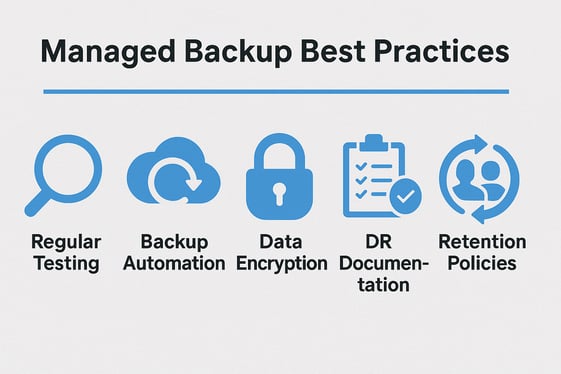
Because managed BDR providers operate at scale, they build their services with compliance in mind. A mature provider will deliver:
- Audit-ready backup and restore logs – who did what, when, and with what outcome
- Documented backup and retention policies aligned to your regulatory environment
- Evidence of regular testing—including test reports with RPO/RTO results
- Encryption and access controls consistent with common frameworks
- Support for e-discovery and legal holds for specific datasets
- Reporting that aligns with your auditors’ expectations
This doesn’t replace your broader governance efforts, but it gives you a solid, defensible foundation for the backup and disaster recovery components of your compliance program.
When auditors ask, “Show us how you back up and restore this system, and evidence that it’s been tested,” you can answer in minutes instead of days.
Benefit 4: Cost Predictability & Better Use of Internal IT Resources
On paper, managing backup and disaster recovery in-house can look less expensive. You already own some hardware, you’re paying for storage, and someone on the team “owns” backups. But when you look at the full picture, internal BDR often costs more—both in hard dollars and in opportunity cost.
The True Cost of DIY BDR
Here’s where the hidden costs show up:
- Infrastructure – Backup servers, storage appliances, additional disks, replication targets, and networking.
- Licensing – Backup software licenses, cloud storage subscriptions, and maintenance contracts.
- Human time – Daily backup checks, troubleshooting failed jobs, performing test restores, documenting processes, answering audit questions.
- Emergency consulting – Specialized help when a major incident overwhelms the internal team.
- Downtime impact – Every extra hour of outage translates into lost revenue, lost productivity, and reputational damage.
How Managed BDR Delivers Cost Predictability
Managed BDR bundles most of these cost elements into a single, predictable monthly operating expense, usually based on factors like:
- Protected data volume
- Number of systems or VMs
- Required RPO/RTO tiers
- Compliance and reporting requirements
In that monthly fee, you get:
- Backup software and platform licensing
- Backup infrastructure and cloud storage (depending on the model)
- Monitoring and management services
- Testing and documentation
- Access to recovery experts during incidents
Instead of constantly adjusting CapEx budgets and scrambling during crises, you know exactly what you’re spending to protect your business.
Freeing Internal IT to Focus on Higher-Value Work
Perhaps the biggest financial win is the opportunity cost you reclaim.
When your internal IT team isn’t tied up with manual backup checks, report generation, or emergency recovery firefighting, they can focus on:
- Modernizing legacy systems
- Improving user experience and productivity
- Advancing cybersecurity initiatives
- Delivering analytics and automation projects
- Supporting strategic growth initiatives
Put differently: every hour your experts spend babysitting backups is an hour they’re not moving the business forward. Managed BDR gives them that time back.
Benefit 5: Clear Accountability & Measurable ROI
Backup and disaster recovery used to be something leaders reluctantly paid for but never quite understood. That’s changing. Boards, executives, insurers, and customers are all asking more pointed questions:
- How resilient are we, really?
- What is our current RPO/RTO posture?
- How long would we be down if we were hit by ransomware?
- Are we meeting cyber insurance and regulatory expectations?
- Are we overspending or underspending on protection?
A managed BDR program gives you the data and accountability to answer those questions with confidence.
Shared Responsibility & Defined Outcomes
With managed BDR, ownership is clearly defined:
- The provider is responsible for operating the backup and DR platform, monitoring, testing, and meeting defined service levels.
- Your internal IT team is responsible for communicating changes in the environment, business priorities, and any new systems that must be protected.
- Leadership has visibility into the risk posture, costs, and performance metrics.
Everyone knows who does what, instead of wondering whether DR is “someone else’s problem.”
How to Measure BDR ROI with Metrics Your Leaders Care About
To demonstrate ROI, you need numbers that translate into business language. A mature managed BDR program will help track at least three categories of metrics.
1. Recovery Performance Metrics
These prove that the solution delivers:
- Average RTO by system tier – Are critical apps consistently recovered within target timelines?
- Average RPO by system tier – How fresh is the recovered data?
- Backup job success rate – What percentage of backups complete each day/week/month successfully?
- Test restore success rate – Are restores consistently successful during testing?
- Recovery drill performance – How long full or partial DR tests take compared to previous baselines.
2. Operational Efficiency Metrics
These show how managed BDR improves day-to-day operations:
- Hours of IT staff time saved per month compared to managing backup/DR internally
- Reduction in the number or severity of incidents related to backup failures or incomplete restores
- Decreased use of external emergency consultants
- Fewer off-hours emergencies that require overtime or burnout-inducing heroics
3. Risk & Compliance Metrics
Finally, tie BDR performance to broader risk reduction:
- Percentage of critical systems with tested, documented DR plans
- Alignment with cyber insurance requirements (often related to immutability, testing, and recovery capabilities)
- Compliance status for backup-related controls under your frameworks (HIPAA, PCI, etc.)
- Number of audit findings related to backup/DR before vs. after implementing managed BDR
These aren’t theoretical benefits—they directly affect your ability to avoid fines, pass audits, and recover from cyber incidents with less damage.
When you can put these metrics on a dashboard and show improvement quarter over quarter, backup and disaster recovery stop being a sunk cost and become a measurable investment in resilience.
The Managed BDR Value Stack
Let’s recap the core ways a managed backup and disaster recovery plan strengthens your organization:
- SLA-Backed Recovery Times
You know exactly how fast you can recover critical systems and how much data you can afford to lose—because it’s defined, tested, and documented. - Tested Restores and Audit Trails
You don’t just have backups; you have proven recovery processes with logs and reports to satisfy auditors, insurers, and leadership. - Policy Alignment for Compliance
Backup and DR policies are mapped to your regulatory and industry requirements, supported by documentation and reporting. - Cost Predictability and Fewer Surprises
You replace unpredictable CapEx and emergency spending with a predictable OPEX model that includes licensing, infrastructure, and expert support. - Clear Accountability and Measurable ROI
Dashboards, metrics, and SLAs provide transparency into performance, risk reduction, and financial impact.
Ultimately, managed BDR is about confidence—confidence that when something goes wrong (and it will), you can recover quickly, meet your obligations, and get back to serving customers without chaos or guesswork.
experience matters
Cyber Advisors brings decades of hands-on experience designing and managing dependable Managed Backup and Disaster Recovery (MDR) systems for a diverse range of enterprise, mid-market and SMB clients. Our team continuously tests, validates, and fine-tunes each environment to ensure every backup, failover, and recovery workflow performs exactly as intended—no surprises, no uncertainty. By combining proven methodologies with modern tooling and 24/7 oversight, we deliver the reliability and transparency that business owners and IT leaders need to finally sleep better at night, knowing their organizations can recover quickly and confidently from any disruption.
Book a Managed BDR Review
If you’re unsure how your current backup and disaster recovery strategy would hold up under real pressure, the most valuable next step is a Managed BDR Review.
During this engagement, you can:
- Benchmark your current RPO/RTO posture
- Identify coverage gaps across on-prem, cloud, and SaaS workloads
- Review recovery testing practices and documentation
- Evaluate compliance alignment and audit readiness
- Estimate the business impact of potential downtime scenarios
- Quantify the payback of moving to a managed model
Instead of relying on assumptions, you’ll have hard data—and a roadmap—to strengthen resilience.
Book a Managed BDR Review to benchmark gaps and quantify payback before the next incident puts your current strategy to the test.