

You can’t defend what you can’t see. In an era of sprawling hybrid networks, SaaS sprawl, and increasingly deft attackers, network visibility is the foundation of cyber resilience. When telemetry is comprehensive and analytics are near real-time, your teams detect anomalies earlier, triage faster, and recover with less business disruption. This post explains why visibility is central to resilience, what “good” looks like, and how to implement monitoring and analytics that yield actionable insight for both IT operations and security.
Why real-time visibility strengthens cyber resilience
Cyber resilience isn’t a single product or a one-time project. It’s your organization’s ability to anticipate threats, withstand incidents, recover quickly, and adapt continuously. Visibility elevates each of these capabilities:
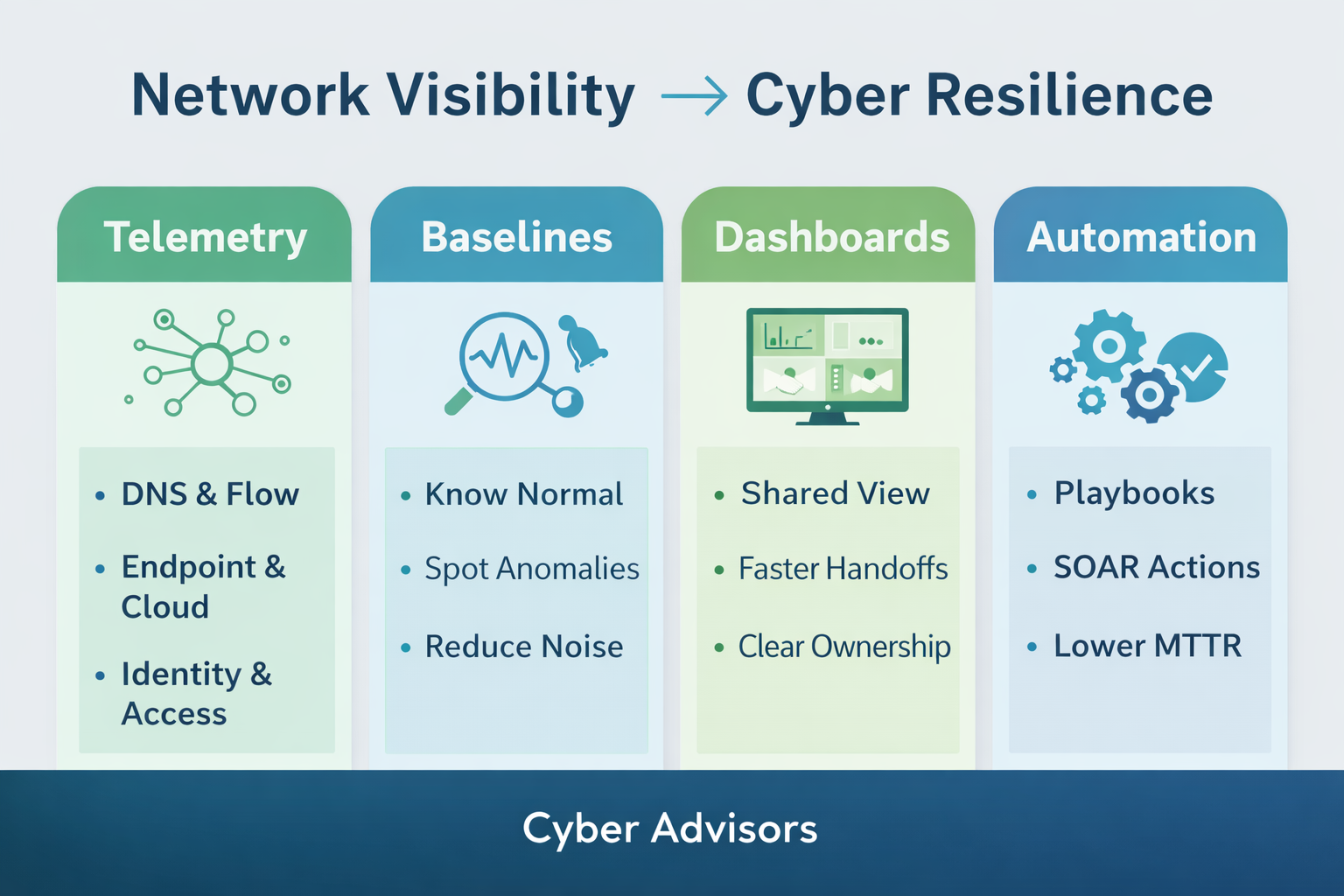
Telemetry reduces blind spots across hybrid environments
Modern networks aren’t confined to a single data center. Traffic traverses branch offices, home networks, multi-cloud VPCs, SaaS platforms, and mobile devices. Without telemetry from each segment—flow records, packet metadata, DNS logs, identity events, endpoint signals—defenders operate with partial information. Blind spots translate into longer dwell time and missed precursors. Comprehensive telemetry, by contrast, illuminates lateral movement, strange egress patterns, and policy violations in context, replacing hunches with evidence.
Baselines make anomalies pop
Visibility isn’t just about collecting data; it’s about understanding normal so you can spot the abnormal. When you baseline traffic volumes, service dependencies, authentication patterns, and software behaviors, even subtle shifts become noticeable—an unusual domain contacted by a finance workstation, a new service-to-service connection in your cloud, a spike in error rates after a patch. Statistical baselines and seasonality-aware thresholds reduce noise and surface genuine indicators of compromise (IOC) and indicators of attack (IOA).
Dashboards align IT operations & security
Resilience is a team sport. NetOps cares about performance, availability, and capacity. SecOps focuses on adversary tactics and containment. Shared dashboards powered by the same telemetry create a single source of truth. The result is faster handoffs, fewer “it’s a network problem” debates, and clearer ownership during incidents. When both teams watch the same dashboards—latency, errors, saturations, and security detections—they can remediate issues before they become customer-visible outages or headline-worthy breaches.
Faster MTTR means higher availability
Mean Time to Detect (MTTD) and Mean Time to Respond/Recover (MTTR) are the heartbeat metrics of resilience. High-fidelity visibility shrinks both. Deep packet visibility or enriched flow data reveals the “what” and “why,” not just the “that.” If a critical business API slows, you can trace it to a noisy neighbor, a misrouted path, or malicious data exfiltration within minutes. Shorter MTTR protects uptime, keeps SLAs intact, and avoids compounding costs from prolonged disruptions.
Bottom line: Network visibility converts uncertainty into insight. Insight accelerates decisions. Faster, better decisions are the essence of resilience.
What “good” network visibility looks like
Teams often ask, “We have tools—do we have visibility?” Here’s a practical model to assess your current state and define “good” for your business.
1) Coverage across critical planes
- North–south and east–west traffic: Gateways, inter-VPC peering, SD-WAN overlays, data center fabrics.
- Identity and access: SSO/IdP events, privileged access, MFA outcomes, account lifecycle changes.
- Endpoints and servers: EDR telemetry, process lineage, file integrity monitoring (FIM).
- Cloud and SaaS: CloudTrail/Activity Logs, VPC flow logs, control plane config changes, CASB signals.
- DNS and web: Resolver logs, egress proxy logs, URL filtering decisions.
- Applications and APIs: APM traces, service mesh telemetry, error budgets, dependency maps.
- OT/IoT: Passive network discovery for non-agentable devices, protocol-aware insights (Modbus, BACnet, SIP, etc.).
2) Depth of data
Not all data is equal. “Good” pairs breadth with the right level of detail for investigative pivoting. For example, NetFlow/IPFIX provides lightweight visibility at scale; packet capture (full or header-only) offers payload-aware context for short windows around detections. Similarly, DNS logs plus passive DNS help you attribute a suspicious domain to a known malware family or newly registered infrastructure.
3) Timeliness
Log ingestion and query latency make or break investigations. When “real time” is really “in 15 minutes,” you lose containment opportunities. Aim for sub-minute latency for streaming analytics on high-risk sources (DNS, auth, egress) and under five minutes for bulk sources (cloud logs, NetFlow). Timeliness applies to retention, too—keep hot data in searchable storage for the full dwell-time window relevant to your threats and compliance needs.
4) Enrichment & correlation
Raw logs are noisy. Enrichment transforms them into signals: geoIP and reputation on IPs, ownership on subnets, business criticality tags for applications, user & device identity from your CMDB/asset graph, and MITRE ATT&CK mappings on detections. Correlation finds the thread connecting a phishing click to an OAuth grant to unusual egress to S3: a narrative, not a pile of events.
5) Actionability & automation
Dashboards and alerts should direct the next best action. That might be isolating a device via NAC/EDR, disabling a token in the IdP, or rolling back a suspect configuration. Playbooks executed via SOAR (Security Orchestration, Automation, and Response) help analysts act consistently and quickly with fewer swivel-chair steps.
How to implement monitoring & analytics for actionable insight
Whether you’re starting from scratch or rationalizing an existing toolset, use the following implementation path to build reliable, scalable visibility.
Step 1 — Discover & inventory
You can’t observe what you don’t know exists. Start with automated discovery: cloud asset crawlers, passive network discovery for unmanaged devices, API-driven app/service catalogs, and identity/privilege inventories. Tag assets with ownership and criticality. This inventory becomes the backbone for prioritizing data collection and alerting.
Step 2 — Instrument the right data sources
Based on risk and business importance, select data sources with the best signal-to-noise ratio:
- Enable VPC Flow Logs / NSG Flow / Firewall logs for coarse traffic patterns.
- Add packet inspection at key chokepoints for protocol anomalies and content-aware detections.
- Forward DNS resolver logs and web proxy logs for threat intel correlation.
- Stream IdP/SSO events, including OAuth grants and administrative actions.
- Collect EDR telemetry for host-level behavior and isolation actions.
- Capture APM traces and service mesh metrics for application-level visibility.
Step 3 — Centralize & normalize telemetry
Ship logs and metrics to a central analytics platform (SIEM + data lakehouse or log analytics + time-series DB). Normalize fields (src_ip, dst_ip, user, action, resource) and enrich during ingestion (asset owner, geo, threat intel). Adopt a common schema to simplify queries and cross-tool correlation.
Step 4 — Build baselines & detections
Create detections that combine signatures (known bad) with behavioral analytics (unknown bad). Baselines should account for diurnal and seasonal patterns—end of month financial exports, nightly batch jobs—so that alerts fire only on deviations that matter. Tie each detection to ATT&CK techniques to illuminate coverage and gaps.
Step 5 — Design dashboards for shared outcomes
Build views for executives (risk and resilience posture), SecOps (threat and incident pipeline), NetOps (SLA, capacity, and error budgets), and application owners (latency, dependencies, change impact). Limit each dashboard to a small set of decisive indicators. If every panel is “red,” none are actionable.
Step 6 — Tune alerts & automate responses
Alert fatigue kills resilience. Start with a narrow set of high-value alerts. For each, define a playbook: triage steps, data to pull, and actions to take. Automate repetitive steps—enriching an IP with threat intel, quarantining a device, revoking tokens—while keeping humans in the loop for risky actions. Measure precision (false positive rate) and coverage (detection rate) monthly.
Step 7 — Integrate incident response & recovery
True resilience includes recovery. Ensure backups are immutable and tested. Tie visibility to recovery triggers: for example, when ransomware behavior is detected, automatically snapshot critical volumes and notify the recovery team. Maintain communications templates and stakeholder lists for time-bound updates.
Step 8 — Extend to cloud, SaaS, & remote work
Hybrid is the new normal. Ensure log ingestion pipelines handle cloud provider nuances and SaaS APIs gracefully. Use secure access service edge (SASE) / zero trust network access (ZTNA) to centralize egress and enforce consistent policies for remote users, feeding those logs into your analytics for uniform visibility.
Step 9 — Include OT/IoT without disruption
Many operational devices can’t run agents or tolerate active scanning. Use passive network monitoring to identify devices, protocols, and communication patterns. Baseline normal interactions (e.g., PLC → HMI) and alert on unexpected peers or commands. Segment aggressively and test response playbooks with operations stakeholders.
Step 10 — Govern, measure, & iterate
Treat visibility capabilities like products with SLAs, roadmaps, and a customer feedback loop. Hold quarterly reviews that evaluate coverage, precision, latency, and automation rates, then align on the next set of improvements.
High-impact visibility use cases across SecOps and NetOps
1) Early ransomware containment
Ransomware rarely starts with encryption. Precursors include credential abuse, suspicious SMB traffic, and command-and-control (C2) beacons. Visibility across DNS, auth, and east-west traffic flags these signals early. Automated actions can isolate the host via EDR, disable the user in the IdP, and block the domain at the resolver—often preventing blast radius expansion.
2) Insider risk & data exfiltration
Baselines on normal data volumes and destinations highlight unusual egress—think finance data heading to a personal cloud drive or source code being pulled from unexpected subnets. When alerts combine identity (user role, recent HR changes) and egress context (new geo, atypical protocol), investigations are faster and more accurate.
3) Shadow IT & SaaS sprawl control
DNS and HTTP telemetry reveal new SaaS usage. Flagging “first-seen” applications and correlating with finance data prevents silent proliferation, enabling consistent access policies and data governance. For sanctioned apps, API visibility tracks risky configurations and privilege drift.
4) Cloud misconfiguration detection
Most cloud incidents stem from configuration drift—public buckets, permissive security groups, and overbroad IAM roles. Streaming cloud control plane logs into your analytics surface changes in near real time, while periodic posture scans confirm that baseline policies remain intact.
5) Performance degradation triage
Visibility isn’t only for security. When a revenue-critical app slows, traces plus network telemetry quickly pinpoint the bottleneck: a database lock, a missing index, a noisy neighbor, or a congested link. Shared dashboards keep security and IT aligned during customer-impacting incidents where the cause isn’t immediately apparent.
6) Third-party & supply chain risk
Map dependencies between your services and external providers. Alert on new dependencies or abnormal volumes. If a partner is compromised, your visibility reveals which systems communicated, when, and what data moved—allowing swift containment and communications grounded in facts.
7) Zero Trust progress measurement
Zero Trust isn’t a switch; it’s a maturity journey. Visibility shows whether policies work as intended: which pathways are used, which are blocked, who requests elevated access, and where segmentation is still too permissive. These insights turn Zero Trust from aspiration into a measurable reality.
KPIs, MTTR, & building the resilience ROI case
Boards and business leaders fund outcomes, not tools. Here’s how to quantify the value of network visibility and link it to resilience.
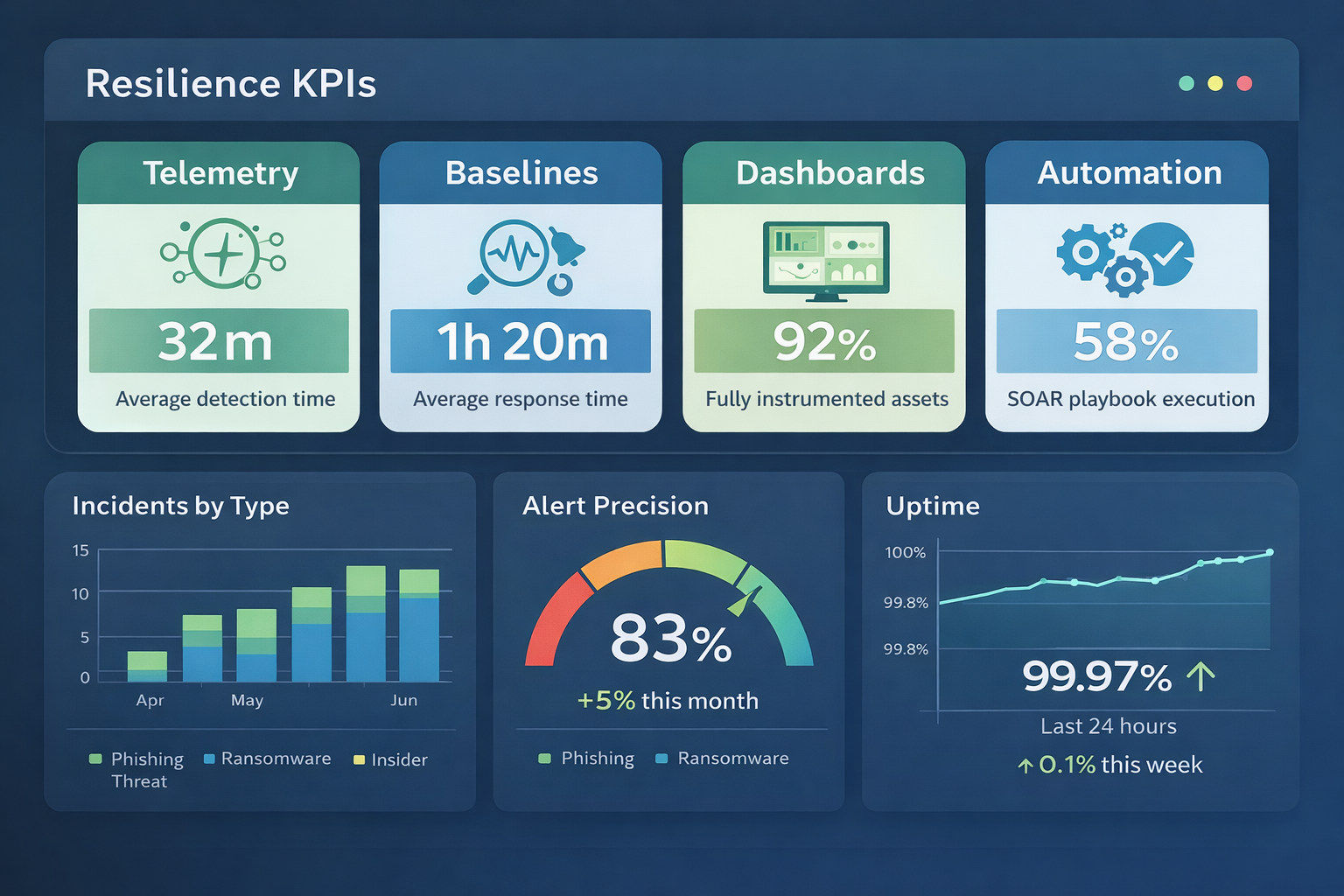
Measure what matters
- MTTD and MTTR by incident class: phishing, ransomware, insider threat, supply chain.
- Containment time: time from detection to isolation or kill switch.
- False positive rate: per detection, per queue, trending down month over month.
- Coverage: % of crown-jewel assets fully instrumented.
- Change failure rate: % of changes causing incidents, tracked pre- and post-visibility initiative.
- Availability/Uptime: SLA adherence, error budget burn rate for critical services.
Translate improvements into dollars
Shorter outages protect revenue and avoid SLA penalties. Faster response reduces breach costs (forensics, notifications, legal, downtime). Automations save analysts time and help prevent burnout. When you tie MTTR reductions and avoided incidents to average cost per minute of outage and cost per incident, the ROI becomes clear and compelling.
Tell the story with before/after
Executive stakeholders respond to stories. Share a timeline of a recent incident where visibility shaved hours off detection and days off recovery. Show the “before” (fragmented data, finger-pointing) and the “after” (shared dashboards, decisive containment). This narrative cements continued investment.
Common pitfalls & how to avoid them
Collecting everything, understanding nothing
Storage is cheap until it isn’t—and volume alone doesn’t deliver outcomes. Start with goal-first telemetry: for each use case, identify the minimum viable data needed to detect, investigate, and respond. Expand deliberately from there.
Unowned tools & zombie dashboards
If everything is owned by “security” or “the network team,” nothing is truly owned. Assign product owners, SLAs, and stakeholders to dashboards and detections. Retire unused views and rules quarterly.
Alert fatigue
An alert that no one acts on is technical debt. Keep a tight core of high-confidence detections, measure action rates, and tune ruthlessly. For lower-confidence detections, route to weekly hunts instead of real-time paging.
Blind spots in encryption & east-west traffic
TLS everywhere is good for privacy, but challenging to inspect. Use TLS fingerprinting, SNI/SAN analysis, and selective decryption at policy-approved chokepoints. For east-west, combine segmentation with flow analytics and, where feasible, packet metadata at key junctions.
Neglecting SaaS & identity
Many breaches now pivot on OAuth grants, API tokens, or SaaS misconfigurations. Ensure identity and SaaS logs are first-class citizens in your visibility program, not afterthoughts.
One-time projects instead of continuous improvement
Threats evolve, architectures change, and business priorities shift. Visibility must evolve, too. Quarterly roadmap reviews keep telemetry aligned with risk.
A practical 90-day visibility roadmap
Days 0–30: Establish the baseline
- Stand up centralized logging and analytics for core sources (firewalls, DNS, IdP, EDR, cloud control plane).
- Inventory crown-jewel applications and map dependencies.
- Build shared SecOps/NetOps dashboards with 5–7 decisive indicators each.
- Define two high-value playbooks (e.g., suspected ransomware, data exfiltration) and manual runbooks.
- Launch an initial Visibility Assessment to identify top blind spots and quick wins.
Days 31–60: Expand coverage & cut MTTR
- Enable VPC/virtual network flow logs and packet visibility at key egress/ingress points.
- Deploy first wave of detections mapped to ATT&CK (credential abuse, C2, lateral movement).
- Automate enrichment (asset owner, business criticality, threat intel) for faster triage.
- Begin limited SOAR actions (isolate host, disable account) with human approval.
Days 61–90: Industrialize & integrate
- Extend telemetry to SaaS and OT/IoT segments; onboard app traces for top business services.
- Move from manual runbooks to semi-automated playbooks; measure false positives and tune.
- Hold a joint SecOps/NetOps game day to test detection, containment, and recovery processes.
- Present a before/after MTTR and risk reduction report to leadership to maintain momentum.
How Cyber Advisors helps accelerate visibility and resilience
Many teams know where they want to go but are stretched thin by day-to-day demands. As a trusted partner to SMB and mid-market organizations, Cyber Advisors’ Managed IT Services and Cybersecurity practices work together to deploy practical, right-sized visibility programs that align with your business goals. From network and cloud observability to SIEM design, detection engineering, and incident response, we combine proven playbooks with vendor-agnostic guidance.
Close blind spots with real-time insight & proactive action
Visibility is the lever that multiplies the impact of every other security and IT investment you make. Start by illuminating the paths attackers favor and the dependencies your business relies on most. Then operationalize that insight with clear detections, right-sized automation, and shared dashboards. The payoff is faster detection, faster recovery, and less disruption—hallmarks of a resilient business.
Appendix: Quick-reference checklists
Telemetry sources to prioritize
- DNS resolver logs with threat intel enrichment
- Firewall & proxy logs with user identity
- IdP/SSO events, including admin operations and OAuth grants
- EDR telemetry (process, network, isolation capability)
- VPC/virtual network flow logs and selective packet capture
- Cloud control plane logs (create/modify/delete config events)
- APM traces for critical services and APIs
- OT/IoT passive discovery and protocol-aware monitoring
Essential dashboards
- Executive: risk heatmap, incident trends, resilience KPIs (MTTD/MTTR, automation rate)
- SecOps: detection pipeline, high-risk assets, containment status, emerging threats
- NetOps: latency/errors/saturation, top talkers, link health, change impact
- App owners: dependency map, error budget burn, release impact
Top five playbooks to automate first
- Suspected ransomware: isolate host, snapshot volumes, block C2 domains, notify IR.
- Credential compromise: disable account, revoke sessions/tokens, force reset, review activity.
- Data exfiltration spike: block the destination, isolate the endpoint, collect forensics, notify the owner.
- Malicious domain observed: sinkhole/block across DNS and proxies, search back 30 days, notify.
- High-risk cloud config change: auto-remediate (if safe), create a ticket, and alert the owner.
Frequently asked questions
Do I need full packet capture everywhere?
No. Use a tiered approach. Combine scalable flow data for broad coverage with targeted packet capture at high-risk or high-value junctions. Retain packets for shorter windows to control cost while ensuring deep context during incidents.
Isn’t endpoint telemetry enough?
Endpoints are vital, but they miss unmanaged/legacy/IoT devices and don’t always capture cross-service dependencies. Network visibility provides a resilient “backstop,” catching behaviors that endpoints miss or suppress.
We already have a SIEM—why invest more?
A SIEM is only as valuable as the data it ingests and the workflows around it. Investments in source coverage, normalization, enrichment, and automation magnify SIEM value. Many organizations realize the biggest gains by improving the quality of visibility rather than adding more tools.
How do we balance privacy with inspection?
Establish clear governance: what data is inspected, where decryption is allowed, how long data is retained, and who can access it. Leverage selective decryption and metadata analysis to minimize exposure while maintaining effective detection.
From Blind Spots to Insights: Cyber Advisors Delivers
Cyber Advisors helps organizations of every size—from fast-growing startups to multi-site enterprises—turn fragmented data into clear, actionable visibility that strengthens cyber resilience. Our team unifies telemetry across on-prem, cloud, and SaaS; builds right-sized SIEM/log analytics; engineers high-fidelity detections; and operationalizes response with playbooks that cut MTTR. Whether you need fully managed services or a co-managed boost for your internal teams, we bring deep experience in regulated industries, manufacturing/OT and IoT environments, and distributed workforces. The result is a living visibility program: shared dashboards for IT and Security, measurable risk reduction, and a roadmap that evolves with your business.