

Shadow IT isn’t just “rogue apps.” In 2026, SaaS sprawl is the norm as teams move fast, and a growing wave of AI-enabled tools. This guide gives SMB and mid-market leaders a practical blueprint to reduce risk without adding headcount: high-impact controls, clear owners, quick wins, and KPIs that prove progress.
What’s at Stake in 2026
SaaS sprawl creates three overlapping blind spots: visibility gaps (unknown apps), control gaps (inconsistent access/logging/sharing), and response gaps (slow containment and unclear impact).
Vendor/tool sprawl adds complexity and increases exposure. And “shadow AI” adoption is a growing source of data leakage and compliance risk.
Common Failure Patterns That Keep SaaS Sprawl Dangerous
Failure Pattern 1: “We’ll inventory everything first.”
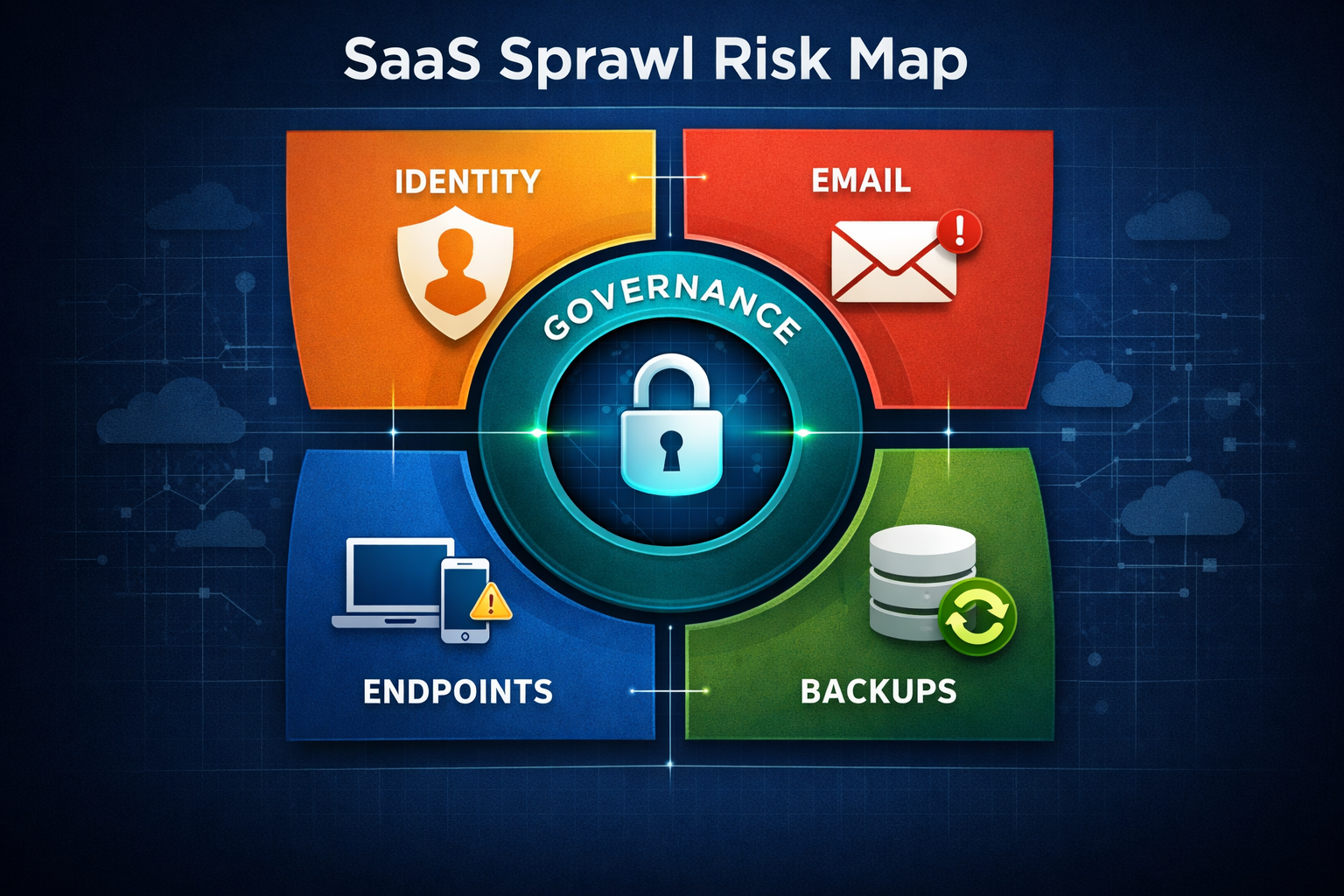
Inventory is never done. Start where identity, data, and money intersect: email, file sharing, HR, finance, CRM, and endpoints.
Failure Pattern 2: “Security owns it, but IT can’t enforce it.”
Every policy must map to enforceable controls: Conditional Access, phishing-resistant MFA, endpoint compliance, DLP, backups, and vendor requirements.
Failure Pattern 3: “We bought a tool, so we’re safe.”
Tools help, but only if you make decisions and operationalize them.
Failure Pattern 4: “We’ll figure incident response out later.”
Modern incident response is practice, not paperwork. Tabletop drills and playbooks compress time-to-response.
Failure Pattern 5: “MFA is on, so we’re covered.”
Weak MFA is increasingly bypassed. Move to phishing-resistant MFA and enforce it with Conditional Access, using authentication controls.
Top 10 Ways to Avoid Shadow IT Risks with SaaS Sprawl
1) Make Identity the Front Door: Enforce Phishing-Resistant MFA + SSO
- Put priority apps behind SSO (email, file sharing, HR, finance, CRM, collaboration).
- Require phishing-resistant MFA for admins immediately, then expand to high-risk users and sensitive apps.
- Move toward passwordless where feasible; disable legacy authentication.
- Apply Conditional Access guardrails (risk, device compliance, location, session controls).
Owner: IT + Security | KPI: % phishing-resistant MFA coverage for priority apps
2) Tune Email Security Like It’s Your Primary Perimeter
- Disable legacy protocols where possible.
- Enable impersonation protection, anti-BEC tuning, link scanning, and attachment controls.
- Validate SPF/DKIM/DMARC and monitor spoofing attempts.
- Make “Report Phish” easy and integrate it with response workflows.
3) Get Serious About Endpoint Coverage: EDR + Baselines + Compliance Gates
- Measure EDR coverage by active reporting endpoints (not licenses).
- Enforce baselines: encryption, patch SLAs, local admin controls.
- Require compliant devices for sensitive apps; use secure sessions for unmanaged devices.
4) Make Backups a Recoverability Program (Including SaaS Data)
- Identify Tier 0 systems (M365/Workspace, file sharing, CRM, finance, HRIS).
- Implement SaaS backups where needed; define RPO/RTO by system.
- Test restores regularly and track results.
5) Create a Lightweight App Intake Process That Beats Shadow IT
- Use a simple intake: purpose, data types, owner, integrations, and user group.
- Publish approved alternatives by category.
- Fast lane for low-risk apps; review lane for sensitive data.
- Set a decision SLA (e.g., 5 business days).
6) Reduce SaaS Data Exposure with Safe Defaults
- Restrict anonymous sharing links; require expirations where possible.
- Implement simple data classification.
- Apply DLP for high-risk data types first.
- Review OAuth permissions; remove unused/high-risk integrations.
7) Treat Vendor Risk as a SaaS Sprawl Control
- Tier vendors by data sensitivity and business criticality.
- Require baseline evidence for Tier 1–2 vendors; tie reviews to renewals.
- Ensure offboarding clauses: export, deletion, and access termination.
8) Update User Awareness for 2026: SaaS + Shadow AI Behaviors
- Teach safe SaaS habits (no personal email for work tools, no blind OAuth approvals).
- Publish shadow AI guardrails: what data is prohibited and approved alternatives.
- Use short, targeted modules tied to real incidents.
9) Run Tabletop Drills for SaaS Scenarios
- Create 1–2-page playbooks for compromised email, OAuth abuse, credential stuffing, and vendor breach notices.
- Drill quarterly; measure time-to-revoke access and identify impacted apps.
10) Publish a One-Page Monthly Scorecard
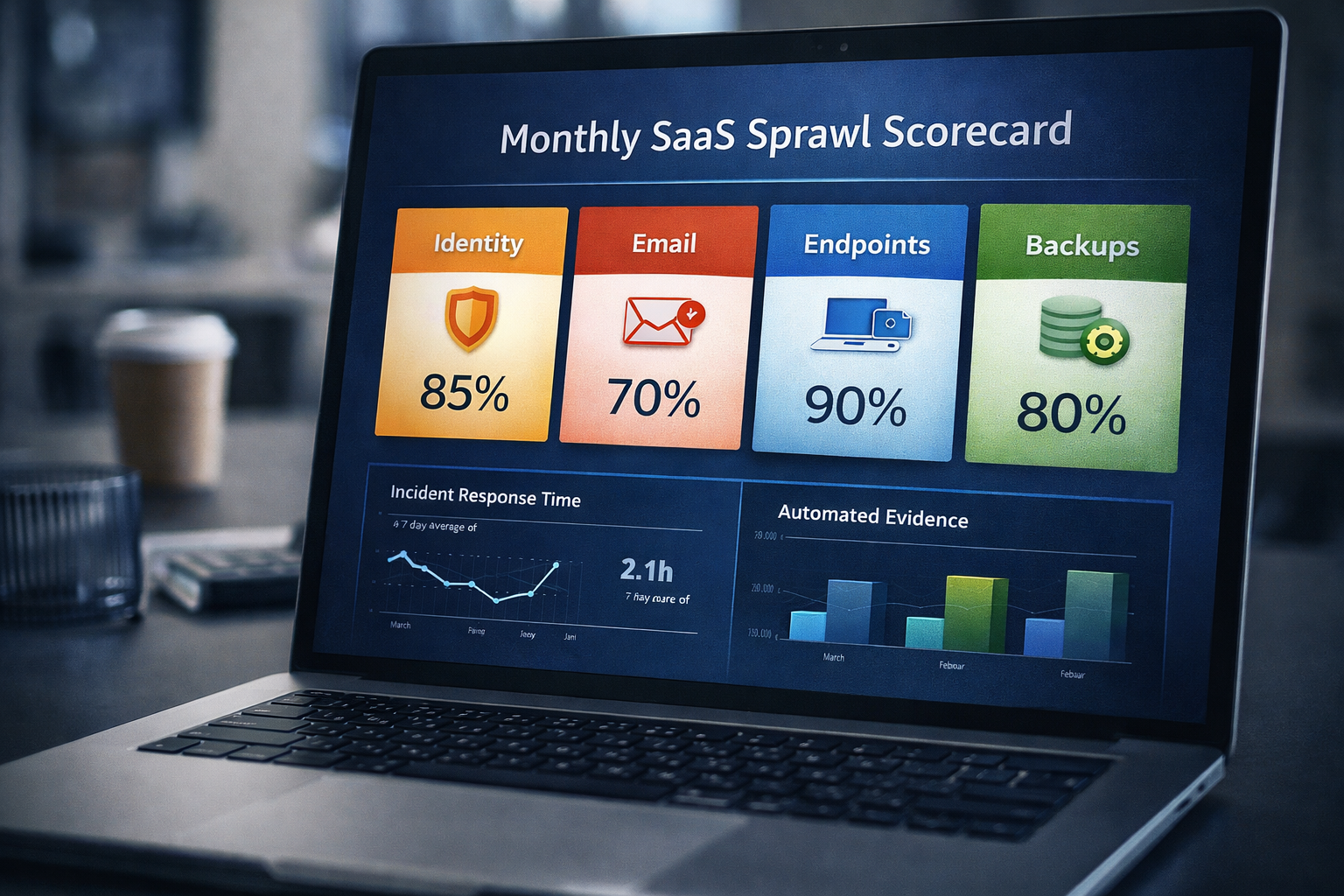
Track identity, email, endpoints, backup recoverability, and governance KPIs monthly. Publish, review, and act.
How to Act: A 30-60-90 Day Plan
First 30 Days
- Enforce phishing-resistant MFA for admins and high-risk users; move priority apps behind SSO.
- Tune email security and validate SPF/DKIM/DMARC.
- Measure endpoint EDR coverage and patch compliance; close major gaps.
- Verify Tier 0 backups and restore testing.
Days 31–60
- Launch app intake + approved alternatives.
- Implement vendor risk tiers + renewal-driven evidence collection.
- Reduce oversharing and review OAuth permissions.
Days 61–90
- Run a SaaS tabletop drill and publish lessons learned.
- Deploy a one-page KPI scorecard and review monthly with leadership.
- Launch SaaS + shadow AI awareness modules.
How Cyber Advisors Can Help
Cyber Advisors helps SMB and mid-market teams reduce SaaS sprawl and shadow IT risk without slowing the business or burying teams in new tools and processes. We start by aligning with your business priorities—revenue, uptime, and regulatory requirements—then design a practical sequence of controls that can be implemented with the staff and systems you already have.
Our first focus is on the controls that deliver the fastest and most measurable risk reduction:
Identity: Tightening access around the accounts and roles that matter most, with phishing-resistant MFA, SSO, and Conditional Access policies that limit where and how users can connect.Email: Treating email as a primary attack vector, hardening it against phishing, business email compromise, and account takeover with targeted configuration, monitoring, and user reporting workflows.
Endpoints: Ensuring laptops, desktops, and mobile devices are covered by modern EDR, kept patched, encrypted, and governed by clear baselines so compromised devices can’t quietly become a pivot point into your data.
Backups: Validating that critical systems—especially SaaS platforms like Microsoft 365, Google Workspace, CRM, finance, and HR—can be restored within your recovery time and recovery point objectives.
Once those foundations are in place, we help you operationalize governance so security becomes part of how work gets done, not an afterthought or a blocker. That includes lightweight app intake processes that reduce shadow IT, vendor- and SaaS-risk tiers tied to renewals, and clear ownership for identity, email, endpoint, and backup decisions.
We also build and refine response readiness so your team is prepared when something goes wrong: playbooks for common SaaS and email incidents, tabletop exercises that test decision-making under pressure, and integration of your tools so detection, containment, and communication are coordinated rather than ad hoc.
The result is a sustainable program that steadily reduces exposure from SaaS sprawl and shadow IT, gives leadership clear visibility into risk, and allows your teams to keep adopting the tools they need—within guardrails that protect the business.