

Financial institutions are expected to deliver near-continuous availability while proving that controls around change, access, and resilience are consistently implemented—not just documented. VMware remains a common virtualization backbone in financial services, but many environments drift over time: clusters become imbalanced, patching is deferred, monitoring becomes noisy, and recovery objectives become assumptions.
This guide outlines a practical, risk-based approach to strengthening VMware operations so you can improve uptime, reduce audit findings, and align with common expectations found in FFIEC-style guidance and GLBA Safeguards security programs—without overengineering. The focus is simple: stabilize the platform, harden the control points, optimize for predictable operations, and validate recoverability with evidence you can hand to internal audit, risk committees, and examiners.
By the end, you’ll have a roadmap you can use whether you run vSphere on-prem, in a hybrid model, or as part of a broader modernization effort. You’ll also see the KPIs that matter most when you need to prove resilience and maturity over time.
Before we get tactical, set the frame correctly: “VMware resilience” is not a collection of best practices in a binder. Resilience is an outcome measured in availability, recoverability, and controlled change. In regulated environments, it’s also a governance problem—who can do what, how you prove they did it appropriately, and how you show the environment stays within defined baselines over time.
The goal is not perfection. The goal is repeatability: predictable patching, predictable change windows, predictable recovery outcomes, and predictable evidence.
VMware in Financial Services: Why It’s Still a Strong Foundation
VMware continues to show up in financial services for good reasons:
- Mature virtualization stack with strong ecosystem support. vSphere and vCenter have been operating in regulated environments for years, with broad vendor compatibility and well-understood operational patterns.
- Operational leverage. Standardized clusters, templates, and automation can reduce the operational load compared to bespoke physical deployments.
- Availability and performance options. Features like HA, DRS, vMotion, and storage integration can provide meaningful resilience when properly designed and operated.
- A clear control plane. vCenter (and supporting components) provides a centralized management surface, which is helpful for governance—so long as it is properly secured and monitored.
The caution is equally important: a common platform can create common failure modes. In many environments, vCenter becomes a “keys to the kingdom” system with too many admins, inconsistent hardening, and insufficient monitoring. Meanwhile, clusters can quietly drift into risky states: thin capacity headroom, inconsistent configuration, and patch levels that slip because downtime is hard to schedule.
A resilient VMware platform is less about advanced features and more about consistent operating discipline.
The Pain Points That Erode Resilience (Drift, Patch Debt, Access Sprawl)
Most resilience problems are not due to a single catastrophic mistake. They are the accumulation of small compromises.
Configuration drift
Drift happens when “temporary” exceptions become permanent. Someone adjusts an ESXi setting to fix a performance issue, a host is rebuilt from a non-standard image during an incident, or a cluster is expanded with different hardware because procurement moved fast. Individually, these choices seem reasonable. Collectively, they create an environment where behavior is unpredictable—and unpredictable environments fail under stress.
Patch debt
Patch debt is the gap between where you are and where you should be. In financial services, deferred patching quickly becomes more than an IT backlog item; it becomes a governance and risk issue. If patching is inconsistent, it’s harder to claim you have an effective vulnerability management program. If exceptions aren’t documented, it’s harder to show you have control.
Access sprawl
Access sprawl is when too many accounts have too much power for too long. It often starts innocently: “Give them full admin while they’re learning,” “We need the vendor to troubleshoot,” “We’ll remove it later.” Over time, the vCenter RBAC model becomes messy, local accounts accumulate, MFA coverage is inconsistent, and a single compromised credential can lead to a broad impact.
Noisy monitoring & weak alert hygiene
It’s hard to be resilient if you can’t see problems early. But it’s also hard if your monitoring is so noisy that teams ignore alerts. Resilience requires signal: thresholds tied to business services, tuned alerts that trigger action, and clear ownership for response.
Unvalidated recovery assumptions
Many teams assume that because backups are running, recovery will work. In reality, recoverability depends on restore speed, dependency mapping, and the ability to rebuild the management plane under pressure. If recovery testing is rare, you are operating on hope—and hope is not a control.
If any of these sound familiar, you’re not alone. The good news is that resilience improves dramatically when you approach VMware as a governed platform, not a collection of hosts.
Roadmap Phase 1 — Stabilize: Standards, Capacity, Monitoring
Stabilization is where you stop the bleeding. The goal is to reduce variability and create predictable operations so that later hardening and optimization efforts stick.
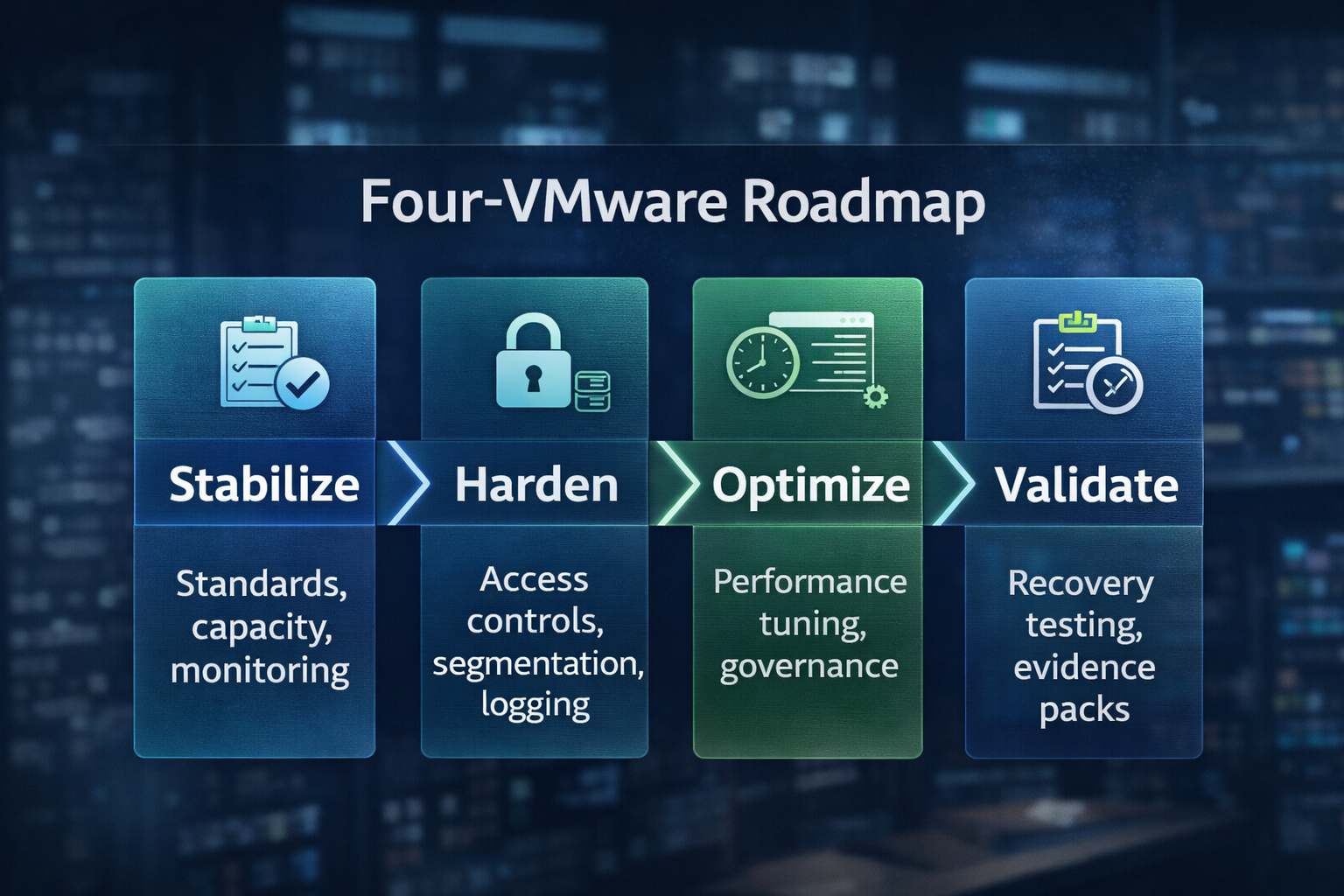
Four-phase roadmap: Stabilize → Harden → Optimize → Validate (build resilience, then prove it).
1) Start with business services, not infrastructure components
Resilience should be designed around business services (e.g., online banking, core processing, loan origination, call center systems), not around “clusters” or “datastores.” Create a simple service tiering model:
- Tier 0/1: Mission-critical services requiring high availability and tight recovery targets
- Tier 2: Important services with moderate recovery tolerance
- Tier 3: Non-critical services with flexible recovery tolerance
For each tier, define target availability and recovery expectations. Even if the numbers evolve, having explicit targets forces clarity. It also gives you a rational basis for design decisions and budget requests.
2) Standardize host builds and cluster configuration
- A defined ESXi baseline: version, patch level, secure configuration, services enabled/disabled
- Consistent vSwitch/vDS design, VLAN naming, and port group standards
- Standard storage presentation patterns and multipathing settings
- Consistent NTP, DNS, syslog forwarding, and certificate management practices
- Documented cluster settings (HA, DRS, admission control) aligned to the tier model
3) Address capacity and imbalance before it becomes an outage
- CPU and memory headroom targets by tier
- Storage performance and capacity thresholds (including thin provisioning risk)
- Network throughput and redundancy checks for management, vMotion, storage, and production traffic
- Cluster imbalance checks (hot hosts, storage hotspots, uneven VM placement)
Don’t wait for performance complaints. Build review cadence: weekly operational review, monthly trend review, quarterly capacity planning. Leadership appreciates predictability more than heroics.
4) Improve monitoring with alert hygiene and ownership
- Health of the management plane: vCenter availability, authentication failures, certificate expiry, database health
- Cluster health: HA state, DRS functionality, host isolation events, datastore latency
- Backup and replication status: success rate, failure reasons, age of last successful backups
- Security signals: privileged logins, account changes, unusual administrative actions, configuration changes outside of maintenance windows
5) Establish a predictable patch cadence with a living exceptions process
- Define patch windows per tier (e.g., monthly for Tier 0/1 components, quarterly for lower tiers)
- Use staged rollouts: lab → non-critical cluster → critical cluster
- Document known risks and validated backout plans
- Track exceptions with an owner, a reason, a compensating control, and a review date
Roadmap Phase 2 — Harden: Access Controls, Segmentation, Logging
Change control that reduces risk (approvals, backout plans, maintenance windows)
- Clear change categories: standard (pre-approved), normal, and emergency
- Required change artifacts: purpose, scope, risk rating, test plan, backout plan, and verification steps
- Maintenance windows aligned to service tiers
- Post-change validation: health checks, performance spot checks, and log review where appropriate
- Change success measurement: did it achieve the intended outcome without causing incidents?
vCenter identity: RBAC, MFA, break-glass, least privilege
- Integrate identity with your authoritative directory and define roles aligned to job functions.
- Use least privilege by default.
- Require MFA for privileged access wherever possible.
- Create a controlled break-glass process with strict conditions, logging, and post-use review.
- Reduce local accounts and remove dormant or orphaned access.
- Implement joiner/mover/leaver workflows.
Segmentation patterns: management plane isolation, east-west controls
- The management plane network is isolated from user networks and server production networks
- Separate networks for vMotion, storage, and backup traffic where feasible
- Restricted admin access paths (jump hosts / privileged access workstations)
- East-west controls for high-risk tiers (micro-segmentation / policy-based firewalling)
Continuous compliance: baselines, drift detection, reporting
- Secure configuration baselines for vCenter and ESXi
- Automated drift detection where possible
- Periodic reporting with clear remediation ownership
- A defined process for approving and documenting exceptions
Logging, time synchronization, & evidence-quality telemetry
- Centralized log forwarding from vCenter and ESXi to your logging/SIEM platform
- Time synchronization (NTP) is enforced across hosts and management systems
- Alerts for privileged role changes, authentication anomalies, and changes outside approved windows
Roadmap Phase 3 — Optimize: Performance Tuning & Governance
Optimization is about moving beyond baseline stability to achieve consistent performance and predictable operations at scale.
- Tune for service tiers and workload realities.
- Reduce operational toil with automation and standard workflows.
- Establish a governance rhythm (weekly ops review, monthly platform review, quarterly resilience review).
- Rationalize tools and clarify ownership/escalation paths.
Roadmap Phase 4 — Validate: Recovery Testing + Evidence
Validation is where resilience becomes real. If you stabilize, harden, and optimize but never validate, you still cannot confidently claim the environment will recover under pressure.
Define realistic recovery targets & map dependencies
- Confirm RTO and RPO by service tier.
- Map dependencies (identity, network services, storage/replication, backup, vCenter/management plane).
- Document and test management-plane rebuild/runbooks.
Run scheduled recovery tests (not just annual tabletop exercises)
- Component restore tests
- Application recovery tests
- Management plane recovery drills
- Scenario-based ransomware-style exercises
Build “evidence packs” that stand up to audit and exams
- Asset inventory and tiering summary
- Patch cadence evidence and exception logs
- High-risk change records with backout plans and validation
- Privileged access reviews
- Drift/compliance reports and remediation tracking
- Recovery test results (targets vs observed, issues, corrective actions)
KPIs to Prove Resilience & Maturity Over Time
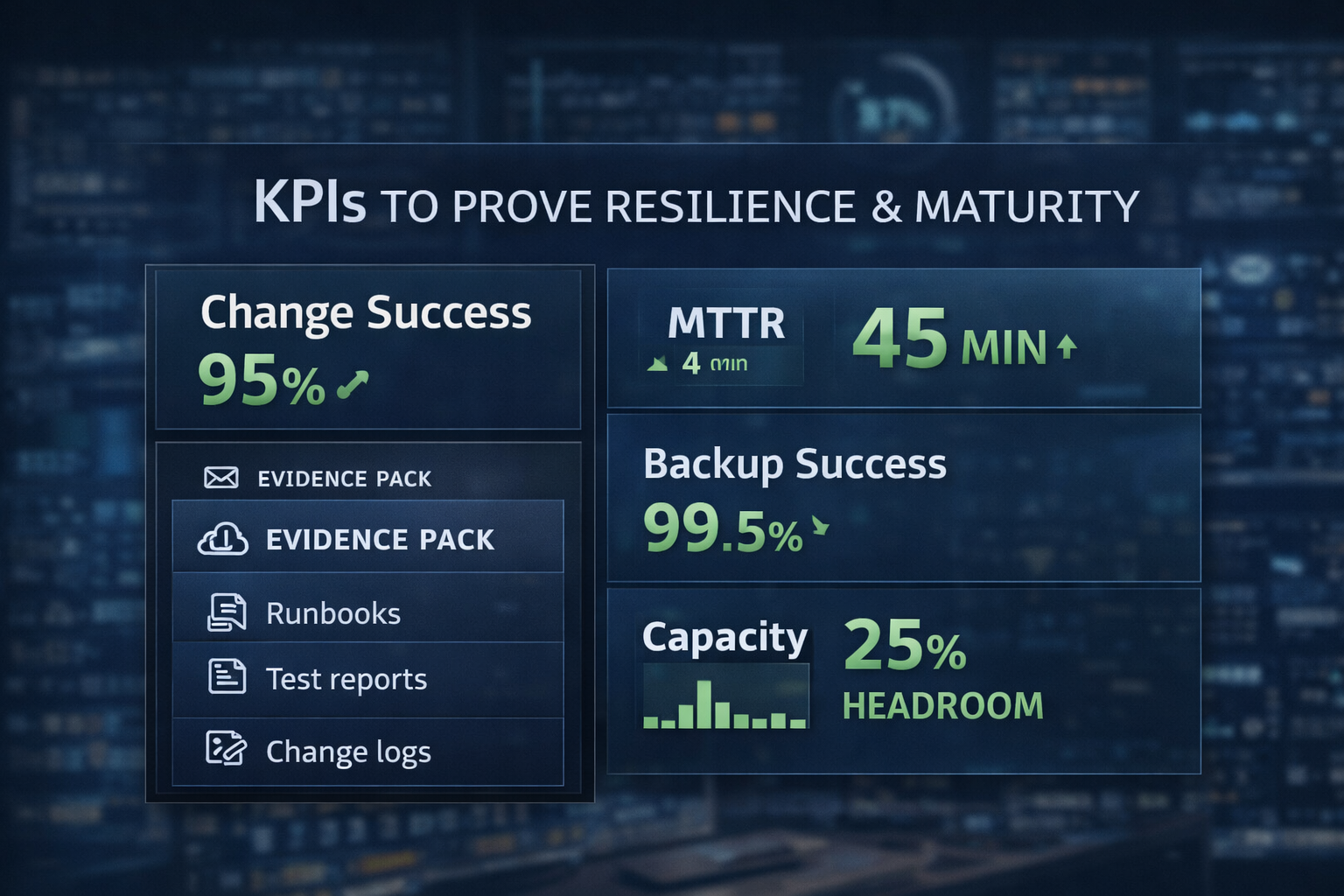
Operational KPIs + evidence artifacts turn resilience from an aspiration into something you can demonstrate.
Executives and examiners both respond to measurable outcomes. Track a small set of high-integrity KPIs:
- Availability by tier; Sev 1/2 incidents; MTTD/MTTR
- Change success rate; changes within windows; emergency change volume
- Patch compliance by tier, age of critical vulns; overdue exceptions
- Backup success rate, measured restore times, RTO/RPO achievement
- Capacity headroom; storage latency; snapshot sprawl
- MFA coverage; privileged account count; high-risk admin actions investigated
Common Pitfalls & How to Avoid Them
- Hardening as a one-time project → use baselines + drift detection + cadence.
- Overengineering micro-segmentation early → start with management plane isolation.
- Patching only when forced → set cadence + exceptions process.
- Assuming DR works because backups run → test restores and document outcomes.
- Too many admins/tools/unclear ownership → least privilege + rationalization + escalation clarity.
A Quick “First 30 Days” Checklist
- Review and reduce vCenter admin rights.
- Validate centralized logging and NTP consistency.
- Document patch state and schedule the next two patch windows with backout plans.
- Identify Tier 0/1 workloads and confirm RTO/RPO.
- Run and document one Tier 0/1 restore test.
- Review cluster capacity headroom and near-term risks.
- Create ESXi/vCenter baseline docs and begin weekly drift checks.
How Cyber Advisors Helps Financial Institutions Strengthen VMware Resilience
Cyber Advisors combines infrastructure engineering discipline with security and compliance alignment for regulated environments—helping you move from “we think we’re resilient” to “we can prove we’re resilient.”
- Assessment and roadmap: current-state review and prioritized remediation plan tied to tiers and recovery requirements.
- Hardening and governance: RBAC, MFA/break-glass, baselines, drift detection, change control tuning.
- Segmentation and Zero Trust: management plane isolation and east-west controls for sensitive workloads.
- Backup/DR validation: runbooks, testing cadence, evidence packs for audits and exams.
- Managed services: virtualization operations plus GLBA/FFIEC-style readiness and continuous improvement.
Request a VMware Resilience & Compliance Readiness Review
If VMware is the backbone of your virtual infrastructure, resilience and auditability depend on how consistently it’s operated. A focused, risk-based review can quickly identify where drift, patch debt, access sprawl, or untested recovery assumptions are increasing operational and compliance risk.
Get help from Cyber Advisors to receive a prioritized remediation roadmap aligned to common FFIEC/GLBA expectations—covering stabilization, hardening, governance, and recovery validation. You’ll walk away with clear next steps, measurable KPIs, and an evidence-ready plan you can execute with confidence.