

Because it keeps lines running smoothly and margins intact. Cyber maturity reduces outage time, protects engineering IP, and prevents supplier-originated incidents by aligning identity, backups, segmentation, monitoring, and rehearsed responses across IT and OT.
What Cyber Maturity Means for Manufacturers
Cyber maturity is not a product—it's an outcome. Mature programs operate safely despite threats and disruptions. In a plant context, that means you can:
- Identify critical assets across IT and OT (ERP, MES, PLM/CAD, historians, controllers, robots, vendors).
- Protect with identity, segmentation, hardening, and data controls aligned to business criticality.
- Detect early indicators—lateral movement, anomalous SMB traffic, off-hours file pulls, unusual logic pushes.
- Respond together—IT, OT, operations, quality, legal, comms—using rehearsed playbooks.
- Recover quickly from known failure modes using immutable backups and practiced runbooks.
- Maturity is measured with a score, a plan, and evidence—not a shelf of tools.
- NIST CSF 2.0 provides a common language for customers, auditors, and insurers.
- IT and OT share one program with domain-specific tactics and shared KPIs.
The Business Case: Dollars, Designs, & Dependencies
Cyber incidents hurt manufacturers in three interconnected ways: downtime, intellectual property (IP) leakage, and supply-chain disruption. Downtime shows up as lost throughput, scrap, overtime, and missed shipments. IP leakage quietly erodes your pricing power and time-to-market as competitors gain access to your designs, recipes, and process know-how. Supply-chain disruptions ripple through production schedules, triggering missed SLAs, deferred revenue, and strained customer relationships when a single compromised supplier or OEM portal stalls a critical line.
A mature cyber program is designed to blunt all three at once. By aligning identity, backups, segmentation, monitoring, and rehearsed incident response across IT and OT, cyber maturity reduces outage duration, hardens your IP against theft, and limits the blast radius when a third party or shared credential is compromised.
Downtime
Hours of production lost to ransomware or supplier email compromise don’t just show up as a blip on an availability report—they cascade into overtime to catch up lost shifts, expedited freight to salvage customer commitments, rework when quality is rushed, and ultimately missed SLAs and unhappy customers who start questioning your reliability as a strategic supplier.
Intellectual Property
Designs, recipes, vendor pricing, and process parameters are your moat—the compound advantage you’ve built over years of engineering and operational discipline. When those artifacts walk out the door, you’re not just losing files; you’re subsidizing competitors’ R&D, accelerating their time-to-market, and making it easier for them to undercut your bids on the next program.
Dependencies
Every plant relies on a web of suppliers and OEM support. Their security posture effectively becomes yours the moment credentials are shared, remote sessions are opened, or portals and APIs are connected into your ERP, MES, or OT networks. A weak password at a machining vendor, an unmonitored OEM VPN, or a compromised cloud portal can provide attackers with a trusted path into your environment—often with privileged access and little scrutiny.
Downtime Costs: Modeling the Real Exposure
“A few hours” adds up quickly. Use this three-step model to quantify risk in dollars:
- Minute value of production: (Average daily output × contribution margin) ÷ operating minutes.
- Expected outage cost: Minute value × mean time to recover (ERP, MES, HMI/PLC orchestration, file services).
- Secondary costs: expedited freight, scrap, QA rework, overtime, penalties, and churn.
Example: A plant with $600K/day contribution margin operating 1,200 minutes/day values each minute at $500. A 10-hour outage is $300,000 before freight and rework. Cutting recovery in half via immutable backups and practiced playbooks pays fast.
Controls that predictably cut outage impact
- Segmentation & least privilege keep a single compromised workstation from becoming a plant-wide event.
- Immutable backups + timed restores give a ransom-proof recovery option with known RTO/RPO.
- EDR + 24/7 monitoring detects mass encryption behavior and suspicious tool use early.
- Tabletop drills compress decision times: isolate? Failover? Notify? Ship from another site?
IP Protection: Locking down the Crown Jewels
IP loss rarely creates a dramatic outage—it quietly erodes margin over quarters. Attackers target where designs really live: PLM/CAD systems, shared engineering folders, and supplier collaboration portals. They exfiltrate assemblies, pricing models, and process parameters a few gigabytes at a time, often by riding valid credentials and standard protocols. Over time, that leakage shows up as mysteriously tighter bids from competitors, faster copycat products, and shrinking win rates on programs you used to win on technical merit.
It isn’t always an external adversary, either. Insiders—malicious, careless, or simply rushed—magnify the risk through oversharing, unchecked sync tools, and unmanaged personal cloud accounts. A departing engineer syncing an entire project library “to finish something at home,” a maintenance vendor copying configs to an unencrypted laptop, or a well-meaning supervisor emailing drawings to a personal inbox to print on another shift can all create the same outcome: your crown-jewel designs and process know‑how sitting in places you don’t control, with no easy way to pull them back.
Build a layered IP defense
Identity First
Phishing-resistant MFA and conditional access for all engineer and vendor accounts, with just‑in‑time elevation so privileged sessions are short‑lived, tightly scoped, logged, and tied to a verified user and healthy device.
Data Classification
Labels like “Confidential – Engineering” automatically enable encryption and DLP for email and cloud storage.
Secure Collaboration
Use governed workspaces for co-engineering. Block unmanaged file-sharing where designs disappear.
Insider Risk Analytics
UEBA flags off-hours bulk downloads and anomalous transfers before IP walks out the door.
Proof point: One mid-market manufacturer cut unauthorized CAD sharing by 92% after rolling out labels, DLP, and just-in-time access for elevated engineering roles.
Supply Chain Risk: Your Vendors Are Your Attack Surface
From machining vendors to robotics OEMs, third parties are integral—and risky. A compromise at a small supplier can quickly become your incident, whether it starts with a shared VPN account, a compromised vendor portal, or an infected maintenance laptop plugged into a cell. The more tightly your ERP, MES, and OT networks are integrated with external partners, the easier it is for an attacker to ride trusted connections and identities straight into production—often bypassing the controls you’ve worked hardest to harden internally.
Supplier assurance that actually works
- Tier suppliers (A/B/C) by business impact; apply deeper validation to A-tier vendors.
- Contract for security: MFA, patch SLAs, breach notification windows, evidence of backups, right to audit.
- Brokered remote access: jump hosts, short-lived credentials, session recording for OEM support.
- Continuity options: alternate sources for single-point-of-failure components; rehearse switchovers.
Measure Maturity Fast (NIST CSF 2.0)
Executives need a score, a plan, and evidence. Align your baseline to NIST CSF 2.0 across IT and OT. Score each function (Identify, Protect, Detect, Respond, Recover) and each domain (Identity, Data, Network, Endpoint, Application, Cloud, OT, Governance).
| Domain | What to Verify | Evidence That Sticks |
|---|---|---|
| Identity | MFA everywhere; privileged access vaulted and just-in-time. | Conditional access policies, PAM logs, and MFA enrollment reports. |
| Data | Engineering labels, DLP, eDiscovery readiness. | Label configs, blocked exfil events, and legal hold steps. |
| Network | IT/OT segmentation; east-west controls; vendor jump hosts. | Firewall policies, VLAN maps, session recordings. |
| Endpoint/Server | EDR deployed; patch SLAs met; allow-listing on jump servers/HMIs. | Agent coverage, MTTR trend, and patch compliance dashboard. |
| OT | Asset inventory, change control, and safe monitoring. | Passive discovery reports, firmware/backup inventories. |
| IR/BC/DR | Tabletops; immutable backups; timed restores. | IR playbooks, restore results, after-action notes. |
| Governance | Quarterly reviews; exception tracking; training KPIs. | Scorecards, exception logs, phish-test metrics. |
A lightweight assessment cadence
- Workshop (2–4 hrs): operations, IT/OT, quality, safety, identify crown jewels and critical processes.
- Evidence review: policies, network maps, PLC inventories, backup reports, vendor access, and change logs.
- Field validation: spot checks on segmentation, patching, restore testing, and remote access.
- Scorecard: 0–5 levels with quarterly targets and owners—your one-page roadmap.
A Detailed 90-Day Quick-Start Playbook
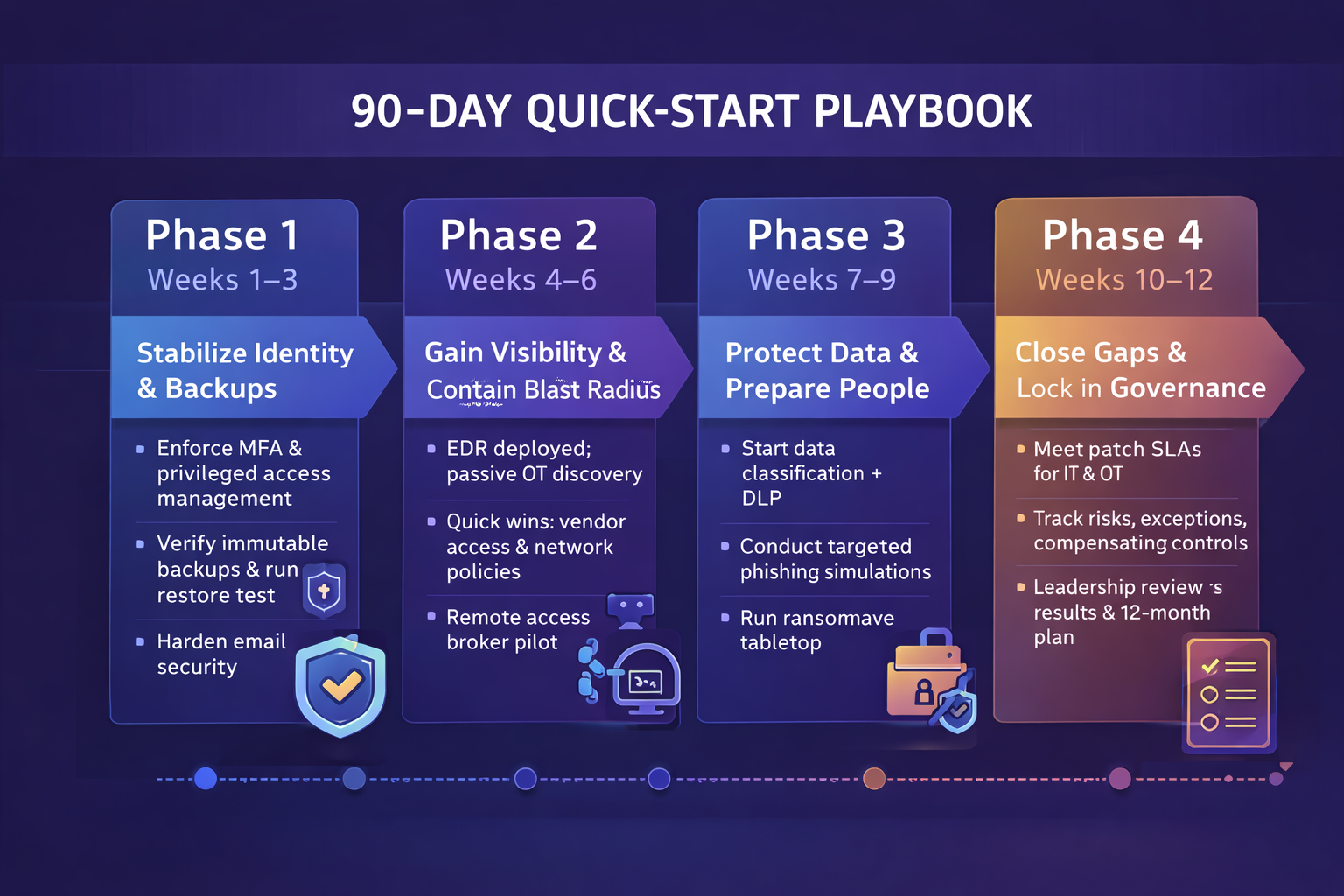
This is the fastest and lowest-risk way to increase maturity without halting production. It focuses on tightening identity controls, hardening and testing backups, improving visibility across IT and OT, and sharpening incident readiness—then systematically builds containment, segmentation, and data protection around your most critical lines, applications, and engineering assets.
Phase 1 (Weeks 1–3): Stabilize Identity & Backups
- Enforce phishing-resistant MFA for all users; require device health for admin roles.
- Privileged access management (PAM) with password vaulting and just-in-time elevation.
- Backups: Verify immutable copies for ERP/MES and engineering shares; encrypt in transit/at rest.
- Run a timed restore test (target RTO set by operations). Document steps and gaps.
- Email security hardening: impersonation protection, link isolation for high-risk users.
Phase 2 (Weeks 4–6): Gain Visibility & Contain Blast Radius
- EDR coverage to 95% of endpoints/servers; OT jump servers in monitor-only mode.
- Passive OT discovery to map PLCs/HMIs and flows; identify internet-exposed or unsupported gear.
- Network policy quick wins: block SMBv1; restrict RDP; enforce deny-by-default between IT and OT zones.
- Vendor remote access broker pilot with MFA and session recording.
Phase 3 (Weeks 7–9): Protect Data & Prepare People
- Data classification labels for engineering repositories; apply DLP for external sharing and mass download alerts.
- Phishing simulations tailored to plant scenarios (shift-change notices, maintenance approvals).
- Tabletop exercise (2 hrs): “Ransomware at a production cell.” Include operations, quality, HR, legal, comms. Capture decisions and owners.
Phase 4 (Weeks 10–12): Close Gaps & Lock in Governance
- Patch SLAs (30 days for servers/clients; 90-day cycles for OT in maintenance windows).
- Exception register for unavoidable risks (legacy HMIs, unsupported OS). Track compensating controls and expiration dates.
- Leadership review: Present the 90-day results, traffic-light scorecard, and a funded 12-month plan.
- MFA and PAM enforced with enrollment reports
- Immutable backups with documented restore times
- EDR coverage maps and OT asset inventory
- Network segmentation policies implemented
- Tabletop after-action report and updated IR runbook
12-Month Roadmap: Quick Wins → Resilience
Scale the momentum from the first 90 days into sustainable resilience by turning quick wins into standard practice, expanding controls from your most critical lines to every plant, and maturing governance so identity, backups, segmentation, monitoring, and vendor access are continuously measured, tested, and improved.
Quarter 1: Identity, Backups, & Visibility
- MFA + conditional access; PAM with just-in-time elevation.
- Immutable backups; monthly timed restores; document RTO/RPO by system.
- EDR to IT; OT jump servers monitor-only; passive OT discovery.
- Tabletops: ransomware and vendor compromise.
Quarter 2: Lateral Movement & Data Protection
- Micro-segment high-risk cells; separate IT/OT; broker vendor access.
- Patch hygiene SLAs; risk-based vulnerability prioritization.
- Classify engineering files; DLP + watermarks for external sharing.
Quarter 3: Email/Cloud/App Controls
- Advanced email protections; targeted awareness training.
- Application allow-listing on HMIs and jump servers.
- Zero Trust pilots: device health + location for sensitive apps.
Quarter 4: Institutionalize & Assure Suppliers
- Site-to-site failover tests; cross-train operators for manual workarounds.
- Third-party risk scoring, security clauses in contracts, and evidence reviews.
- Quarterly scorecards tied to budget; insurance evidence pack maintained.
OT Security Essentials for PLCs & HMIs
IT controls alone won’t protect production cells. OT environments require a calibrated approach that preserves safety and uptime.
Five practices that move the needle
- Passive discovery first to map devices and flows without active scans that could disrupt controllers.
- Ring-fence legacy assets behind firewalls; no direct internet; access only through jump hosts.
- Change control with backups of PLC programs/HMI projects; verify restore procedures quarterly.
- Broker OEM access with MFA, just-in-time credentials, and full session recording.
- Alert on unusual logic pushes outside maintenance windows; dual approval for program changes.
OT change window playbook
- Pre-window: risk review, rollback plan, backups verified, comms to shift leads.
- During: change executed with observer; logs captured; safety officer present where required.
- Post: validation tests; sign-off by operations and quality; update as-built documentation.
Cyber Insurance: Step-by-Step Evidence Pack
Insurers increasingly require concrete proof that core controls are in place and operating as designed. Treat every renewal like an audit you’re already prepared for: define the controls your carriers care about most—MFA, backups, EDR, segmentation, vendor access, and incident response—and continuously collect evidence as those controls run. Maintain a living “evidence pack” with reports, screenshots, policies, and recent test results so you’re not scrambling the week before renewal or when a strategic customer requests assurances. This keeps approvals moving, avoids costly delays in closing deals, and gives executives a clear, defensible story about how you manage cyber risk.
Evidence bundle (organize by folder)
| Folder | Include | Update Cadence | Owner |
|---|---|---|---|
| 01-MFA-Identity | MFA enrollment/export; conditional access screenshots; privileged access policy; PAM logs (last 90 days) | Monthly | Identity engineer |
| 02-EDR-Monitoring | EDR coverage report; list of non-compliant endpoints; last 3 incident summaries | Monthly | SecOps lead |
| 03-Backups-DR | Immutable backup configs; last 3 restore test results with timing; DR runbooks | Quarterly | Infra/BCDR |
| 04-Email-Phishing | Impersonation/link policies; phish-sim results; targeted training content | Quarterly | Messaging admin |
| 05-Vulns-Patching | Vulnerability summary; criticals >30 days; patch compliance dashboard | Monthly | Vuln mgmt |
| 06-Segmentation-OT | IT/OT zoning diagram; firewall rules; vendor access broker screenshots | Semi-annual | Network & OT |
| 07-IR-Tabletops | IR plan; contact trees; tabletop agendas and after-action reports | After each drill | IR coordinator |
| 08-Policies-Training | Security policies, exception register, and training completion rates | Quarterly | GRC |
How to answer common insurer questions
- “Is MFA universal?” Provide the enrollment % and list any exceptions, including compensating controls and target dates.
- “Are backups immutable and tested?” Show retention policies and the latest restore results, including start/stop times.
- “How do you manage vendor access?” Provide broker screenshots, session recordings, and access review logs.
- “What’s your incident response process?” Share playbooks, tabletop notes, and escalation timelines.
Outcomes
- Faster approvals and fewer follow-ups
- Potential premium reductions tied to control evidence
- Zero last-minute scrambles when renewals collide with audits
KPIs & Governance for Plant Leaders
Governance keeps maturity from becoming a one-time project. Track these indicators quarterly with operations and finance:
Resilience
- RTO/RPO achieved in the last restore test
- % of critical assets with tested backups
- Number of successful failovers this quarter
Exposure
- Devices discovered vs. managed (IT & OT)
- Critical vulns open > 30 days
- Third-party risk scores (A-tier suppliers)
Detection & Response
- Mean time to detect (MTTD)
- Mean time to contain (MTTC)
- Phishing simulation failure rate
Governance
- Maturity level by domain vs. quarterly targets
- Policy exceptions and aging
- Insurance control compliance status
RACI snapshot for incident response
| Role | Responsibility | R/A/C/I |
|---|---|---|
| CISO / Security Lead | Overall incident command, insurer liaison | A/R |
| IT Ops | Containment, restore, endpoint/server recovery | R |
| OT Engineer | Isolation of cells, logic verification, and vendor coordination | R |
| Plant Manager | Production decisions, shipment priorities | A/C |
| Quality | Product integrity checks, release/hold decisions | C |
| Legal/Comms/HR | Regulatory, customer notifications, workforce comms | C/I |
DEEP-DIVE OT CASE STUDIES
Case 1: Food & Beverage—Ransomware Meets File Services
Situation: A finance employee approved a spoofed vendor invoice, exposing credentials. The attacker leveraged a legacy VPN to a file server; shared recipes and supplier contracts were encrypted. MES stayed up, but QA and scheduling lost visibility.
Response: File services isolated; recovery from immutable backups in 4 hours. Conditional access + MFA deployed broadly. VLANs between offices and plant re-segmented; jump hosts mandated for remote maintenance.
Outcome: No ransom paid; 96% of planned output achieved. Within 90 days, vendor access moved to a broker with session recording; restore tests became monthly with timing SLAs.
Lesson: Backups only count when tested. A clean, timed restore turned a potential multi-day outage into a contained event.
Case 2: Precision Manufacturing—Quiet IP Leakage
Situation: A departing engineer synced confidential CAD assemblies to a personal cloud. No labels, no DLP, and off-boarding took 48 hours.
Response: Data classification applied to PLM libraries; DLP blocked external sharing; off-boarding automated to revoke access within 30 minutes. Insider-risk analytics flagged bulk downloads after hours.
Outcome: Design advantage preserved; the company passed a strategic customer’s security review and won a multi-year contract.
Lesson: Label + DLP + fast off-boarding is the trifecta for engineering IP.
Case 3: Discrete Assembly—OEM Remote Access Compromise
Situation: An OEM technician’s credentials were compromised through phishing. The attacker used an unmanaged VPN to leap from a support laptop toward an OT flat network.
Response: Brokered remote access with ephemeral credentials and MFA; session recording required; micro-segmentation enforced around HMIs; program changes restricted to maintenance windows with dual approval.
Outcome: Audit findings closed; insurance renewal approved without a premium hike; maintenance continued without disruption.
Lesson: Flat networks turn small mistakes into plant-wide crises. Broker access and segmentation reduce blast radius.
Trust Cyber Advisors
For more than a decade, our team has helped manufacturers raise cyber maturity across IT and OT—without interrupting production schedules. We pair practical, plant-safe controls (identity, segmentation, backups, vendor access, and OT change governance) with a measured roadmap your operations leaders can support. For qualifying engagements, we also offer a cyber warranty that aligns incentives and adds confidence to your program. Let’s talk about your environment—your mix of ERP/MES, PLCs, and supplier access is unique, and your roadmap should be too. Connect with Cyber Advisors to see exactly how we can help you increase cyber maturity without disrupting the business.
FAQ
How is “cyber maturity” different from compliance?
Compliance is the minimum bar to operate or keep a customer. Cyber maturity focuses on outcomes: fewer outages, faster recovery, safer collaboration. Mature programs map controls to compliance—and then go further.
Do we need separate programs for IT &OT?
No. Run one program with domain-specific tactics. Governance, identity, incident response, and vendor oversight span both. Asset inventory and change control look different in OT, but the scorecard is shared.
What are the first three actions to take this month?
- Turn on phishing-resistant MFA for all users and vendors with admin or engineering access.
- Verify immutable backups for ERP/MES and perform a timed restore test.
- Run a two-hour tabletop: “ransomware on a production cell.” Document gaps and owners.
How do we secure very old controllers without breaking them?
Don’t touch the firmware first. Isolate behind firewalls, remove internet exposure, enforce jump hosts and MFA, and monitor passively. Many risks drop without touching the device.
What’s the ROI in CFO terms?
Translate controls into protected throughput. If your minute of production is $500 and you avoid even one four-hour outage per year, that’s $120,000 before freight and rework—often exceeding the annualized cost of core controls.
Ready to raise your cyber maturity?
Schedule a call with Cyber Advisors to benchmark your current state and leave with a 90-day plan you can start next week.