

Reaching cyber maturity in manufacturing isn’t about buying a single platform. It’s about orchestrating a fit-for-purpose stack across operational technology (OT) and information technology (IT)—from SCADA/ICS protection and network segmentation to vendor risk oversight and pragmatic patch management. This guide breaks down the essential tools, managed services, and governance practices manufacturers need in 2025 to move confidently from “reactive” to “resilient.”
Why Cyber Maturity Matters More in Manufacturing
Manufacturers operate at the nexus of safety, uptime, and supply chain commitments. A security incident doesn’t just threaten sensitive data; it can stall production lines, jeopardize worker safety, and ripple through your suppliers and customers. Attackers know this—ransomware groups and state-aligned actors increasingly target industrial environments because disruption pays. In parallel, customers and regulators are tightening expectations: think contract clauses mandating incident response times, evidence of patch hygiene, and secure-by-design practices in connected products.
Cyber maturity is your ability to anticipate, withstand, recover from, and adapt to cyber attacks—without compromising production or safety. Mature programs blend prevention (segmentation, hardening), detection (OT-aware monitoring), response (playbooks and retainers), and governance (risk-based decision-making anchored to frameworks like NIST CSF 2.0). The tooling and services below map directly to those capabilities.
OT & IT: Different Worlds, One Risk Surface
In many plants, OT networks grew up separately from IT. But Industry 4.0 has connected PLCs, HMIs, historians, quality systems, and MES to business applications. That connectivity unlocks efficiency—and broadens the attack surface. What’s unique about OT?
- Legacy and proprietary protocols: Many controllers predate modern security controls and run for decades.
- Safety and availability first: Patching and rebooting must be scheduled around production cycles and hazards.
- Opaque assets: You can’t protect what you can’t see; asset inventories are frequently incomplete.
Achieving cyber maturity requires a unified approach that respects OT constraints while applying proven IT practices. Start with visibility and segmentation; then layer controls that detect and contain abnormal behavior without breaking operations.
SCADA/ICS Security: Visibility, Anomaly Detection, & Safe Response
Your supervisory control and data acquisition (SCADA) and industrial control systems (ICS) regulate physical processes. Protecting them requires passive discovery (to avoid impacting fragile devices), protocol-aware monitoring, and a safety-first response plan. Consider the following tool and service categories:
1) OT Asset Discovery & Inventory
Passive network sensors fingerprint PLCs, HMIs, RTUs, drives, and firmware versions without active scanning. A detailed inventory enables risk scoring, patch/firmware planning, and segmentation decisions. It also accelerates incident response when every minute counts.
- Agentless, passive discovery for sensitive segments
- Normalization of vendor-specific identifiers and firmware
- Integration with CMDB/asset repositories
2) OT Network Monitoring & Threat Detection
OT-aware tools decode industrial protocols (e.g., Modbus, DNP3, S7, EtherNet/IP) and baseline command sequences to flag anomalies—such as unexpected writes to PLC logic, unauthorized changes in ladder code, or rare communications between zones. Pair detection with a human-led 24×7 monitoring service that understands plant context.
- Protocol parsing for your installed base
- Behavioral analytics vs. simple signature alerts
- Use-case content tuned to safety/availability
- Escalation runbooks aligned to plant operations
3) Secure Remote Access to OT
Many incidents begin with remote connections for OEMs, integrators, and maintenance partners. Mature programs move away from flat VPNs to brokered, least-privileged access with granular logging.
- Per-session approval and just-in-time credentials
- Multi-factor authentication (MFA) and modern identity
- Session recording and keystroke logging for forensics
4) Change & Configuration Monitoring
Track and validate ladder-logic changes and controller-configuration drift. Alert on unauthorized modifications and maintain golden configs for quick rollback post-incident.
Network Segmentation: From Flat to Zoned
Most plant networks begin as flat Layer 2 domains where any compromised workstation can laterally move to sensitive controllers. Cyber maturity demands that you enforce logical separation between business apps, industrial DMZs, and plant-floor zones. A practical path:
Stage A: Establish Purdue-aligned Zones & Conduits
- Create or validate an industrial DMZ (IDMZ) between IT and OT with tightly controlled conduits.
- Segment lines/cells into zones; limit inter-zone traffic to approved protocols and endpoints.
- Harden switch infrastructure, disable unused services, and implement ACLs.
Stage B: Enforce Policy with Next-Gen Firewalls & Microsegmentation
- Use application-aware rules to control industrial protocols and block risky functions.
- Introduce identity-aware policies where feasible to map people and services to permissions.
- Consider host-level microsegmentation for IT/OT convergence zones and servers.
Stage C: Zero Trust Progression
Zero Trust is a maturity journey: verify explicitly, use least privilege, and continually evaluate risk. In OT, that translates to per-connection risk checks, brokered remote access, and strong identity for humans and machines—tempered by safety constraints.
Identity, Access, & Privilege in a Mixed OT/IT Environment
Identity is the control plane for every other control. For cyber maturity, consolidate identities where possible and standardize strong authentication and privileged workflows:
- Directory & SSO: Centralize workforce identity and federate OEM/vendor users through secure portals.
- MFA Everywhere: Prioritize remote access, engineering workstations, maintenance laptops, and shared accounts.
- PAM for OT: Vaulted credentials, ephemeral access, session recording, and approvals for elevated tasks.
- Service Accounts: Inventory, rotate, and restrict machine identities used by historians, MES, and data bridges.
Patch & Vulnerability Management—Without Stopping the Line
Patching in OT is nuanced. You can’t blindly push updates to PLCs or HMIs mid-shift, and some vendor support contracts require specific firmware levels. Mature programs combine risk-based decisions with careful scheduling:
Define Risk-Based Policies
- Classify assets by criticality and exposure (e.g., internet-facing gateways vs. isolated controllers).
- Use vulnerability intelligence tied to exploit availability and safety impact.
- Set target remediation timelines by class—e.g., P1 within days, P3 within maintenance windows.
Operationalize OT Patching
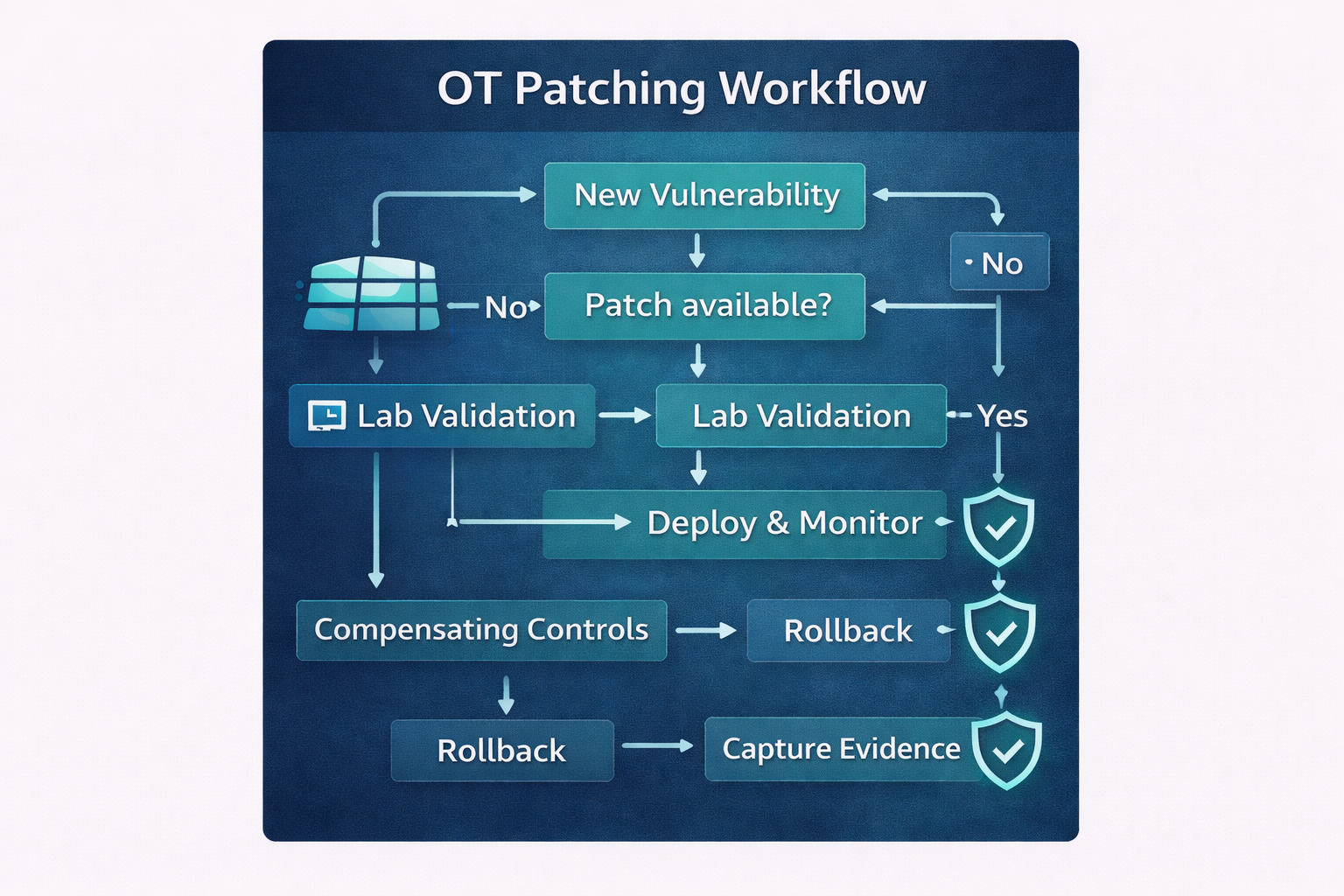
- Test in the lab or a digital twin before plant deployment.
- Use maintenance windows aligned to production schedules and ensure rollback plans.
- Where patching is not possible, layer compensating controls (segmentation, allow-lists, monitoring).
IT Patching & Endpoint Hardening
Don’t neglect Windows servers, engineering workstations, and operator HMIs. Centralized patch tools, EDR hardening, and application allow-listing reduce exploitability while providing telemetry for incident response.
Detection & Response: EDR/XDR, SIEM, & MDR Built for Manufacturers
Cyber maturity requires that you detect intrusions early and respond decisively. That means combining device-level visibility (EDR/XDR), centralized analytics (SIEM/UEBA), and human-led monitoring (MDR) that understands both IT and OT signals.
- EDR/XDR: Protect engineering laptops, HMIs, servers, and cloud workloads. Favor tools with behavioral detections and isolation capabilities.
- SIEM/UEBA: Aggregate logs from OT monitoring tools, firewalls, identity systems, and EDR into correlated detections.
- MDR (Managed Detection & Response): 24×7 triage and containment. For OT, ensure escalation paths account for safety and shift schedules.
- IR Retainer: Pre-contracted incident response hours with defined SLAs and forensics capabilities that include OT.
Backup, Recovery, & Immutability for Industrial Environments
Resilience demands the ability to restore quickly—from both IT systems (ERP, MES) and OT configurations (PLC logic, HMI screens). A mature program:
- Maintains immutable backups with offline or logically air-gapped copies.
- Captures device configurations and ladder logic as part of standard backup jobs.
- Runs tabletop and full restore tests each quarter, including rebuild of engineering workstations and redeployment of golden controller configs.
Vendor & Supply Chain Risk Management
Manufacturers rely on a dense ecosystem of OEMs, integrators, logistics partners, and software vendors. Third-party compromises routinely become first-party incidents. Mature programs implement:
- Tiered vendor risk: Assign risk levels based on network access, data sensitivity, and operational impact.
- Security questionnaires and evidence: Request artifacts (SOC 2, ISO 27001, external pentest summaries) proportional to risk tier.
- Contractual controls: Breach notification timelines, vulnerability remediation expectations, right to audit, and insurance requirements.
- Continuous monitoring: Where appropriate, use external risk ratings and attack surface discovery for internet-facing vendor properties.
- Remote access governance: Combine identity federation, PAM, and session recording for third parties.
Governance, Standards, & the NIST CSF 2.0 Lens
Tools without governance become shelfware. NIST CSF 2.0 provides a practical way to measure and communicate progress with leadership. Map your capabilities across core functions:
- Identify: Asset inventory, business environment, risk assessment, and governance.
- Protect: Access control, training, data security, maintenance, protective technology.
- Detect: Anomalies and events, continuous security monitoring.
- Respond: Planning, communications, analysis, mitigation, improvements.
- Recover: Recovery planning, improvements, communications.
- Govern: Strategy, policy, oversight, and accountability (the new cross-cutting function).
A VCISO or governance partner helps translate framework speak into plant-floor reality—defining policy exceptions, audit evidence, and KPI/KRI dashboards your board can digest.
People & Process: Training, Drills, & Change Management
Cyber maturity is as much about humans as it is about hardware. Prioritize:
- Role-based training: Engineers, operators, maintenance techs, and IT admins each face different threats.
- Tabletop exercises: Walk through ransomware in a plant, vendor access misuse, and a controller misconfiguration scenario.
- Change control: Formalize MOC (Management of Change) for network and controller modifications.
- Communication plans: Escalation maps that coordinate plant leadership, safety teams, and IT/security.
A Practical 12-Month Roadmap to Cyber Maturity
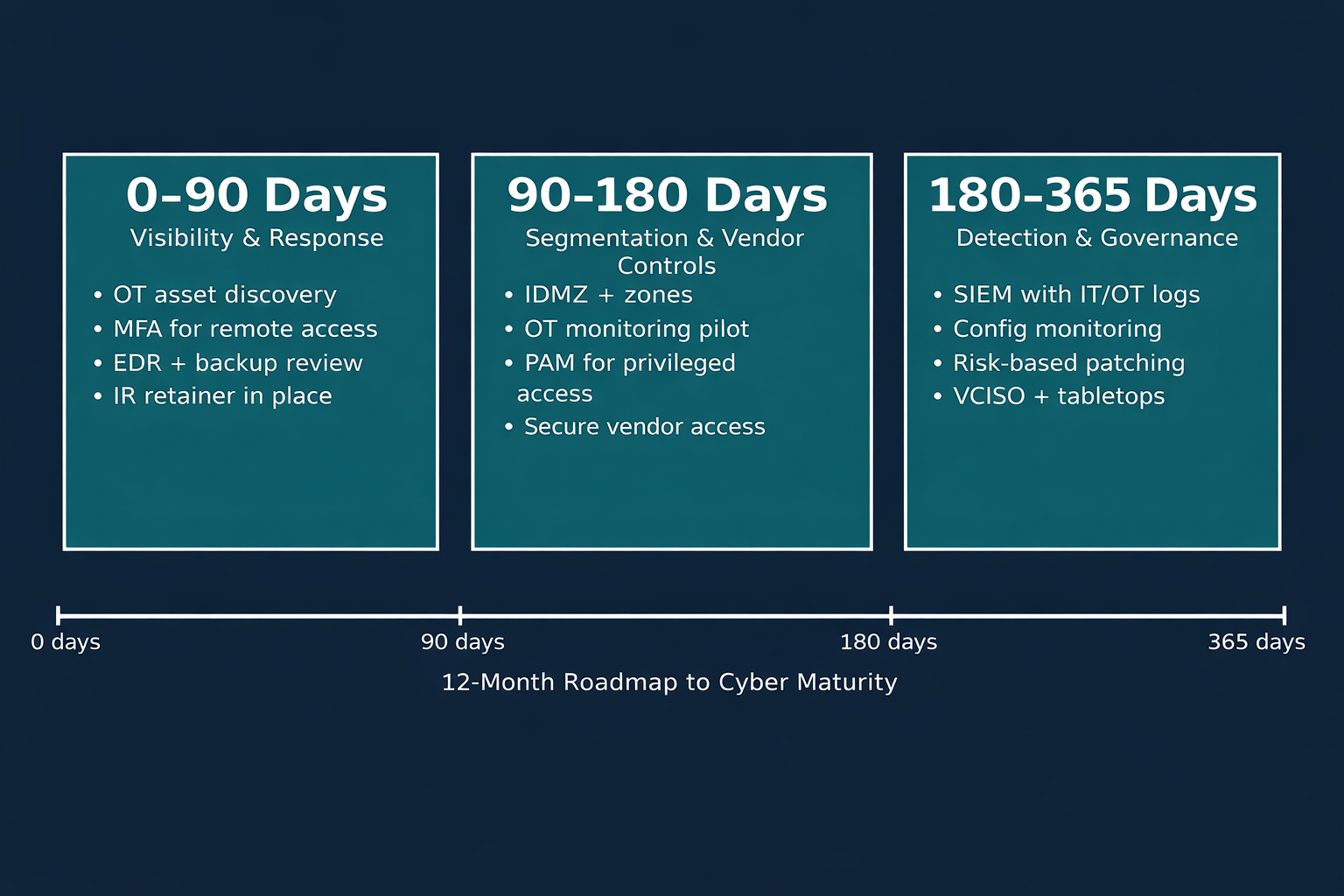
Every manufacturer starts from a different place. Use this phased plan to create momentum without overwhelming plant operations.
| Phase | Objectives | Key Tools & Services | Outcomes |
|---|---|---|---|
| 0–90 days | Establish visibility, quick wins, and response readiness. | OT asset discovery, vulnerability snapshot, MFA for remote access, EDR on engineering/IT assets, backup review, and IR retainer. | Known inventory; high-risk access locked down; incident hotline and playbooks in place; verified restores. |
| 90–180 days | Reduce lateral movement and vendor risk. | Network zoning/IDMZ build, OT monitoring pilot, PAM for privileged accounts, third-party access broker with session recording, vendor tiering. | Fewer pathways to crown jewels; accountable vendor access; actionable OT alerts. |
| 180–365 days | Scale detection, harden configurations, and codify governance. | SIEM with OT + IT log sources, configuration monitoring for PLC/HMI, patch orchestration with maintenance windows, VCISO for NIST CSF 2.0 program, quarterly tabletops. | Measurable MTTD/MTTR improvements; audited configs; policy-driven decisions; culture of continuous improvement. |
The Tool & Service Stack—At a Glance
This is a reference checklist—not a one-size-fits-all bill of materials. Your plant, OEM mix, and production cadence will shape the final design.
- OT Asset DiscoveryOT Network MonitoringSecure Remote AccessPAM
- Network SegmentationIndustrial DMZMicrosegmentation
- EDR/XDRSIEM/UEBAMDRIR Retainer
- Backup & ImmutabilityConfiguration Backup
- Patch OrchestrationVulnerability Intelligence
- VCISORisk AssessmentsNIST CSF 2.0 Mapping
- Third-Party RiskSecure Vendor Access
- TrainingTabletopsChange Control
Mini Case Snapshots: What “Better” Looks Like
Case 1: Reducing Alerts by 80% While Improving Detection
A discrete manufacturer piloted OT monitoring on two lines notorious for false positives. By tuning use cases to the plant’s specific PLC model and normal traffic patterns, the MDR partner dramatically reduced noise. More importantly, they caught an anomalous write request from a vendor laptop that indicated credential reuse—isolated within minutes via PAM session controls.
Case 2: Patching Without Pain
An industrial food producer faced critical vulnerabilities in Windows-based HMIs. Working with plant operations, the team created a rolling patch window during sanitation cycles. Lab validation and a rollback image were prepared in advance. Result: zero downtime and a dramatic risk reduction within two weeks.
Case 3: From Flat to Zoned in 120 Days
A multi-site shop had organically grown into a flat network. A rapid design introduced an IDMZ and segmented lines by cell. The outcome was measurable: ransomware simulated on an office workstation could no longer reach PLC networks, and production continued unaffected.
Buying Criteria: How to Evaluate Vendors & Platforms
- OT depth: Does the tool understand your protocols and vendor ecosystem? Can it parse ladder logic changes?
- Safety-first response: Are containment actions designed not to brick controllers or halt lines unintentionally?
- Open integrations: Can it feed your SIEM and ticketing? Does the MDR partner work with your chosen platforms?
- Time-to-value: How quickly can you deploy in a pilot, and what outcomes will be measured?
- Total cost of ownership: Licensing, sensors, support, and the operational effort. Managed services can reduce internal burden.
Metrics That Matter to Plant Leadership
- MTTD/MTTR: Mean time to detect/respond in hours or minutes.
- Vulnerability exposure window: % of critical vulnerabilities older than policy threshold.
- Backup reliability: Restore success rate and average time to restore controller configs.
- Change control hygiene: % of controller/config changes with approved tickets and documented outcomes.
- Vendor access accountability: Sessions recorded and reviewed; exceptions resolved.
- Production impact: Unplanned downtime attributed to cyber events (target: near zero).
Common Pitfalls & How to Avoid Them
- Scanning OT like IT: Active scans can crash legacy devices. Favor passive discovery and vendor-approved methods.
- Tool sprawl: Multiple consoles without integration dilute your response. Prefer platforms that feed a common SOC/MDR workflow.
- Unmanaged vendor access: Generic VPNs and shared credentials are an open door. Move to brokered, recorded, least-privilege sessions.
- No lab or digital twin: Without a safe testing space, patching and segmentation slow to a crawl.
- Neglecting backups of configs: You can’t rebuild a line if you can’t restore controller logic quickly.
FAQ: Fast Answers for Busy Manufacturers
How is OT monitoring different from IT monitoring?
OT monitoring decodes industrial protocols and understands the semantics of control commands. Instead of just flagging a suspicious IP, it can detect an unauthorized function code sent to a PLC or an unusual state change in a controller—even if the traffic is “allowed” by a firewall rule.
We can’t patch some controllers. Are we stuck?
Not at all. Compensating controls—like strict zoning, allow-listing, and targeted monitoring—can meaningfully reduce risk. Document the rationale, schedule maintenance windows, and work with OEMs on supported upgrade paths.
What’s the minimum viable stack to start?
Asset inventory, MFA for remote access, EDR on IT/engineering assets, verified backups (including configs), an IR retainer, and a plan for basic segmentation. Expand from there with OT monitoring and PAM for critical access.
Key Takeaways
- Start with visibility: you can’t protect what you don’t know exists.
- Design segmentation to contain the blast radius without breaking operations.
- Adopt OT-aware detection and 24×7 MDR with safety-first playbooks.
- Make patching risk-based and scheduled with production in mind—backed by lab testing and rollback images.
- Govern with NIST CSF 2.0, report progress via plant-relevant KPIs, and drill your response.
Ready to reach cyber maturity without disrupting production?
Schedule a Manufacturing Cyber Maturity Assessment with Cyber Advisors. Our OT/IT experts will baseline your risk, design a practical 12-month roadmap, and implement the right mix of SCADA/ICS protection, segmentation, vendor access controls, and patch orchestration.