
Zero Trust is not just a cybersecurity trend in 2025 — it has become a core business strategy for building resilience, enabling secure digital transformation, and reducing risk across increasingly distributed environments.
What was once regarded as “advanced security architecture” has now become an essential building block for every modern organization. The proliferation of permanent remote work, widespread cloud adoption, and the emergence of increasingly sophisticated threat actors—empowered by automation and artificial intelligence—have fundamentally changed the cybersecurity equation. Relying on traditional perimeter-based defenses is no longer viable; security leaders are compelled to rethink their approach, prioritizing agility and resilience over outdated models.
However, while technology forms the backbone of Zero Trust, the driving force behind its global adoption is distinctly business-centric. Today’s boards and executive teams demand solutions that address pressing strategic concerns: ensuring compliance with evolving regulations, minimizing the financial and reputational fallout from cyber incidents, sustaining uninterrupted operations, and preserving customer and partner trust. Zero Trust stands out because it enables organizations to proactively manage risk—not just react to threats—while supporting broader business imperatives.
This comprehensive guide explores the top five business drivers accelerating Zero Trust adoption in 2025. We’ll provide actionable insights, practical examples, and real-world scenarios to help you understand how aligning Zero Trust strategy with executive priorities can deliver measurable value. Whether your goal is to satisfy regulatory mandates, reduce operational risk, or strengthen stakeholder confidence, this resource will equip you with the knowledge to position Zero Trust as a catalyst for secure transformation and long-term business success.
What Zero Trust Really Means in 2025
Before diving into the drivers, it’s important to level-set what Zero Trust represents today. Zero Trust is not a single product — it is a security philosophy and architectural approach built on the principle:
“Never trust, always verify.”
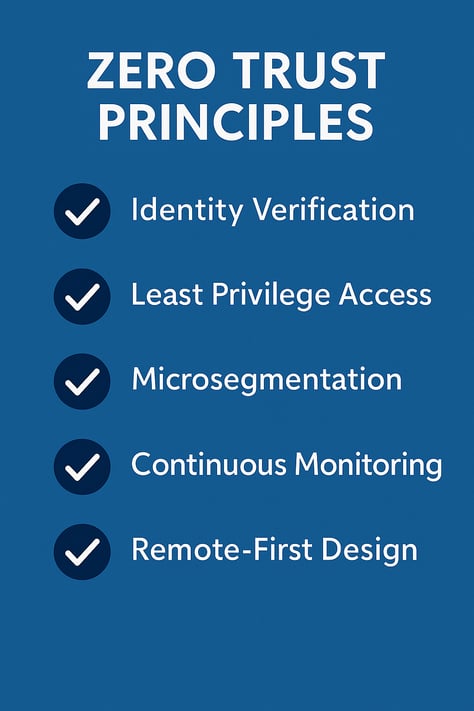
Every user, device, application, and workload must continuously authenticate and prove legitimacy before gaining access. The modern definition of Zero Trust focuses on:
- Identity-centric security — users and devices are validated before access is granted.
- Least-privilege enforcement — users only get what they need, nothing more.
- Microsegmentation — lateral movement is minimized through granular network segmentation.
- Continuous monitoring — behavior and context are constantly evaluated.
- Cloud and remote-first design — optimized for distributed environments.
In 2025, organizations are adopting Zero Trust not just to strengthen cyber defenses, but to meet urgent business demands.
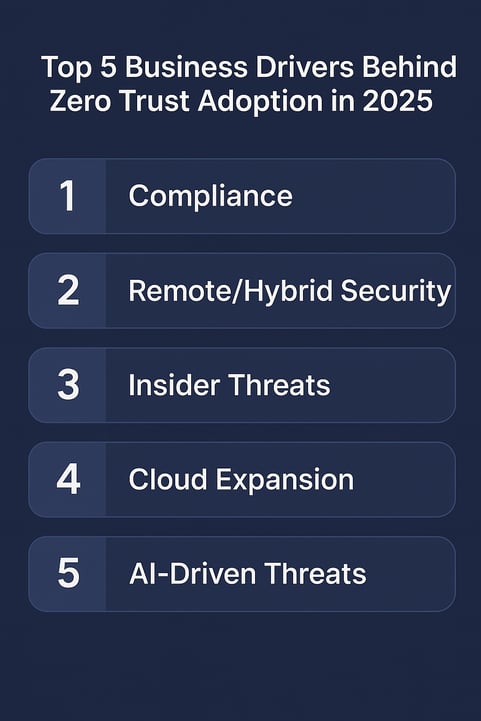
The Top 5 Business Drivers Behind Zero Trust Adoption in 2025
The shift to Zero Trust is unfolding against a backdrop of heightened business expectations and increasingly complex external pressures. Organizations are navigating an environment where boardroom decisions on cybersecurity are directly influenced by rapidly evolving regulatory demands, escalating cyber risk, and the imperative to maintain operational continuity amid an uncertain economy. These forces are not merely accelerating adoption—they are fundamentally reshaping security priorities and compelling a more strategic, business-aligned approach to Zero Trust implementation.
In 2025, five critical factors are converging, driving organizations to urgently reimagine and modernize their security architectures to remain resilient, compliant, and competitive.
1. Compliance Requirements Are Tightening Across Every Industry
Compliance has always been a strong motivator for cybersecurity investment, but in 2025, the landscape is changing rapidly. New regulations are emerging, enforcement is becoming stricter, and fines are increasing dramatically. Zero Trust has become the preferred — and in some cases, expected — framework for meeting security and privacy mandates.
Why Compliance Is Driving Urgency
- Regulatory bodies now expect stronger identity controls to protect sensitive data.
- Audits require demonstrable proof of access governance and privilege limitations.
- Cyber insurance providers are tightening requirements for identity security, MFA, and segmentation.
- Penalties for breaches are increasing under state, federal, and international privacy laws.
Industries Feeling the Most Pressure in 2025
- Healthcare: New HIPAA modernization guidelines emphasize continuous identity verification.
- Financial Services: FFIEC and PCI DSS v4.0 expand expectations for access control and logging.
- Manufacturing: CMMC 2.0 enforcement pushes defense suppliers toward Zero Trust maturity.
- Retail & Ecommerce: Consumer privacy regulations mandate granular restrictions on data access.
Example Use Case
A regional healthcare provider struggled during a 2024 audit due to insufficient access controls. By deploying Zero Trust identity architecture—including multi-factor authentication, conditional access, and least-privilege enforcement—they closed compliance gaps and reduced audit preparation time by 60%.
2. Remote & Hybrid Work Are Now Permanent & Expanding
The distributed workforce model is no longer a reaction to global events — it’s the standard operating model for most organizations in 2025. With remote employees, contractors, and partners accessing systems from multiple networks and devices, traditional VPN and perimeter-based security approaches are no longer effective.
Zero Trust Solves the Biggest Hybrid Work Challenges
- Device security — untrusted personal devices require real-time posture evaluation.
- Network unpredictability — home Wi-Fi and public networks cannot be implicitly trusted.
- Access sprawl — employees use more SaaS applications than ever before.
- Increased phishing and credential theft targeting remote workers.
Example Use Case
An engineering firm with a large field workforce implemented Zero Trust Network Access (ZTNA) to replace their legacy VPN. This reduced unauthorized access attempts by 88% and eliminated frequent support tickets related to VPN downtime.
3. Insider Threats Are Rising — Both Malicious & Accidental
Insider threats remain one of the most difficult risks for organizations to manage. In 2025, the combination of distributed teams, increased data accessibility, cloud-based collaboration, and contractor-heavy workforces has amplified the challenge.
Zero Trust Mitigates Insider Threats Through:
- Behavior-based access control that detects unusual activity in real time.
- Microsegmentation that prevents lateral movement.
- Just-in-time access that limits exposure windows.
- Granular data controls that manage who can access, download, or share sensitive information.
As organizations adopt more AI-driven productivity tools, insider risk increases—especially as employees upload proprietary information to generative AI platforms.
Example Use Case
A mid-market manufacturer faced significant financial and reputational repercussions when an employee, unaware of the information's sensitivity, inadvertently uploaded confidential CAD designs to a publicly accessible AI tool. This accidental exposure of proprietary intellectual property highlighted the growing risks associated with unsanctioned AI usage and insufficient data governance. In response, the organization prioritized the deployment of Zero Trust data loss prevention (DLP) policies, alongside comprehensive governance measures that specifically regulate the use of AI technologies across the enterprise. By implementing granular controls—such as real-time content inspection, strict contextual access policies, usage monitoring, and explicit restrictions on third-party AI integrations—the manufacturer strengthened its ability to detect and prevent unauthorized data transfers. As a result, the organization not only reduced the risk of future data leakage but also improved compliance with privacy and industry regulations, reinforced stakeholder confidence, and demonstrated a proactive approach to managing emerging insider threats in a data-driven, AI-powered operating environment.
4. Cloud Expansion & Multi-Cloud Complexity Demand Stronger Security Architecture
Cloud adoption has accelerated across all industries. Organizations are now running workloads across AWS, Microsoft Azure, Google Cloud, and a multitude of SaaS applications. While this improves agility, it also introduces new security gaps.
Cloud-First Environments Need Zero Trust Because:
- The perimeter no longer exists.
- Cloud misconfigurations are the #1 cause of breaches.
- Applications and data are distributed globally.
- Multi-cloud identity management is increasingly difficult.
How Zero Trust Helps
- Unified identity access management across cloud platforms.
- Continuous device and user verification regardless of location.
- Granular access policies for workload-to-workload communication.
- Visibility into cloud resources through centralized monitoring.
Example Use Case
A SaaS company undergoing rapid expansion adopted a multi-cloud strategy, shifting workloads to both AWS and Azure. Recognizing the security challenges inherent in managing distributed applications across multiple platforms, the organization implemented Zero Trust microsegmentation to enforce granular controls between cloud workloads. By segmenting their cloud environments at the application and workload level, they significantly minimized lateral movement opportunities for threat actors. As a result, the company not only achieved a measurable reduction in blast radius exposure—limiting the potential scope of any breach—but also improved its overall security posture scores by more than 40% within six months. This proactive approach empowered their team to onboard new cloud services with confidence, accelerate DevOps initiatives, and meet security and compliance requirements demanded by both regulators and enterprise customers.
5. AI-Driven Threats & Automation Are Transforming the Cyber Landscape
Threat actors have rapidly adopted AI-powered tactics to amplify the scale, speed, and sophistication of their attacks. They leverage automation not only to conduct reconnaissance more efficiently—scanning systems for vulnerabilities at unprecedented rates—but also to orchestrate mass credential theft, craft convincingly personalized phishing attacks, and adapt their techniques to evade legacy security solutions. These new AI-driven threats operate with agility, allowing attackers to pivot in real time and exploit opportunities with greater accuracy than ever before.
As a result, organizations face adversaries who can escalate campaigns, automate reconnaissance, and penetrate defenses far more quickly than traditional manual attacks allowed. Defending against this new breed of threat actors requires a fundamental evolution in security strategy. Businesses must modernize their defenses to match the precision and scalability of AI-enabled adversaries by adopting security models built to validate every identity, enforce policy at every access point, and continuously detect abnormal behavior. In this environment, maintaining the status quo is no longer sufficient—organizations must proactively adapt and strengthen their security posture to keep pace with rapidly evolving AI threats.
AI-Driven Threats Are Accelerating Because:
- Machine learning enables faster vulnerability scanning.
- Generative AI produces highly convincing phishing messages.
- Automated malware adjusts its behavior to avoid detection.
- Credential stuffing attacks are now real-time and adaptive.
Zero Trust Counters AI-Driven Threats Through:
- Continuous authentication that detects anomalous user behavior.
- Device posture checks that validate security health before access.
- Granular policy enforcement that reduces the attack surface.
- Real-time analytics that identify suspicious activities early.
Example Use Case
A financial services organization confronted a new wave of AI-generated phishing attacks that were sophisticated enough to evade traditional email filters and manipulate employees through convincingly crafted messages. Recognizing that standard authentication methods alone were no longer sufficient, the organization implemented Zero Trust identity controls with behavioral biometrics as a core strategy. By continuously analyzing user behaviors—such as unique typing patterns, mouse movements, and contextual login information—the system could identify anomalies indicative of credential compromise in real time. This adaptive approach enabled rapid detection of suspicious activity and preemptive blocking of unauthorized access, even if credentials had been stolen through an AI-driven phishing campaign. As a result, the organization achieved a 70% reduction in successful credential-compromise attempts, protected sensitive financial data, and assured regulators of enhanced compliance with industry access-control mandates. This real-world outcome underscores how Zero Trust, when combined with advanced identity analytics, bridges the gap between regulatory pressure and operational resilience in the face of evolving AI-powered threats.
How Zero Trust Enables Business Resilience & Growth
Beyond cybersecurity, Zero Trust delivers tangible business benefits that support growth, innovation, and operational reliability:
- Reduces cyber insurance premiums by meeting insurer requirements.
- Improves operational uptime by preventing lateral movement during incidents.
- Accelerates cloud migration by embedding security into workflows.
- Builds customer trust by increasing transparency and reducing the risk of breaches.
- Supports M&A activity by standardizing identity and access governance.
When aligned with business strategy, Zero Trust becomes an enabler—not an obstacle—to digital transformation.
How to Begin Your Zero Trust Journey in 2025
Zero Trust can initially appear daunting because it permeates every layer of your environment—identity, networks, applications, data, and cloud infrastructure. The crucial first step is to avoid attempting a wholesale overhaul; instead, focus on identifying and addressing your most significant areas of exposure. By starting with high-priority risks—such as unsecured privileged accounts, critical SaaS applications, or unmanaged devices—you build early momentum and demonstrate value. Adopting an incremental, iterative approach allows teams to deliver meaningful improvements at each stage, with clear milestones mapped to business outcomes. This strategy not only simplifies the transition but also ensures your Zero Trust journey aligns with operational realities and resource constraints, laying a strong, adaptable foundation for long-term security maturity.
Recommended Starting Points
- Identity & Access Management (IAM)
- Multi-Factor Authentication (MFA)
- Conditional Access Policies
- Device Posture Enforcement
- Privileged Access Management (PAM)
Cyber Advisors helps organizations identify the highest-impact areas for Zero Trust implementation, focusing on those vulnerabilities and assets that matter most to your business. Our process begins with a strategic assessment, leveraging industry best practices and advanced analytics to pinpoint risks, map existing controls, and prioritize initiatives that will drive the greatest security and operational value. We work alongside your leadership and IT teams to develop a clear, phased Zero Trust roadmap—one that balances risk reduction with budget realities, regulatory obligations, and your unique business objectives. This approach ensures that each step delivers measurable improvements, aligns with your overall digital strategy, and positions your organization to adapt as your environment and threats evolve.
Conclusion
Zero Trust adoption is accelerating because today’s business climate leaves no room for complacency. Driven by mounting compliance obligations, the permanence of remote and hybrid work, escalating insider and supply chain risks, an ever-expanding cloud attack surface, and the rise of AI-enabled threats, organizations stand at a critical crossroads. These forces are collectively reshaping how businesses view and manage risk, making it clear that relying on outdated, perimeter-based defenses is no longer viable in the face of increasingly sophisticated adversaries and evolving regulatory scrutiny.
The imperative is unmistakable: Zero Trust is not simply a cybersecurity consideration—it is now a business-critical mandate. Adopting Zero Trust unlocks more than just improved threat defense; it empowers organizations to proactively reduce cyber and regulatory risk, safeguard operational continuity, and reinforce customer and stakeholder trust. In this landscape, Zero Trust provides the agility and security that serve as a strategic differentiator, enabling organizations to adapt, scale, and innovate without compromise. For forward-thinking businesses, Zero Trust has transitioned from a recommended best practice to an indispensable foundation for sustainable growth and resilience.
Why Organizations Trust Cyber Advisors to Lead Their Zero Trust Journey
At Cyber Advisors, we’ve spent decades guiding organizations of every size—from small regional businesses to complex mid-market enterprises and multi-location national brands—through their Zero Trust evolution. Our team has deep, practical experience working across industries, including healthcare, manufacturing, financial services, professional services, retail, and education, helping clients modernize their security architecture without disrupting operations. We don’t deliver one-size-fits-all templates; we build tailored Zero Trust frameworks that align with your regulatory requirements, business goals, and technology roadmap. Whether you’re just beginning your Zero Trust journey or accelerating toward full maturity, Cyber Advisors serves as a trusted partner committed to strengthening your resilience, reducing risk, and ensuring your business remains secure in an increasingly unpredictable threat landscape.
Ready to Align Zero Trust With Your Business Goals?
Let Cyber Advisors help align your Zero Trust strategy with your business goals.
Our team builds tailored Zero Trust roadmaps that reduce risk, strengthen compliance, and support digital transformation initiatives.