
Public companies now face tighter, time-bound expectations to report material cyber incidents and to describe their cyber risk management. Those expectations are flowing into supply chains, insurance underwriting, lender requirements, M&A diligence, customer questionnaires, and boardroom governance—meaning private and mid-market companies are increasingly expected to operate with similar discipline.
If you’re a private or mid-market organization, it’s tempting to treat the SEC’s cyber disclosure rules as “a public company problem.” But that mindset is quickly becoming a business risk. In practical terms, private companies will increasingly be asked to prove they can:
- Detect and contain incidents quickly
- Make defensible materiality decisions
- Preserve evidence and document actions
- Communicate clearly with stakeholders
- Demonstrate board-level oversight and repeatable governance
Whether you’re preparing for a new customer contract, renewing cyber insurance, seeking financing, or considering a future exit, SEC-style cyber readiness is becoming the new baseline.
What the SEC Rules Mean & Why They Matter
The SEC’s cyber disclosure rules focus on two big things:
- Rapid disclosure of material cybersecurity incidents
- Ongoing disclosure of cybersecurity risk management and governance
For public companies, these requirements formalize the timely, accurate reporting of cyber events and transparency into whether leaders are actively managing cyber risk. For private companies, the rules set a regulator-backed benchmark for what “good” cyber governance and incident readiness looks like.
What “material” really means in a cyber context
Materiality is a legal concept. In cyber, it often ties back to business impact, such as:
- Operational downtime affecting revenue, production, or patient care
- Exposure of sensitive or regulated data (PII, PHI, PCI)
- Loss of intellectual property or trade secrets
- Fraud, wire diversion, or direct financial loss
- Regulatory investigations, fines, or litigation risk
- Customer churn, reputational harm, or contract penalties
The challenge is that materiality is rarely obvious in the first hour of an incident. SEC-style expectations push organizations to build repeatable mechanisms for making high-stakes decisions under uncertainty—exactly what insurers, lenders, and customers want to see.
Time-bound expectations change the response model
The expectation of speed is increasing. Even if you aren’t filing SEC forms, similar time pressure can come from:
- Contractual notification clauses requiring notice within 24–72 hours
- Cyber insurance requirements tied to coverage eligibility
- Downstream customers that must report to their own regulators
- Incident-driven audits and due diligence from boards, lenders, or acquirers
Why Private & Mid-Market Companies Should Care
1) YOUR CUSTOMERS WILL PUSH COMPLIANCE DOWNSTREAM
As public companies strengthen reporting and governance, they also tighten vendor requirements, contractual notification timeframes, and evidence requests. If your response is ad hoc or inconsistent, it can directly impact revenue.
2) Cyber insurance underwriting is becoming more demanding
Underwriting increasingly favors demonstrable maturity: logging/detection, tested incident response, governance accountability, third-party risk visibility, and evidence that controls are operational.
3) Lenders & investors treat cyber as a business risk
Cyber readiness now influences valuation, deal timelines, and post-close cost expectations. A mature program reduces perceived risk; a weak program can slow a deal or reduce purchase price.
4) Boards & leadership are expected to govern cyber
Leaders are increasingly expected to know who owns cyber risk, how posture is reviewed, what metrics matter, and how incident readiness is tested.
Governance & Board Reporting: Turning “Cyber” Into a Business Conversation
Effective cyber governance bridges technical reality and business outcomes—clarifying likely scenarios, business impact, readiness, and proof. Focus on three outcomes: accountability, cadence, and evidence.
Accountability: define who owns decisions
- Executive sponsor (CEO/COO/CFO) for risk ownership
- IT/security leader for operational control ownership
- Legal/compliance for obligations, privilege strategy, evidence
- Finance for financial impact and insurance requirements
- Communications/HR for messaging responsibilities
- Board/advisory group for oversight and escalation
Cadence: establish a regular rhythm
- Monthly leadership updates
- Quarterly maturity and trend reviews
- Annual roadmap alignment to business goals
- Post-incident briefings and after-action reviews
Evidence: measure what matters
- MTTD/MTTR trends
- Critical patch compliance
- MFA and privileged access governance coverage
- Backup success rates and recovery test outcomes
- Security awareness and phishing outcomes
- Third-party assessments completed and remediations closed
- Tabletop cadence and action-item closure
Incident Readiness & Materiality: Building a Repeatable Decision Process
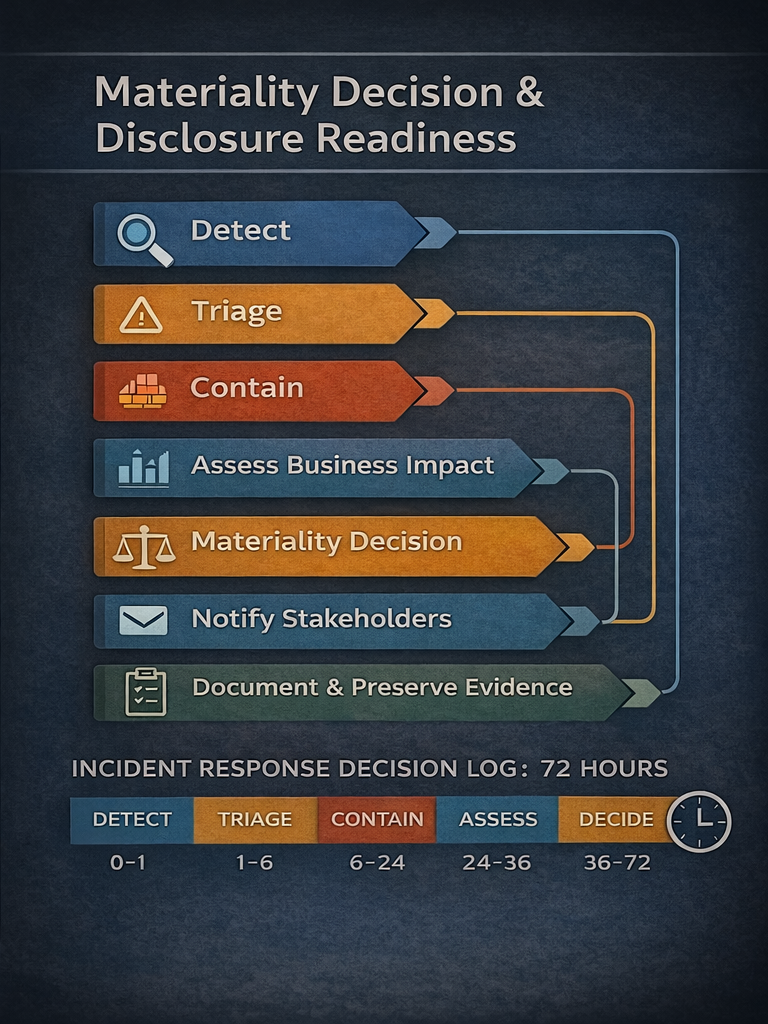
Step 1: Define materiality criteria in business terms
- Revenue impact (downtime, penalties, lost sales)
- Operational impact (service delivery, safety, SLAs)
- Data impact (type, sensitivity, regulatory exposure)
- Legal/regulatory impact (notification duties, compliance)
- Customer impact (trust, churn potential)
- Strategic impact (IP loss, long-term harm)
- Financial impact (loss, recovery costs, insurance)
Step 2: Establish escalation path & decision authority
- Who convenes the incident leadership team?
- Who declares a “major incident”?
- Who recommends/approves materiality decisions?
- When do you engage counsel, forensics, or insurance?
- How and when do you notify stakeholders?
Step 3: Create a decision log & evidence checklist
Document what was known, what actions were taken, who participated, what evidence supports conclusions, and what communications were approved.
Step 4: Practice with tabletop exercises
- Realistic scenarios (ransomware, BEC, exfiltration, vendor breach)
- Role-based participation (IT, leadership, legal, HR, comms)
- Time-bound decisions
- Evidence and communication requirements
- After-action reporting with assigned improvements
Operationalizing Incident Response: Roles, Communications, Legal, & Evidence
BUILD AN INCIDENT RESPONSE PLAN THAT MATCHES REALITY
- Incident severity levels and activation criteria
- Escalation steps and decision authority
- Role-based responsibilities
- Communication playbooks and templates
- Internal/external contact lists
- Evidence preservation and chain-of-custody steps
- Alignment with BC/DR
Communications: speed, accuracy, & consistency
- Single “source of truth” channel
- Structured update cadence
- Pre-approved notification templates
- Legal review before external messaging
- Document what was said, to whom, and when
Legal & insurance: engage early
Early engagement supports regulatory/contract duties, privilege strategy, evidence handling, and insurance notice/vendor requirements.
Evidence preservation: treat it as first-class
- Secure endpoint, firewall, identity, cloud, and email logs.
- Capture images where appropriate.
- Preserve communications related to decisions.
- Document timeline of actions.
- Maintain chain of custody for sensitive artifacts.
Logging & Detection Coverage: The Foundation of Credible Readiness
Logging and detection are the difference between “we think” and “we know.” A practical mid-market target in 2026 includes:
- EDR is deployed broadly across workstations and servers
- Centralized log aggregation from identity, email, firewall/VPN, and cloud audit logs
- Defined retention (often 90–180 days baseline)
- Alert tuning and clear escalation procedures
- Playbooks mapping detections to actions
Vendor & Third-Party Risk Exposure: Your Risk Is Not Just Your Own
START WITH TIERING
- Tier 1: network access/admin privileges/sensitive data
- Tier 2: limited access/indirect impact
- Tier 3: low-risk/minimal access
Practical controls for higher-risk vendors
- Questionnaires and evidence requests (SOC 2, ISO 27001, pen test summaries)
- Contract language for notification windows and cooperation
- Least privilege, time-bound access, MFA enforcement
- Periodic reassessment
- Defined vendor-breach incident procedures
Ransomware & Extortion: The Scenario You Must Be Ready For
Modern ransomware typically includes access, escalation, exfiltration, encryption, and extortion threats. Key readiness measures:
- Reduce likelihood: MFA/identity controls, patching, EDR/MDR, segmentation, email security, training
- Reduce blast radius: least privilege, separate admin accounts, MFA everywhere, monitor privileged activity
- Reduce business impact: immutable/offline backups, tested recovery, BC aligned to technical capability
- Improve decision defensibility: playbooks, counsel/forensics triggers, comms plan, decision log
Ransomware readiness is not a single tool. It’s a program.
Documentation for Audits, Insurers, & “Prove It” Moments
In 2026, expect evidence requests from insurers, customers, lenders, auditors, and acquisition diligence teams. High-value documentation includes:
- Incident response plan + tabletop report + remediation tracking
- Asset inventory and critical systems list
- Vulnerability management process and recent reports
- Patch compliance and exception handling
- Identity governance (MFA, admin controls, access reviews)
- Backup and recovery test results
- Security awareness and phishing outcomes
- Third-party risk assessments for critical vendors
- Logging/monitoring architecture and retention
- Leadership reporting cadence and sample dashboards
Next Steps: A Practical 2026 Readiness Checklist
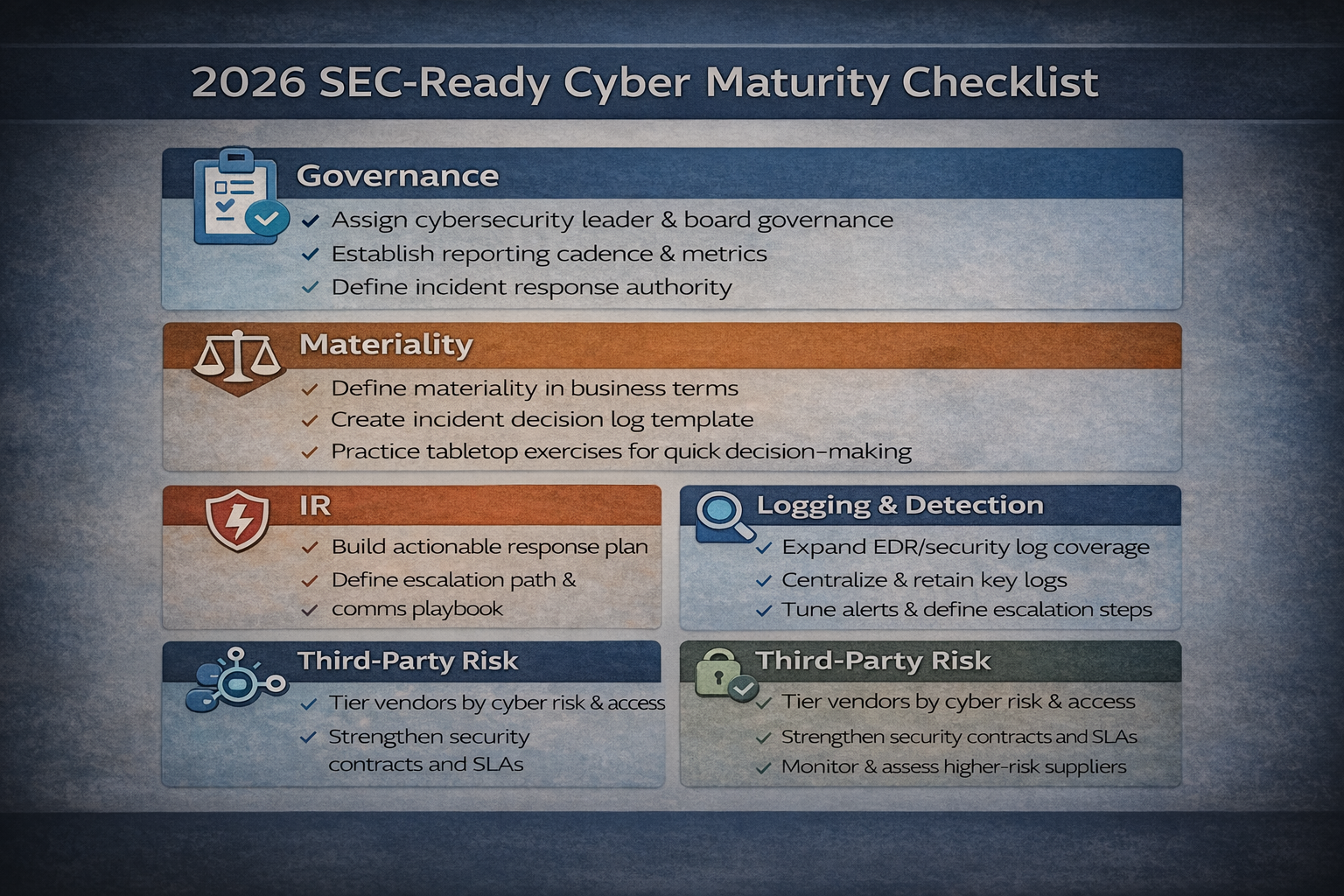
1) Governance & oversight
- Assign executive ownership of cyber risk
- Set leadership reporting cadence
- Define meaningful risk/readiness metrics
- Document decision authority and escalation paths
2) Materiality & decision discipline
- Translate materiality into business terms
- Create an incident decision log template
- Define notification obligations (contracts/regulators/insurers)
- Run at least one tabletop that forces materiality decisions
3) Incident response readiness
- Build/update an IR plan that matches reality
- Define roles and communications playbooks
- Align IR with BC/DR
- Maintain current contact lists
4) Detection, logging, & evidence
- Expand EDR coverage
- Centralize and retain key logs (identity/email/firewall/cloud)
- Tune alerts and clarify escalation
- Create an evidence preservation checklist
5) Third-party risk
- Tier vendors by risk
- Strengthen contracts and notification windows
- Enforce least privilege and MFA
- Include vendor breach scenarios in tabletops
How Cyber Advisors Helps
Cybersecurity is now a board-level business function. Customers expect maturity. Insurers demand evidence. Partners want assurance. Cyber Advisors helps private and mid-market organizations build SEC-style readiness without unnecessary complexity—focused on measurable risk reduction.
Cyber Maturity Reviews & Readiness Assessments
- Clear view of strengths, gaps, and priority risks
- Practical roadmap aligned to business goals
- Evidence-ready recommendations that support insurance and customer outcomes
Incident Response Planning & Tabletop Exercises
- Actionable incident response plans
- Realistic tabletop exercises for leadership decision-making
- After-action reports with prioritized remediation
Security Operations & Managed Detection
- EDR/MDR alignment and operational integration
- Log centralization, retention, and alert tuning
- Incident workflows that improve speed and defensibility
Third-Party Risk & Governance Support
Repeatable vendor risk, executive reporting, and evidence collection—so you can answer customer, insurer, and lender questions with confidence.
WHY PRIVATE & MID-MARKET LEADERS CHOOSE CYBER ADVISORS FOR SEC-READY CYBER MATURITY AND DISCLOSURE DISCIPLINE
Cyber Advisors brings deep experience helping private and mid-market organizations build the governance, controls, and incident readiness needed to meet rising SEC-style expectations—without overbuilding or disrupting the business. We guide teams through practical security improvements that stand up to customer, insurer, and lender scrutiny, then help operationalize the processes that matter most when an incident happens: defensible materiality decisions, documented response actions, evidence preservation, and coordinated communications. Whether you’re preparing for tougher third-party requirements, improving cyber maturity for financing or M&A, or supporting SEC-regulated customers and partners, we help you get your systems into compliance and confidently execute the reporting and disclosure workflows that today’s environment demands.
Book a Cyber Maturity Review
Schedule a Cyber Maturity Review with Cyber Advisors to identify exposure before it becomes an incident, build a realistic 2026 roadmap, and improve readiness for insurance renewals, customer diligence, and leadership oversight.