

Many real breaches start with people—not because your team is careless, but because attackers are patient, persuasive, and practiced. They exploit normal work patterns: a rushed finance manager approving a wire transfer, a helpdesk tech resetting a password for a “new exec,” a project lead sharing a document to the wrong address, a remote employee approving an MFA push they didn’t initiate.
Your technical controls matter. EDR/XDR, email security, MFA, conditional access, and least privilege—these are foundational. But humans and process are often the difference between an attempted compromise and a successful one. That’s why the most resilient organizations don’t treat penetration testing and security awareness training as separate programs. They combine them into a single, measurable loop: test what attackers actually do, train where people struggle, and fix the workflows that enable social engineering.
This post breaks down seven practical reasons to pair social engineering penetration testing with awareness, and how to do it ethically—without “gotcha” moments—so you reduce credential-driven risk and build a stronger reporting culture.
Why Targeting HUMANS works
Attackers don’t target people because it’s easier than hacking, though often it is. They do it because it’s reliable and scalable.
- Humans have access to systems and data, and they can be persuaded to use that access in unsafe ways.
- Humans operate inside processes—ticketing, approvals, procurement, HR onboarding/offboarding, vendor support—that can be manipulated.
- Humans are trained to be helpful and to move fast, which is exactly what social engineers exploit.
- Humans are often the MFA bypass when “push fatigue” leads to accidental approval or when a helpdesk reset bypasses strong authentication.
When a breach begins with phishing, business email compromise (BEC), helpdesk manipulation, or credential theft, it’s rarely the result of a single mistake. It’s usually a chain of small gaps: unclear policies, inconsistent verification, weak escalation paths, limited reporting culture, or misaligned incentives (“close tickets fast” instead of “close tickets safely”).
Pairing pen testing with awareness helps you identify and fix the chain—not just the last link.
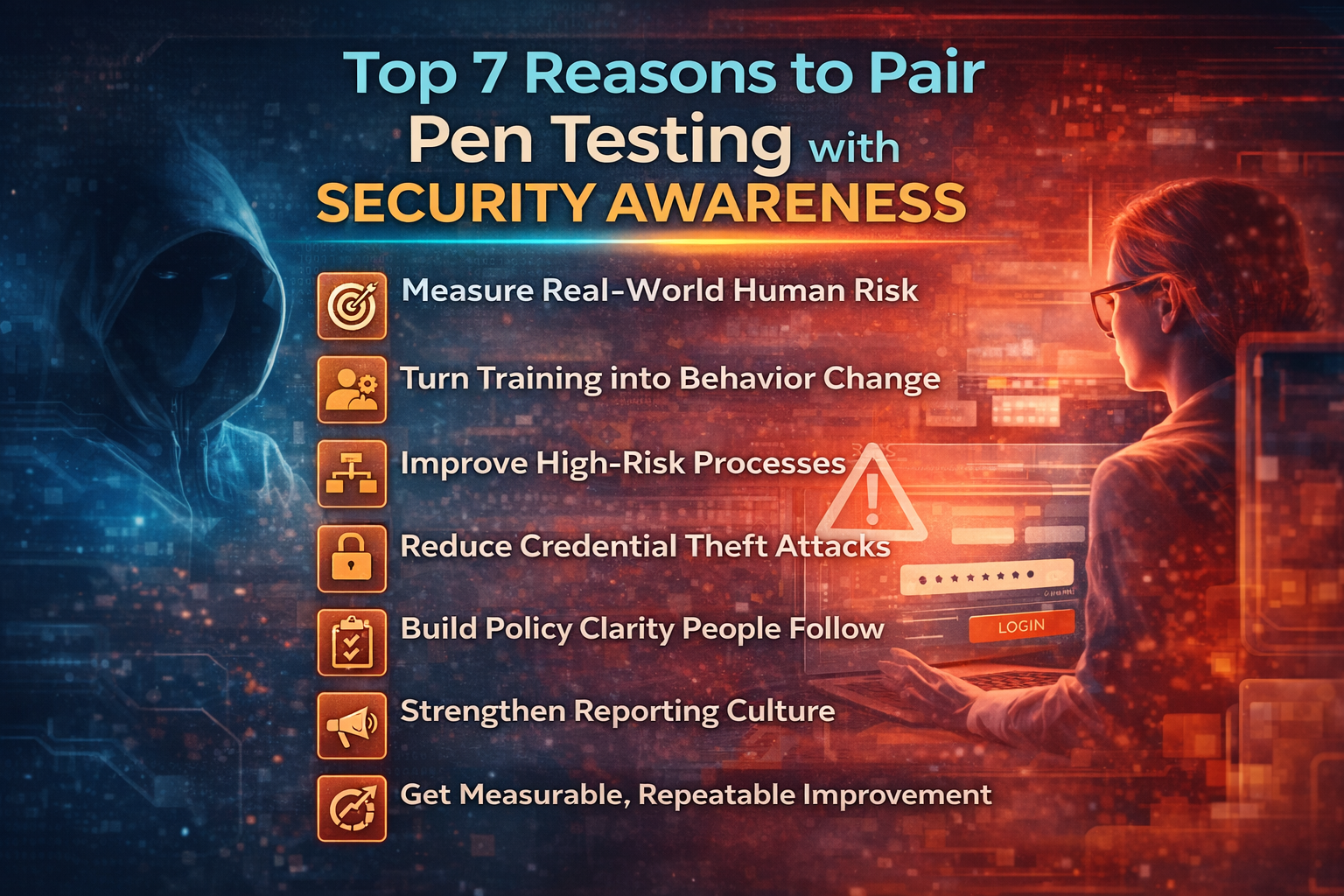
Top 7 Reasons to Pair Pen Testing with Security Awareness
1) You Measure Real-World Human Risk
Security awareness programs often track completion rates, quiz scores, and phishing simulation click rates. Those metrics are useful, but incomplete. They tell you whether people recognize common patterns in a controlled setting—not whether your business can resist modern social engineering that targets your processes, tools, and culture.
A well-scoped social engineering penetration test can validate what really happens when an attacker:
- impersonates a vendor,
- calls the helpdesk with partial information,
- uses a real executive’s writing style,
- requests a payroll change,
- or pivots from one compromised mailbox to another.
What you learn is operational:
- Which departments get targeted successfully?
- Which workflow steps are bypassed?
- Where do people follow policy—and where does policy not match reality?
- How quickly do teams report suspicious activity?
- How many “near misses” go unreported?
Examples of outcomes you can measure:
- Helpdesk identity verification success rate
- Time-to-report for suspicious emails or calls
- Number of policy exceptions requested/granted
- Successful privilege/credential escalations via process manipulation
- Consistency of approvals for high-risk actions (password reset, MFA reset, bank detail changes)
2) You Turn “Training” into Behavior Change by Targeting the Right Moments
Most people don’t get compromised because they don’t know phishing exists. They get compromised because they’re multitasking, under time pressure, trying to be helpful, uncertain about policy, or dealing with a message that looks legitimate in context.
Pen testing helps you pinpoint the exact moment where behavior breaks down and why:
- The email appeared to be a legitimate shared file.
- The caller knew internal jargon and employee names.
- The ticket included enough details to feel “verified.”
- The request came from someone “important.”
- The employee didn’t want to slow down the project.
Once you know the moments that matter, awareness training becomes shorter, more relevant, easier to act on, and more credible to the audience.
Best practice: Treat awareness as performance support, not just education. Build micro-lessons around your actual workflows (“When you get a bank change request, do this…”).
3) You Improve High-Risk Processes Where Most “Human Error” Lives
If a social engineer succeeds, it’s often because a process enables them: password resets without strong identity verification, approvals that rely on email alone, vendor onboarding steps that don’t validate authenticity, privilege elevation that’s too easy, or weak separation of duties in finance or HR.
Pen testing identifies process gaps with real evidence. Awareness training helps people consistently follow the improved process.
Helpdesk verification (password resets, MFA resets, & device enrollment)
Common weakness: Helpdesk staff are trained to restore access quickly. Attackers exploit that urgency.
- Require a defined verification checklist (not “gut feel”)
- Enforce a call-back to a known number (not the one provided)
- Require manager validation for high-risk actions
- Add step-up verification for VIPs/admin accounts
- Log and review every exception
Business email compromise (invoices, wire transfers, bank detail changes)
Common weakness: Finance workflows rely on email authority.
- Out-of-band verification for bank detail changes
- Dual approval thresholds for new payees
- Vendor validation controls
- Store “known good” payment instructions securely (not in email chains)
- Clear escalation for suspicious changes
Privilege & access requests
Common weakness: “Temporary” access becomes permanent.
- Time-bound access with automatic expiration
- Mandatory justification + manager approval
- Conditional access rules for privileged actions
- Regular review of admin group membership
- Restrict helpdesk's ability to reset admin MFA without escalation
Why pairing matters: Training alone can’t fix a flawed workflow. Testing reveals where workflows fail; awareness ensures people execute the improved workflow under pressure.
4) You Reduce Credential Theft & “MFA Fatigue” Attacks with Targeted Controls + Coaching
Credential theft remains one of the most common paths to compromise—through phishing pages, harvesting passwords, token theft, session hijacking, password reuse, or social engineering that convinces someone to approve MFA prompts.
Security awareness should teach people what MFA fatigue looks like, why unexpected prompts are a red flag, and what to do immediately (report, reset, check sessions).
Pen testing adds realism by simulating how prompts are triggered, measuring how often people approve unknown prompts, and validating conditional access and session controls.
Practical improvements to pursue:
- Move to phishing-resistant MFA where feasible (FIDO2/WebAuthn)
- Enable number matching or context-based MFA prompts
- Conditional access (location, device compliance, impossible travel)
- Reduce standing privileges (just-in-time admin access)
- Promote password managers and strong passphrases
- Monitor for risky sign-ins and token abuse
5) You Build Policy Clarity People Can Actually Follow
Policies that are too vague or too complex become optional in real life. Social engineers thrive in ambiguity: “Are we allowed to share this file externally?” “Can I reset MFA if the user answers security questions?” “Can I send this invoice without calling the vendor?”
A social engineering test highlights where policies aren’t understood, where policies conflict with reality, and where employees don’t know who to ask. Then you can refine policy into actionable guidance: short checklists, decision trees, scripts for verification, and “stop-and-verify” moments for high-risk requests.
Make policies operational:
- Turn “verify identity” into a 5-step helpdesk checklist.
- Turn “validate vendor changes” into a finance playbook.
- Turn “report suspicious messages” into a one-click workflow.
- Turn “least privilege” into time-boxed access requests with approvals.
6) You Strengthen Reporting Culture (So Small Issues Don’t Become Big Breaches)
One of the biggest differences between organizations that respond quickly to incidents and those that suffer major impacts is how quickly people report suspicious activity.
If employees fear punishment for clicking something—or they assume IT won’t want “false alarms”—they delay reporting. Attackers benefit from silence. A combined program reinforces the message: “If you’re unsure, report it.” “Reporting quickly is always the right move.” “We reward reporting, not perfection.”
Pen testing can measure how many people report, how quickly they report, and whether the SOC/help desk responds quickly enough. Awareness builds confidence and muscle memory for quick action.
- Deploy a simple report mechanism (button, hotline, ticket category)
- Publish what happens after someone reports (set expectations)
- Respond with gratitude and quick feedback loops
- Run tabletop exercises that include non-IT staff
- Recognize “good catches” publicly (without shaming)
7) You Get Measurable, Repeatable Improvement (Not One-and-Done Testing)
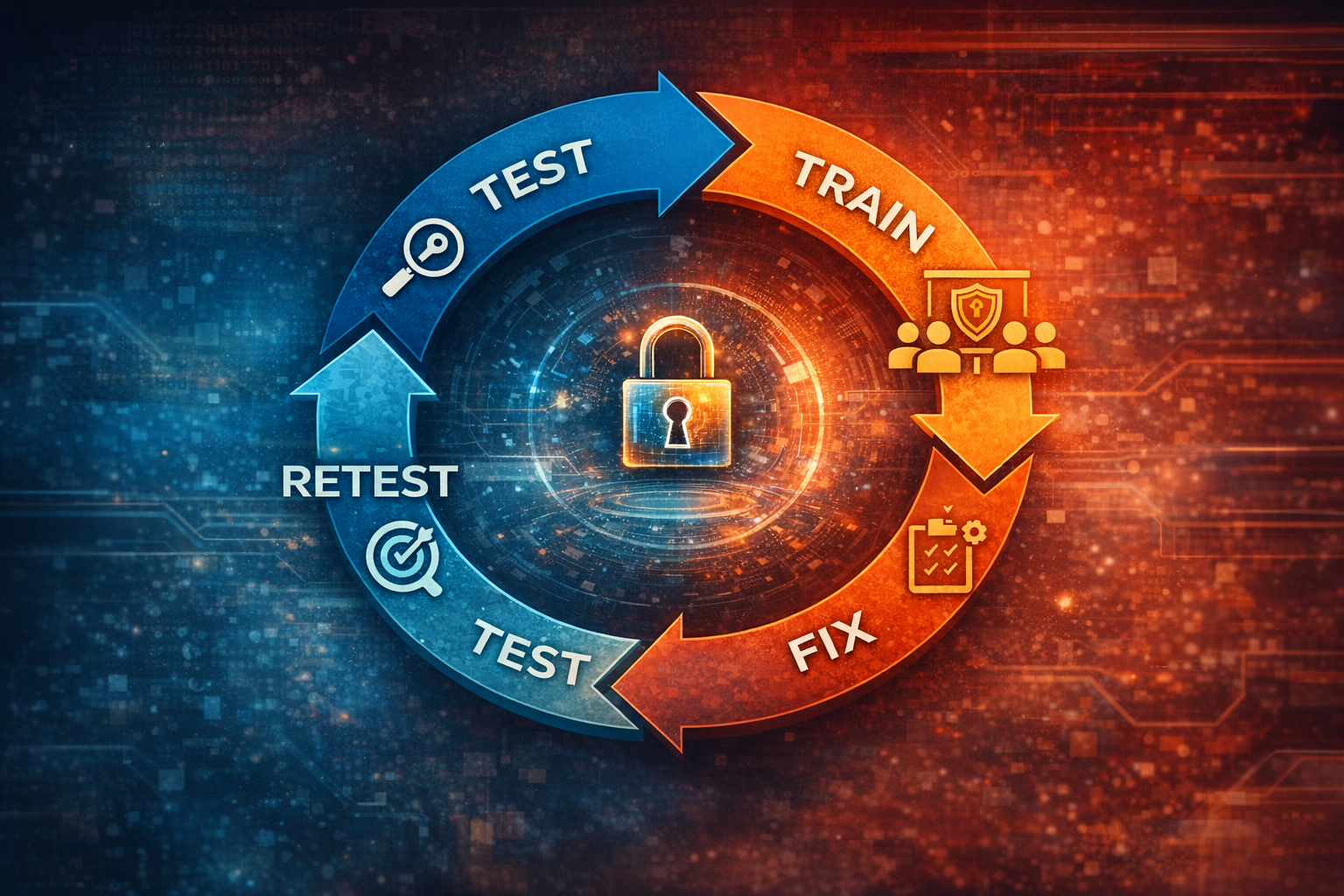
A once-a-year pen test plus annual training creates a compliance checkbox. It doesn’t create resilience. Pairing them enables a continuous cycle:
- Baseline test (ethical, scoped social engineering)
- Findings mapped to behaviors and workflows
- Process fixes (verification, approvals, access, tooling)
- Targeted training (micro-modules, role-based)
- Re-test scenarios after improvements
- Track metrics quarter over quarter
This produces executive-ready reporting: reduced success rates of social engineering attempts, improved time-to-report, fewer risky exceptions, stronger compliance posture, and a clear ROI story.
How to Run Ethical Social Engineering Tests
If you do this wrong, you can damage trust. If you do it right, you build partnership and resilience.
Start with leadership buy-in & clear boundaries
- Define the purpose: improve resilience and workflows, not embarrass individuals.
- Establish what is in scope (departments, systems, time windows).
- Establish what is out of scope (HR-sensitive topics, personal data collection, coercion).
- Decide who will know in advance (a small control group is common).
- Plan the communication strategy after the assessment.
Use realism, but never manipulation that harms people
Ethical tests avoid threats, shame, personal targeting, or content that could cause emotional harm. They focus on business-realistic scenarios like vendor invoice changes, helpdesk reset attempts, shared file requests, and urgent internal requests.
Protect privacy & treat results as coaching data
- Report results in aggregate by role/team (avoid naming individuals).
- Use “learning moments” to improve training and process.
- Celebrate improvements and reporting wins.
Coordinate response & containment
A good test also validates detection and response: whether your team spots patterns, tools generate alerts, incidents are triaged correctly, and staff know what to do.
Close the loop with process changes
If findings are only “people clicked,” you’re missing the point. Deliverables should include process improvements, control recommendations, playbooks, and role-based training updates.
Process Improvements That Pair Especially Well with Awareness + Testing
Helpdesk verification playbooks
- Standard verification steps and scripts
- Mandatory call-back to known numbers
- Step-up verification for high-risk actions
- Escalation path for VIP/admin changes
Phishing-resistant authentication
- FIDO2 security keys where feasible
- Number matching/context-based MFA prompts
- Limit SMS-based MFA where possible
- Device compliance + conditional access
Access governance
- Least privilege + role-based access
- Just-in-time elevation for admins
- Auto-expiring temporary access
- Regular access reviews
Email & domain protections
- DMARC, DKIM, SPF alignment
- External sender banners (use carefully)
- Safe links/attachment detonation
- Lookalike domain monitoring
Finance & HR fraud controls
- Out-of-band verification for payroll and bank changes
- Segregation of duties
- Dual approvals for high-risk transactions
- Vendor validation steps
Reporting culture improvements
- Easy “report” button
- Rapid feedback after reports
- No-blame language reinforced by leadership
- Recognition for fast reporting
Next Steps: Build a Combined Program That Actually Reduces Risk
Step 1: Identify your highest-risk social engineering scenarios
- Helpdesk password/MFA resets
- Finance invoice/wire fraud (BEC)
- Privileged access requests
- Vendor onboarding changes
- Executive impersonation
Step 2: Set success metrics that reflect business reality
- Reduction in successful social engineering attempts over time
- Higher reporting rates and reduced time-to-report
- Reduction in policy exceptions
- Improved verification workflow adherence
- Improved detection and response times
Step 3: Run a scoped, ethical social engineering assessment
Work with a qualified provider to design tests that match your industry, processes, and risk profile.
Step 4: Turn findings into playbooks + training
- Update helpdesk/finance verification workflows
- Revise policies into checklists
- Deploy role-based micro-training (5–10 minutes)
- Reinforce reporting culture
Step 5: Re-test & track improvement
The second test is where ROI becomes visible: fewer successful attempts, better response, stronger process execution, and more confident employees.
FAQs: Pen Testing + Awareness for Social Engineering
Isn’t phishing simulation enough?
Phishing simulations are helpful, but they test only a narrow slice of behavior. Social engineering often succeeds through phone calls, process manipulation, and multi-step impersonation. Pen testing validates those broader paths.
Will this damage employee trust?
Not if you run ethical tests with clear purpose, boundaries, and privacy protections—and focus on process improvement, not punishment.
How often should we do social engineering tests?
Many organizations benefit from an annual assessment, along with smaller quarterly exercises or targeted tests tied to workflow changes. Frequency depends on risk and maturity.
Does this apply to small businesses as well?
Yes. Smaller businesses are often targeted because verification processes can be informal, and roles overlap. A right-sized approach can still significantly improve resilience.
What’s the difference between technical pen testing and social engineering testing?
Technical pen testing focuses on systems and exploit paths. Social engineering testing focuses on human interaction and process manipulation. Attackers use both, so the best programs test and train both.
Final Takeaway
Attackers target people because it works—but “people risk” is not a fixed cost of doing business. When you pair social engineering penetration testing with security awareness training, you create a measurable program that improves behavior, strengthens workflows, and reduces credential-driven attacks.
- You see how attacks really happen in your environment.
- You strengthen the processes social engineers exploit.
- You coach behaviors that prevent credential theft and fraud.
- You build a reporting culture that reduces impact.
- You create a repeatable improvement you can prove to leadership.
A Stronger Security Culture—Backed by Elite Pen Testing.
When it comes to reducing human-driven risk, Cyber Advisors brings deep, real-world experience helping organizations of all sizes strengthen their security culture—without slowing the business down. We combine practical security awareness training and phishing simulations with clear, role-based guidance to help employees recognize modern attacks, follow verification procedures, and report suspicious activity quickly. Just as importantly, we help teams turn lessons learned into repeatable process improvements—so awareness becomes a measurable reduction in risk, not just an annual checkbox. With the recent addition of Stratum Security, Cyber Advisors now offers an unmatched combination of strategic guidance and elite penetration testing capabilities—delivering the expertise to validate real-world exposure, prioritize fixes, and help your organization build resilience with confidence.
Schedule a Social Engineering Assessment
If you want to identify where your verification workflows, reporting culture, and credential protections could be improved—without blame and without “gotcha” tactics—schedule a Social Engineering Assessment with our team. We’ll help you safely test real-world scenarios, prioritize fixes, and turn findings into repeatable training and process improvements.