
Cloud transformation aligns platforms, security, and operations so teams work faster with fewer blockers. For small and mid-market organizations, modernizing through the cloud has become one of the most reliable ways to increase agility, improve security, and support growth without overwhelming internal IT teams.
At its core, cloud modernization is about rethinking how technology supports your people and your goals. It goes beyond simply “moving to the cloud” or lifting and shifting servers. True modernization aligns your platforms, processes, and security so that technology becomes a growth engine instead of an obstacle.
Many leaders know they need to modernize, but they struggle with questions such as: Where do we start? Which systems should move first? How do we manage risk and cost? How do we know if our cloud strategy is actually working? Those are the questions this guide is designed to answer.
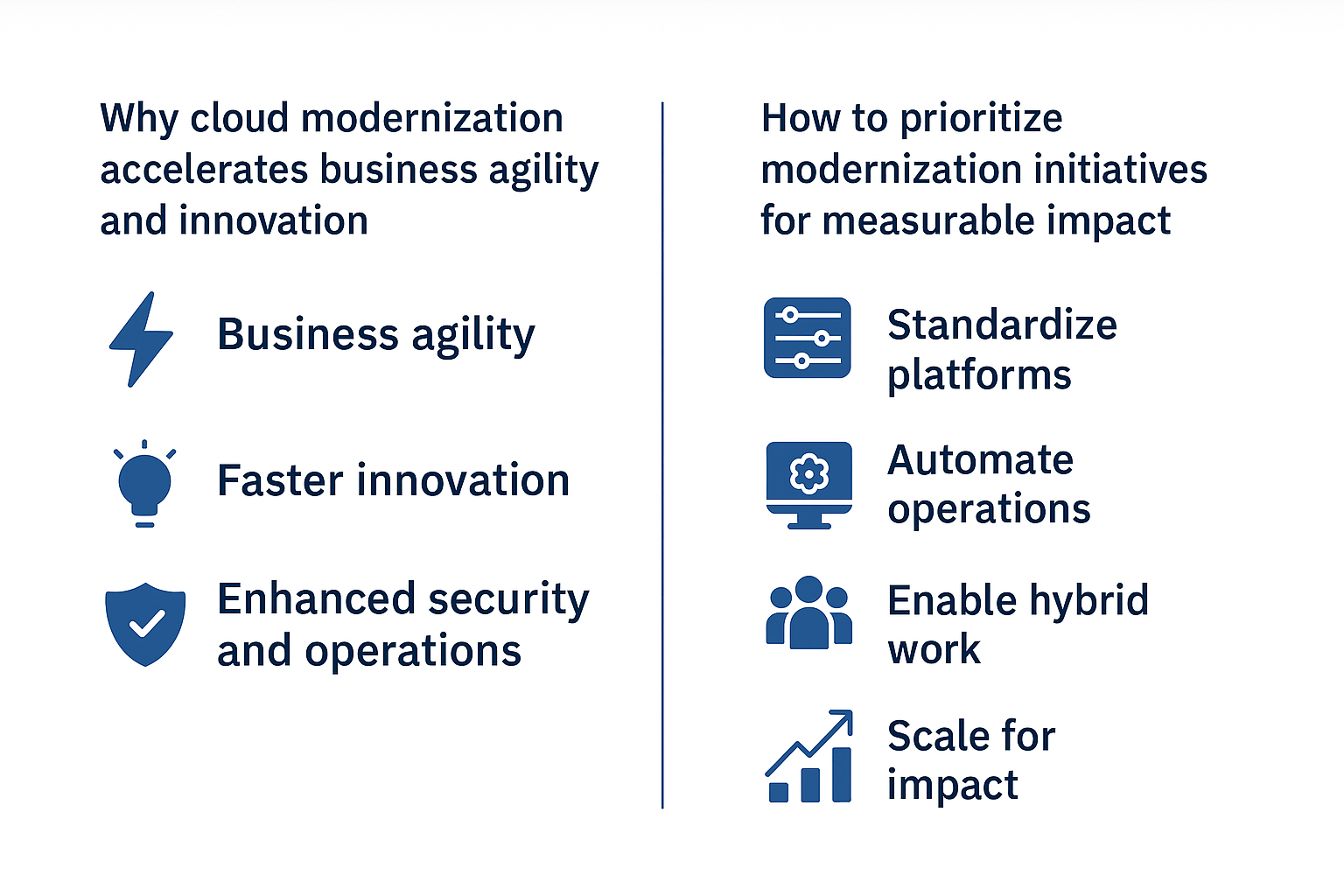
In the sections that follow, you will learn why cloud modernization accelerates business agility and innovation, how to prioritize your initiatives for measurable impact, and how to build a roadmap that balances quick wins with long-term value. The goal is not to chase every new technology trend, but to build a modern, secure, and scalable foundation that supports your business for the next decade.
Why Cloud Modernization Accelerates Business Agility & Innovation
Modernizing through the cloud is not just a technical upgrade; it is a business strategy. Organizations that embrace cloud-first, modernized environments gain the flexibility to respond quickly to change, the resilience to withstand disruption, and the visibility to make better decisions.
For SMB and mid-market organizations, the stakes are high. You may not have the large IT staff or budget that an enterprise does, but customers still expect the same level of responsiveness, security, and digital experience. Cloud modernization helps close that gap.
Cloud as a Strategic Growth Engine
Historically, IT was often seen as a cost center: something necessary to keep the lights on but not a direct contributor to growth. Cloud modernization changes this dynamic. When infrastructure, applications, and security are modernized, IT becomes an enabler of new services, better customer experiences, and faster innovation.
Modern cloud platforms support rapid application development, integration with SaaS solutions, advanced analytics, and automation. They provide a foundation for your team to experiment, iterate, and deploy improvements without being held back by outdated hardware or rigid systems. This shift turns technology from a constraint into a catalyst.
1. Speed, Velocity, & Time-to-Market Improvements
In most organizations, competitive advantage often hinges on how quickly you can respond to customer needs or changes in the market. Legacy infrastructure slows that response. Provisioning a new server might take weeks. Rolling out an application update could require a maintenance window and manual coordination. Testing new capabilities might mean building a separate environment from scratch.
In a modern cloud environment, these limitations largely disappear. Infrastructure can be provisioned in minutes. Development teams can spin up test environments on demand, automate deployments, and roll back quickly if needed. Patch management can be automated. This new velocity means your organization can ship improvements faster, test new ideas more frequently, and adjust products or services based on real-world feedback.
2. Built-In Agility for Unpredictable Market Conditions
The past few years have highlighted just how unpredictable business conditions can be. Supply chains shift, customer demand changes, workforce models evolve, and new competitors emerge quickly. Organizations that rely on fixed, on-premises infrastructure have a hard time adapting under those conditions.
Cloud platforms, by contrast, are designed for flexibility. You can scale capacity up or down based on real-time usage instead of projected peak estimates. You can move workloads to regions that better align with your customers or regulatory requirements. You can roll out new services without waiting for hardware procurement cycles.
For SMBs and mid-market companies, this agility levels the playing field. You gain the ability to move as quickly as much larger competitors without the overhead of owning and managing a large data center footprint.
3. A Stronger, More Connected Workforce
Modern work is no longer tied to a single office or device. Employees expect to be able to work from home, at a client site, or while traveling—all without jumping through hoops to access the tools and data they need. Legacy environments often make this difficult, relying heavily on VPNs, local file servers, and inconsistent access controls.
Cloud modernization supports hybrid work by putting applications, collaboration tools, and data into secure, identity-driven platforms. Common examples include moving email and productivity tools to Microsoft 365, adopting Teams for communication, and using cloud-based file services such as SharePoint or OneDrive.
Instead of worrying about where users are or which device they are on, you focus on who they are and what they are allowed to access. This identity-first model, supported by cloud platforms, makes it easier to onboard new employees, support remote teams, and maintain a consistent user experience.
4. Security That Evolves Faster Than Threats
Cybersecurity is one of the primary reasons many organizations are rethinking their environments. Attackers are evolving quickly, and traditional perimeter-based security is no longer sufficient. Legacy systems can be difficult to patch consistently, may not support modern authentication methods, and often lack the visibility security teams need.
Cloud providers and modern security platforms offer built-in capabilities that were previously out of reach for many SMBs. These include continuous threat monitoring, identity and access management with multi-factor authentication, advanced endpoint protection, and cloud-native security information and event management. Threat intelligence and detection rules are centrally updated, so your organization benefits as soon as they are released.
When combined with a zero-trust security model—where access is continually verified rather than assumed—cloud modernization can significantly reduce risk. You gain better insight into who is accessing what, from where, and on which device, and you can take action quickly when something looks suspicious.
5. Eliminating Technical Debt and Legacy Barriers
Technical debt accumulates over time through postponed updates, custom workarounds, and reliance on outdated platforms. While each decision may have made sense in the moment, the net effect is a brittle environment that is expensive to support and hard to change.
Cloud modernization provides an opportunity to retire outdated systems, simplify the environment, and standardize on platforms that are easier to manage. Applications can be moved to modern architectures or replaced with SaaS alternatives. Infrastructure can be consolidated. Licensing can be rationalized.
By reducing technical debt, you free up time, budget, and attention for strategic work instead of constant firefighting. Modernization is not only about new capabilities; it is also about removing old obstacles.
How to Prioritize Modernization Initiatives for Measurable Impact
With so many opportunities to modernize, it can be tempting to tackle everything at once. That usually leads to stalled projects and frustrated stakeholders. A better approach is to prioritize initiatives based on business impact, risk reduction, and feasibility.
Four core themes guide effective prioritization:
- Standardize platforms and automate operations.
- Improve resilience and security controls.
- Enable hybrid work and collaboration.
- Scale on demand without overprovisioning.
By focusing on these areas first, you build a foundation that supports all future cloud and digital transformation work.
Standardize Platforms & Automate Operations
Over the years, many organizations end up with overlapping tools, multiple versions of similar systems, and one-off solutions added to solve specific problems. While each tool might address a need, the overall environment becomes complex and inconsistent.
Standardizing platforms—such as consolidating productivity tools into Microsoft 365 or unifying servers into a single cloud provider—simplifies management and reduces licensing overhead. Once platforms are standardized, you can introduce automation for tasks like patching, provisioning, monitoring, and backups.
This shift from manual, ad-hoc efforts to automated, policy-driven operations is one of the biggest efficiency gains in cloud modernization. IT teams spend less time on routine maintenance and more time on projects that move the business forward.
Improve Resilience & Security Controls
Resilience and security should be built into your modernization plan from the beginning. That means strengthening identity and access management, improving backup and recovery strategies, and making sure that security tools are integrated into your cloud environments.
Key focus areas include:
- Implementing multi-factor authentication and conditional access to protect user identities.
- Deploying modern endpoint protection and monitoring tools for laptops, desktops, and mobile devices.
- Using cloud-native security services to monitor activity, detect anomalies, and automate responses.
- Modernizing backup and disaster recovery to leverage cloud storage and replication.
Investing in these capabilities early reduces the likelihood of a security incident and ensures that, if something does occur, you can respond quickly and recover effectively.
Enable Hybrid Work and Collaboration
Cloud modernization is one of the most effective ways to improve how your teams communicate and collaborate. When employees can access the tools and information they need from anywhere, productivity increases and frustration declines.
In practice, this often involves:
- Migrating email, calendars, and productivity apps to a cloud suite such as Microsoft 365.
- Adopting cloud-based file storage and collaboration tools like SharePoint, Teams, and OneDrive.
- Implementing device management solutions to secure laptops and mobile devices used off-site.
- Standardizing on a single communication platform for chat, meetings, and calls.
When these pieces are integrated, employees no longer have to jump between disconnected tools or struggle to find the latest version of a file. The result is a more connected, aligned, and productive workforce.
Scale on Demand Without Overprovisioning
Traditional infrastructure planning often meant purchasing hardware based on peak demand, even if that level of usage only occurred a few times per year. This led to overprovisioning, high capital expense, and hardware that sat underutilized most of the time.
Cloud platforms allow you to take a different approach. You can scale resources automatically based on actual usage, pay only for what you need, and adjust quickly if demand changes. This is especially valuable for organizations with seasonal spikes, new product launches, or growth plans that might be difficult to predict precisely.
By aligning capacity with real-world demand, you improve both performance and cost efficiency.
A Proven Modernization Roadmap for SMB & Mid-Market Organizations
To turn modernization from a broad goal into a concrete plan, it helps to follow a structured roadmap. Cyber Advisors typically guides clients through a staged approach that balances assessment, strategy, execution, and optimization.
Step 1: Assess Your Current Environment
Every modernization journey begins with understanding where you are today. This assessment should include infrastructure, applications, security controls, licensing, and support processes. The goal is to identify what is working well, what is creating risk, and where the biggest opportunities lie.
A thorough assessment will typically cover:
- Server and storage inventory, including age, performance, and dependencies.
- Application mapping to understand which systems are business-critical and how they interact.
- Security posture, including identity management, endpoint protection, and patch status.
- Costs for hardware, software, maintenance, and support.
- User experience feedback to identify pain points and bottlenecks.
With this information, you can build a fact-based modernization plan instead of relying on assumptions.
Step 2: Define a Business-Aligned Cloud Strategy
Once you understand your starting point, the next step is to connect modernization to business objectives. This means clarifying what you want modernization to achieve. Do you need to support growth in new regions? Improve uptime for key applications? Reduce security risk? Enable more effective hybrid work?
Your cloud strategy should be grounded in outcomes, not just technology. By framing modernization in terms of goals such as revenue growth, cost control, or customer experience, you create alignment between IT and business leadership and make it easier to prioritize investments.
Step 3: Prioritize & Categorize Workloads
Not every workload belongs in the cloud, and not every workload should be handled the same way. A common way to approach this is to categorize each workload into one of several paths:
- Rehost: Move the application as-is to cloud infrastructure.
- Refactor: Modify the application to better leverage cloud capabilities.
- Replatform: Migrate the application to a managed cloud service.
- Replace: Swap the application for a SaaS solution.
- Retire: Decommission applications that are no longer needed.
This structured approach prevents one-size-fits-all decisions and helps you invest where modernization will have the greatest impact.
Step 4: Strengthen Identity, Security, & Compliance
As workloads move or are modernized, identity and security should move in parallel. Establishing a strong identity and access management foundation early allows you to apply consistent policies and controls across cloud and on-premises systems.
Key actions typically include:
- Implementing multi-factor authentication for all users.
- Defining conditional access policies based on user role, device, and location.
- Centralizing identity through a modern directory service.
- Deploying cloud-native security tools for monitoring and threat detection.
- Reviewing and adjusting permissions based on least-privilege principles.
For organizations in regulated industries, this step also includes aligning cloud configurations with compliance requirements and documenting controls for audits.
Step 5: Modernize Collaboration & Productivity Platforms
With a secure foundation in place, you can modernize collaboration tools without compromising security. This is often one of the most visible and appreciated aspects of modernization, because employees feel the improvement in their daily work.
Typical initiatives in this phase include:
- Consolidating email, file sharing, and communication into a single cloud suite.
- Migrating shared files from local servers to cloud-based document libraries.
- Rolling out team collaboration hubs for projects and departments.
- Automating workflows for approvals, onboarding, and recurring processes.
By the end of this phase, your users should have a consistent experience, regardless of location or device, and IT should have better visibility and control over how data is accessed and shared.
Step 6: Optimize Performance & Control Cloud Costs
Cloud is not a set-it-and-forget-it platform. To get the most value, you need to monitor usage, adjust resource allocations, and refine configurations over time. Optimization is where you turn a functional environment into an efficient one.
Areas of focus include:
- Right-sizing virtual machines and services based on actual usage.
- Using autoscaling to handle peaks without unnecessary baseline capacity.
- Leveraging reserved instances or savings plans where consistent usage patterns exist.
- Reviewing and eliminating unused or underutilized resources.
- Monitoring performance and tuning configurations to meet service-level expectations.
This ongoing optimization helps ensure that your cloud investments remain aligned with business needs and budget expectations.
Step 7: Implement Automation, AI, & Innovation Layers
Once the core environment is stable, secure, and optimized, you can build on it with advanced capabilities that drive innovation. This is where modernization evolves into true digital transformation.
Examples include:
- Using automation to streamline repetitive IT and business processes.
- Applying analytics and reporting tools to gain insights from operational and customer data.
- Exploring AI or machine learning to support decision-making or enhance services.
- Building modern, cloud-native applications that integrate with existing systems.
Because the underlying environment is modernized, these initiatives are easier to deploy, manage, and scale.
Business Outcomes You Can Expect from Cloud Modernization
Cloud modernization is ultimately about outcomes. When executed thoughtfully, it delivers measurable benefits across your organization.
1. Faster Innovation Cycles
With modernized infrastructure and tools, teams are no longer held back by slow provisioning or rigid deployment processes. They can experiment, test, and implement changes more rapidly, shortening the cycle from idea to value.
2. Lower Security & Compliance Risk
Modern security controls, combined with better visibility and automation, reduce the likelihood of breaches and make it easier to demonstrate compliance. Instead of managing fragmented tools, you gain a unified security view.
3. Improved Productivity & Employee Experience
Employees benefit from consistent access to tools, fewer interruptions, and smoother workflows. They spend less time troubleshooting access issues or searching for files and more time on productive work that supports customers and business goals.
4. Reduced Operational Overhead
Automation and platform standardization significantly reduce the manual effort required to manage infrastructure and applications. IT teams can redirect their energy toward strategic projects, innovation, and value-added initiatives.
5. Tighter Alignment Between IT & Business Priorities
With a clearer view of costs, performance, and risks, IT leadership can engage business stakeholders in more meaningful conversations about priorities and trade-offs. Technology discussions become business discussions, not just technical debates.
6. Scalability for Long-Term Growth
Cloud platforms make it easier to enter new markets, support new services, or onboard new teams without needing major infrastructure investments. As the organization evolves, the technology stack can evolve with it.
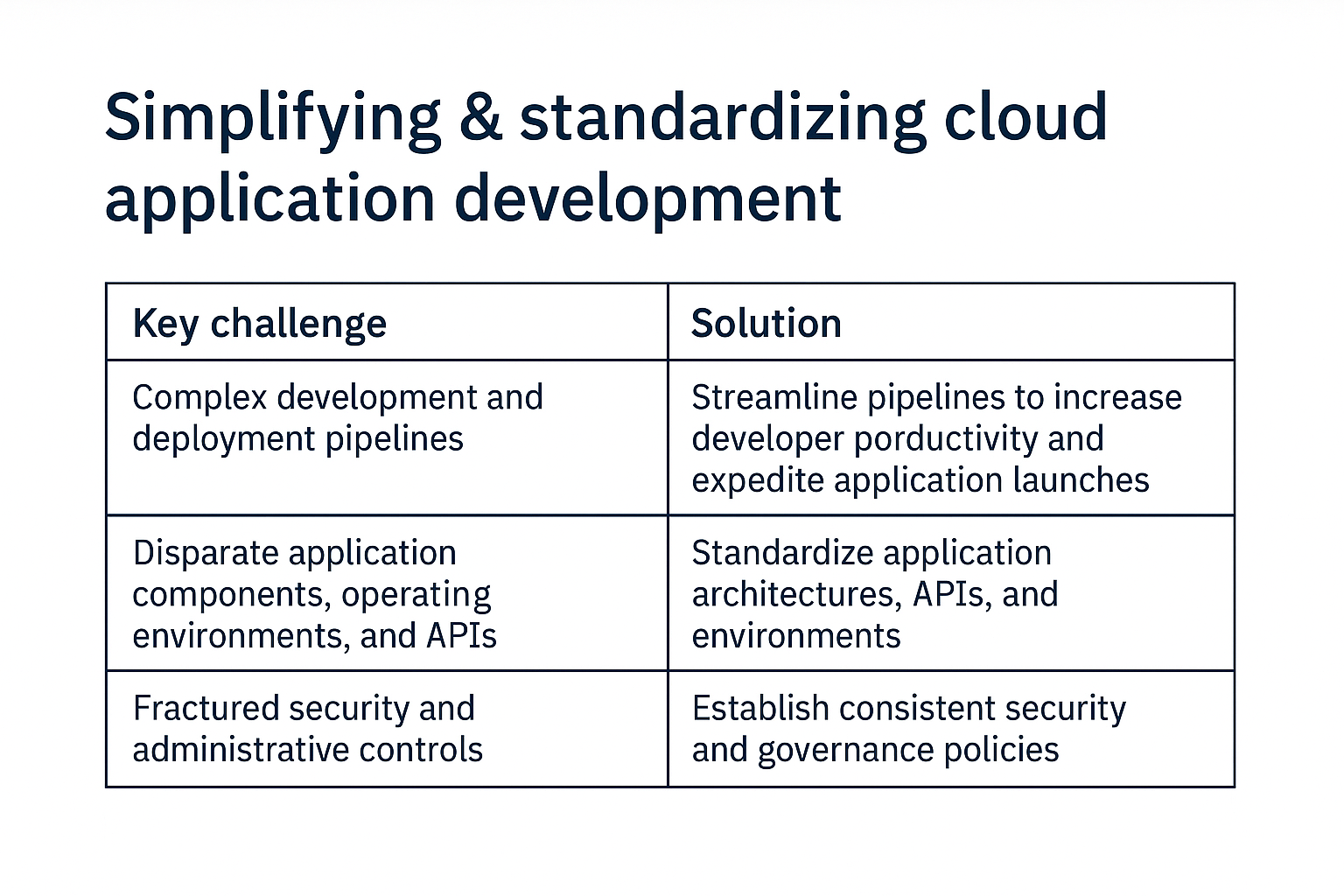
Common Modernization Challenges—and How to Avoid Them
Even well-planned modernization efforts can run into challenges. Being aware of common pitfalls ahead of time helps you avoid them or address them quickly.
Challenge 1: Trying to Modernize Everything at Once
Solution: Start with a focused set of high-impact workloads and build momentum. Early wins help gain support and prove the value of modernization.
Challenge 2: Treating Security as a Separate Project
Solution: Integrate security into every modernization step. Make sure identity, access, and monitoring are addressed alongside infrastructure and application changes.
Challenge 3: Migrating Legacy Apps Without Assessment
Solution: Perform a structured workload analysis before migrating. Decide whether each application should be rehosted, refactored, replatformed, replaced, or retired.
Challenge 4: Underestimating Cloud Costs
Solution: Use cost modeling before migration and adopt ongoing optimization practices. Align cloud usage with business value and regularly revisit configurations.
Challenge 5: Lack of Departmental Alignment
Solution: Involve stakeholders from across the organization, including finance, operations, and line-of-business leaders. Define shared goals and communicate progress clearly.
Real-World Modernization Scenarios
While every organization is unique, certain patterns appear across successful cloud modernization projects. The following scenarios illustrate how SMB and mid-market organizations can benefit.
Scenario 1: Manufacturing Firm Accelerates Innovation
A regional manufacturer struggled with aging on-premises servers running a critical ERP system. Performance issues affected production planning and reporting. By modernizing the ERP workload in the cloud, the company reduced its physical server footprint, improved application responsiveness, and enabled more reliable access for remote facilities.
Because infrastructure provisioning became faster and more consistent, the IT team could support new reporting tools and integration with other business systems, improving visibility across the supply chain and enabling faster decision-making.
Scenario 2: Healthcare Group Improves Security & Compliance
A healthcare organization dealing with sensitive patient information needed stronger security controls and more consistent compliance reporting. Through cloud modernization, they implemented centralized identity management, multi-factor authentication, modern endpoint protection, and cloud-based backup and recovery.
The organization gained better visibility into access patterns and security events, reduced manual compliance reporting effort, and strengthened resilience against ransomware and other cyber threats.
Scenario 3: Financial Services Firm Enables Hybrid Work
A financial services company wanted to support hybrid work without compromising security or regulatory requirements. By moving email and collaboration to a secure cloud platform, modernizing file services, and implementing device management, they created a consistent, secure work experience for employees regardless of location.
Employees could communicate more effectively with customers and colleagues, productivity increased, and IT support tickets related to remote access declined significantly.
Where to Begin: Book a Cloud Readiness Assessment
Cloud modernization does not have to be overwhelming. The key is to start with a clear understanding of your current environment and a roadmap that aligns with your business goals.
A Cloud Readiness Assessment from Cyber Advisors provides exactly that. The assessment typically includes:
- A detailed review of your infrastructure, applications, and security controls.
- Identification of quick wins and high-priority modernization opportunities.
- Cost and ROI analysis to help you plan investments.
- A phased roadmap that balances near-term results with long-term strategy.
- Guidance on security, compliance, and governance in the cloud.
Book a Cloud Readiness Assessment to roadmap quick wins and long-term value.