

Healthcare runs on trust, but fragmented systems, legacy tech, and tight budgets make security uneven. A cyber maturity assessment shows where you stand today versus where you need to be. This guide maps a clear, HIPAA-aligned path to measure, benchmark, and improve using NIST CSF—so you can protect patient safety, reduce downtime, and prove compliance progress.
Why Cyber Maturity Matters in Healthcare
In hospitals and provider networks, security outcomes are clinical outcomes. A ransomware incident doesn’t just encrypt files; it delays lab results, diverts ambulances, and forces staff into paper workflows. A structured, repeatable healthcare cybersecurity maturity assessment moves the program from reactive firefighting to proactive risk reduction.
- Patient safety & care continuity: Mature controls reduce the likelihood of EHR downtime, device disruption, or delayed care decisions.
- Ransomware exposure & downtime cost: Evidence-based prioritization channels investments into controls that materially lower likelihood and speed recovery.
- Regulatory risk (HIPAA/HITECH, state privacy): A defensible maturity model demonstrates “reasonable and appropriate” safeguards and continuous improvement.
- Executive accountability: Scoring and visual heat maps help non-technical leaders govern risk without translating from acronyms and logs.
Pick a Framework: NIST CSF + HIPAA
The most practical foundation for a cyber maturity assessment in healthcare is the NIST Cybersecurity Framework (CSF), mapped directly to the HIPAA Security Rule. This pairing gives you a common, business-friendly structure for your program while keeping you anchored to regulatory expectations for protecting PHI.
NIST CSF organizes cybersecurity into five core functions—Identify (ID), Protect (PR), Detect (DE), Respond (RS), and Recover (RC). Each function is broken down into categories and subcategories that describe what “good” looks like in practice, from asset inventories and identity management to incident response and disaster recovery. When these functions are mapped to HIPAA’s administrative, physical, and technical safeguards, you gain a clear, traceable line from day-to-day controls (like MFA, logging, and backup testing) to specific regulatory requirements.
For healthcare organizations, this approach keeps the assessment grounded in clinical reality. You can evaluate how well controls support care delivery and PHI protection, show auditors and executives how NIST CSF coverage aligns with HIPAA obligations, and use a single framework to drive both compliance and operational resilience.
NIST CSF ↔ HIPAA at a Glance
- ID: Asset management, governance, risk assessment, third-party risk — supports HIPAA 164.308(a)(1) and vendor management obligations.
- PR: IAM, data security, secure configurations, awareness & training, and protective tech — supports 164.308(a)(3)–(5) and 164.312(a)–(e).
- DE: Continuous monitoring, anomaly detection, and log management — supports 164.308(a)(1)(ii)(D).
- RS: Incident response plan, analysis, communication, and mitigation — supports 164.308(a)(6).
- RC: Recovery planning, backups, and business continuity — supports 164.308(a)(7).
For maturity measurement, use the CSF’s Implementation Tiers (1–4) to gauge capability from Partial to Adaptive. Augment with HHS 405(d) HICP Practices to reflect clinical realities, staff constraints, and medical device risks.
Define Scope, Stakeholders, & Data Flows
Before scoring controls, get the scope right. Healthcare environments are sprawling: EHR, imaging (PACS/VNA), lab systems, specialty apps, telehealth, biomedical/IoT devices, cloud services, HIE connections, payor links, and dozens of business associates. That scope should also account for mergers and acquisitions, affiliated physician groups, research environments, and any shadow IT that has grown up around clinical or revenue-cycle workflows.
Be explicit about what is in and out of scope—production vs. non-production, corporate vs. clinical networks, medical device segments, and critical third parties that host or process PHI. Document these boundaries up front so that when you start assigning maturity scores, everyone understands which systems, data flows, and facilities those scores actually represent.
What to Include
- Systems & apps: EHR, RIS/PACS, LIS, pharmacy, scheduling, billing, patient portals, care management, telehealth platforms.
- PHI data lifecycle: Where PHI is created, stored, accessed, transmitted, archived, and disposed of, including imaging and reports.
- Clinical operations: ED, surgery, inpatient units, ambulatory clinics, oncology, imaging centers, home health.
- Third parties: Business associates, cloud/SaaS providers, MSP/MSSP providers, RCM vendors, and HIE participants.
- Physical sites: Hospitals, clinics, data centers, shared services, and remote workforce.
Identify stakeholders early: CIO, CISO/security leader, privacy/compliance officer, CMIO/clinical champions, clinical engineering/biomed, networking, identity, and critical vendors. Use rapid whiteboard diagrams of data flows to anchor risk discussions and prioritize controls where PHI moves or clinical operations converge.
Method: How to Run a Maturity Assessment
A simple, defensible approach combines three evidence streams: documentation review, stakeholder interviews, and technical sampling. Together, these give you a 360° view of how controls are supposed to work, how people say they work, and how they actually operate in production.
Documentation review validates that policies, standards, and procedures exist, are current, and are aligned to NIST CSF and HIPAA requirements. Stakeholder interviews—across IT, security, clinical operations, and compliance—reveal how those policies are interpreted, where workarounds exist, and where clinical realities force deviations. Technical sampling then tests the truth on the ground by examining configurations, logs, and system behavior directly.
The goal is to verify not just that a control is “intended,” but that it’s implemented, enforced consistently, and operating day-to-day. In practice, that means linking each maturity score to concrete evidence across all three streams, so your assessment stands up to auditor scrutiny and executive review.
- Kickoff & scoping (Week 1): Confirm scope, critical systems, stakeholders, and milestones. Align on a risk register template and the scoring rubric.
- Evidence intake (Weeks 1–3): Collect policies, diagrams, inventories, logs, and tool reports. Ask for “how it really works” screenshots, not just policy PDFs.
- Interviews & workshops (Weeks 2–3): Validate how processes run across IT and clinical teams. Capture bottlenecks and exceptions.
- Control sampling (Weeks 2–3): Sample endpoints, identity groups, firewall rules, backup jobs, and SIEM use cases to confirm operation.
- Scoring & validation (Week 4): Apply the rubric, attach evidence, and hold a playback session to validate findings.
- Roadmap & executive readout (Week 5–6): Prioritize, cost, and sequence initiatives. Present the heat map, score deltas, and KPIs.
Tip: To keep momentum, publish interim wins (e.g., MFA coverage jump, backup restore test passed) while the assessment runs. Early progress builds trust.
Assess Current State Across NIST CSF Functions (ID, PR, DE, RS, RC)
For each CSF function, evaluate whether controls are formally designed, consistently implemented, and demonstrably operating effectively across both clinical and business environments. Look for evidence that controls are not only defined on paper, but are enforced in production, measured, and adjusted based on real-world performance. Below are practical checkpoints and example questions tailored to providers to help you validate maturity with clinicians, IT, and business stakeholders alike.
Identify (ID): Know What You Have & What Matters
- Asset & application inventory: A CMDB that includes servers, endpoints, biomedical devices, apps, versions, owners, and criticality. Detect shadow IT and unmanaged SaaS.
- Governance: Security steering committee, defined roles, policy lifecycle, and a risk acceptance process with expiration and review.
- Risk management: Enterprise risk register with threats, likelihood, impact (clinical, operational, financial), and mitigating controls mapped to CSF subcategories.
- Third-party risk: Vendor tiering, BAAs, pre-contract assessments, and continuous monitoring strategies for critical vendors.
Protect (PR): Prevent What You Can
- Identity & access: MFA for administrators and remote access; privileged account management; periodic access reviews; SSO and conditional access policies.
- Endpoint & server security: EDR on all feasible devices, full-disk encryption, secure images, and patch SLAs with executive visibility.
- Network defenses: Segmentation (especially for medical devices), next-gen firewalls, VPN/ZTNA, DNS filtering, and east-west traffic visibility.
- Data security: PHI classification, encryption at rest/in transit, DLP for high-risk flows, and hardened backups with immutability.
- Awareness & training: Role-based programs for clinicians and IT; phishing simulations with coaching and consequence management.
Detect (DE): Find the Signal Fast
- Telemetry: Centralized logs from EHR, domain controllers, firewalls, EDR, and critical apps. Time sync and retention aligned to legal/regulatory needs.
- SIEM/MDR/SOC: 24×7 monitoring, tuned use cases, and well-defined escalation with service-level targets for triage and response.
- Anomaly detection: Behavioral analytics for compromised credentials, unusual data movement, and medical device anomalies.
Respond (RS): Execute Under Pressure
- IR playbooks: Credential theft, ransomware, EHR outage, medical device compromise, and third-party breach scenarios.
- Communication: Internal/external notification, regulatory timelines, patient/provider messaging templates.
- Exercises: Tabletop with executives and clinical leadership at least annually, capturing improvement actions.
Recover (RC): Resume Care Quickly
- Backups: Immutability, offline copies, encrypted, with tested restores for Tier-1 systems; documented RTO/RPO.
- DR/BCP: Application criticality tiers, downtime procedures for clinical units, periodic failover tests and business resumption steps.
- Post-incident improvements: Root-cause analysis, corrective actions, and governance review with closure tracking.
Score, Benchmark, & Identify Risk-Based Gaps
Scoring transforms fragmented findings into an executive-ready picture that clearly shows where you are today and where you need to be. Use a 1–4 scale aligned to NIST CSF Implementation Tiers so your results are defensible and easy to explain:
Tier 1 – Partial: Ad hoc, reactive, heavily dependent on individual effort.
Tier 2 – Risk-Informed: Policies exist and are followed inconsistently; pockets of good practice.
Tier 3 – Repeatable: Standardized processes, consistently implemented and monitored.
Tier 4 – Adaptive: Data-driven, continuously improved based on threat intelligence and incidents.
Apply the 1–4 rating to each CSF subcategory in scope (e.g., ID.AM-1, PR.AC-3) and roll scores up by function (ID, PR, DE, RS, RC) and key domains (identity, EDR, backups, vendor risk, biomed/IoT). For every score, attach concrete evidence—policy references, standard operating procedures, screenshots, sample tickets, configuration exports, or tool reports—so that anyone reviewing the assessment can see exactly why a control landed at a given tier. This turns the scoring from opinion into an auditable record that can stand up to regulators, internal audit, and the board.
Evidence-Backed Scoring Rubric
- Policy present? Documented and approved within the past 12–24 months.
- Implemented? Deployed across in-scope systems and identities; exceptions documented.
- Operating? Logs, metrics, or tickets show how the control works day-to-day.
- Measured? KPI are defined and reviewed in governance; actions are taken when thresholds are missed.
Heat Map: Likelihood × Impact
Build a simple 3×3 or 5×5 matrix listing top risks (e.g., credential theft, device compromise, EHR downtime). Map each to current maturity and mitigating controls. Red cells, where low maturity meets high impact, drive the roadmap.
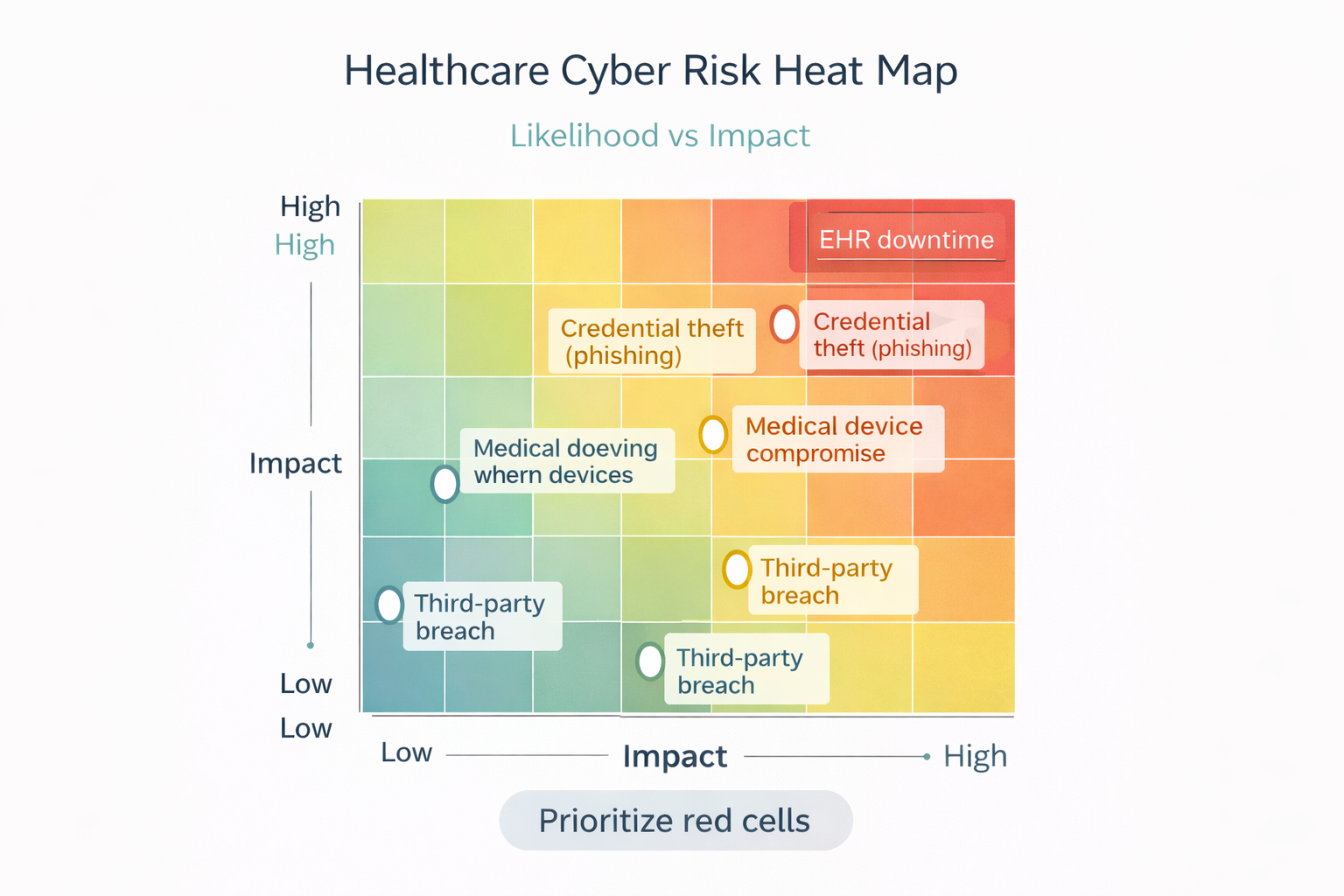
A single picture communicates priority better than a 50-page report.
Benchmarking Options
Compare your scores to prior internal assessments, peer averages (if available), or target states set by risk appetite. Trend lines are more persuasive than point-in-time rankings—boards want to see direction and velocity.
Prioritize a 12–18 Month Roadmap and Metrics
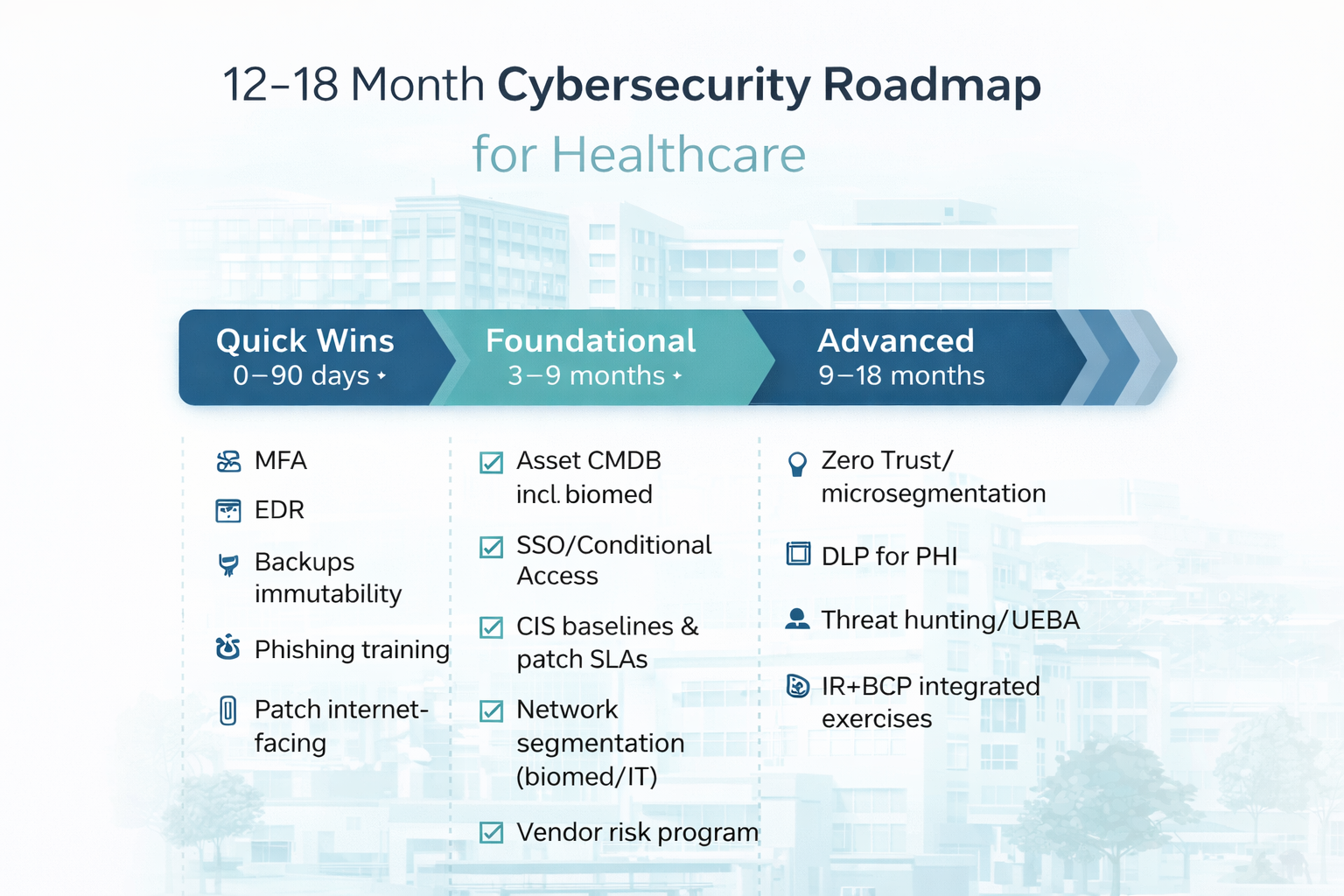
A great assessment ends with a prioritized, costed plan that executives can understand and fund. Structure your roadmap across three lanes: quick wins, foundational controls, and advanced capabilities. In each lane, estimate one-time and recurring costs (licensing, services, FTE effort), identify owners, and set realistic timelines so the plan can plug directly into budget and capital cycles.
Quick wins should focus on controls you can deploy in 30–90 days that measurably reduce likelihood or impact (e.g., MFA coverage, backup hardening, critical patching). Foundational initiatives build the core program over 3–9 months—centralized identity, asset inventory including biomed, network segmentation, and vendor risk management. Advanced capabilities extend maturity over 9–18 months with Zero Trust concepts, automation, and deeper detection/response.
For every initiative, tie it explicitly to a business outcome and a KPI so leaders see exactly what they’re buying: reduced downtime hours, lower incident likelihood, stronger HIPAA posture, or faster recovery. Examples: “Increase MFA coverage to ≥98% of admins,” “Meet 14-day SLA for critical patches on Tier-1 systems,” or “Achieve quarterly tested restores for all Tier-1 applications.” When your roadmap is framed in terms of outcomes, metrics, and cost, it becomes an operational plan—not just a security wish list.
Quick Wins (0–90 Days)
- Enforce MFA on remote access and privileged accounts; close obvious gaps (unused legacy protocols, default accounts).
- Deploy or tune EDR on all feasible endpoints and critical servers; validate alert routing to SOC/MDR.
- Harden backups with immutability and offline copies; perform targeted restores to confirm RTO/RPO.
- Run a focused phishing awareness burst for high-risk roles (ED, revenue cycle, IT admins, leadership) with coaching.
- Patch internet-facing systems with exploitable vulnerabilities; establish emergency change playbooks.
Foundational (3–9 Months)
- Stand up a trustworthy asset/CMDB, including medical devices; assign ownership and business criticality.
- Centralize identity (SSO/Entra ID), implement conditional access and least privilege, and automate joiner/mover/leaver processes.
- Adopt secure configurations (CIS baselines) and set patch SLAs with dashboard visibility for executives.
- Implement network segmentation for biomed and administrative zones; add east-west monitoring.
- Formalize vendor risk reviews prior to contract and annual attestations for critical vendors; track BAAs.
Advanced (9–18 Months)
- Progress toward Zero Trust: continuous verification, microsegmentation, device posture checks.
- Enable DLP for regulated PHI flows where feasible; instrument high-risk exfiltration paths.
- Expand threat hunting, UEBA, and automated containment for high-confidence detections.
- Evolve IR/BCP into integrated resilience exercises, including clinical downtime procedures and third-party breach scenarios.
Operational KPIs & Governance
Measurement sustains maturity. Select a concise set of KPIs that directly reflect risk reduction and resilience—ideally 8–12 metrics tied to your highest-value systems and workflows. Keep the list short, visible, and actionable: place it on a single-page dashboard that security, IT, and operations leaders can review at a glance, and ensure every metric has a clear owner and threshold.
Operationalize review cadences so metrics drive decisions, not just reporting. Review KPIs monthly in a security steering committee to adjust tactics and clear roadblocks. Roll them up quarterly for executives to confirm funding, reprioritize the roadmap, and validate progress against business goals. Annually, brief the board on trends, major risk movements, and how maturity improvements have reduced downtime, strengthened HIPAA posture, and improved overall resilience.
- Patch Compliance: % of critical systems meeting SLA (e.g., 14 days) and backlog trend.
- MFA Coverage: % of users/admins with MFA enforced; gaps by application and method.
- Phishing Resilience: Click/fail rates, report-to-detect time, and coaching completion.
- MTTD/MTTR: Mean time to detect/respond for priority incidents.
- Backup Success & Restores: Backup success rate; last tested restore date by Tier-1 system.
- Third-Party Reviews: % of critical vendors with current security assessment and BAAs on file.
Align KPIs to incentives. Publish trends, not just snapshots. Celebrate improvements and call out stalled areas with an action owner and date.
Common Pitfalls & How to Avoid Them
- Paper maturity: Policies exist but aren’t enforced. Fix by sampling configs and tickets to validate operation.
- Tool sprawl: Overlapping products without an operating model. Rationalize and integrate around well-defined processes.
- Ignoring clinical workflows: Controls that slow clinicians will be bypassed. Co-design with nursing/physician champions and pilot in real settings.
- Under-scoped biomed/IoT: Legacy devices become backdoors. Inventory, segment, and monitor passively; pursue vendor patch SLAs in contracts.
- One-and-done assessments: Maturity is a program, not a project. Reassess quarterly and after major changes.
Medical Device & IoT Security Considerations
Biomedical devices complicate maturity scoring. Many run legacy operating systems, are vendor-managed, or cannot be patched on clinical schedules, which means traditional endpoint and vulnerability metrics don’t tell the full story. A practical approach treats these assets as a distinct risk domain: prioritize compensating controls and clear contract language, align scoring to what you can measurably enforce (segmentation, access control, monitoring, and downtime procedures), and factor vendor dependency and end-of-support status directly into your risk register and capital planning.
- Inventory & classification: Model, OS, location, clinical criticality, network segment, support status, and vulnerability exposure.
- Risk-based segmentation: Isolate by modality and function; restrict lateral movement; enforce least-privilege network rules.
- Compensating controls: Tighten ACLs, virtual patching/IPS, harden credentials, remove default accounts, and monitor behavior.
- Procurement security: Bake requirements into contracts: vulnerability disclosure, patch SLAs, hardening guides, logging compatibility, and secure configuration baselines.
- Downtime procedures: Ensure units have clear manual procedures if a device or modality must be taken offline for safety.
Third-Party & Vendor Risk
Your risk surface extends into your broader ecosystem. Mature programs treat business associates as an extension of their own environment and hold them to the same standard of control, design, implementation, and monitoring. That means aligning vendor security requirements to NIST CSF and HIPAA, validating that minimum controls are actually enforced (not just promised in contracts), and folding third-party performance and incidents into your regular risk reviews.- Pre-contract diligence: Require BAAs; review security questionnaires, audit reports, and breach history; set minimum controls (MFA, encryption, logging).
- Tiering: Classify vendors by data sensitivity and operational criticality; tailor assessment depth accordingly.
- Continuous monitoring: For critical vendors, collect incident notifications, pen test summaries, and SLA performance at least quarterly.
- Exit planning: Ensure secure data return/destruction and clear off-boarding steps.
Incident Response, DR/BCP, & Tabletop Testing
Playbooks tested under pressure save minutes when minutes matter—minutes that can mean the difference between delayed care and safe continuity of operations. A mature posture doesn’t just document incident response, disaster recovery, and business continuity in separate silos; it tightly unites IR and continuity planning with well-rehearsed clinical downtime operations. That means clear decision trees for diverting patients, switching to paper, escalating to command centers, and communicating with clinicians and leadership—so when systems fail, teams know exactly what to do, in what order, and how to resume safe care as quickly as possible.
- IR playbooks: Credential theft, ransomware, EHR outage, medical device compromise, third-party breach.
- Tabletops: Simulate real decisions: diverting patients, paper workflows, public statements, and regulator notifications.
- Forensic readiness: Centralized logging, time synchronization, snapshots, and chain-of-custody procedures.
- Recovery testing: Regular restores and failovers for Tier-1 apps; measure time until safe care resumes.
Making the Business Case for Investment
Executives fund clarity, not jargon. Translate maturity findings into a narrative that starts with current risk, shows the operational impact in terms they already track, and ends with specific, funded actions. Connect each recommendation to a clear financial and clinical outcome: how much unplanned downtime you expect to avoid, how it improves your HIPAA posture, how it reduces the likelihood or blast radius of a ransomware event, and how quickly you can safely resume care if something does go wrong.
Use simple visuals—trend lines, before/after heat maps, and a one-page scorecard—to show how a move from Tier 1 to Tier 3 in key domains (identity, backups, monitoring, medical devices, and third-party risk) translates into fewer outages, faster recovery, and lower incident response spend. Where possible, quantify the change: estimate reduced staff overtime during downtime events, fewer diversion hours, and fewer emergency change windows.
The goal is to make the funding decision feel like any other capital or operational investment: a clear, defensible trade between today’s exposure and tomorrow’s resilience. When executives see that every dollar is tied to reduced downtime, a stronger compliance posture, and measurable risk reduction, the maturity roadmap becomes a business improvement plan—not just a security request.
Structure Your Business Case
- Problem statement: “MFA coverage is 62% across admins; phishing fail rate averaged 8%; backup restores have not been tested in 9 months.”
- Risk/impact: Quantify the cost of downtime per hour for EHR and modalities; incorporate patient safety impacts and reputational risk.
- Solution & cost: MFA + PAM rollout, SOC/MDR expansion, biomed segmentation, privileged workstation controls.
- Outcome & KPI: Target maturity uplift (Tier 1 → 3), expected incident likelihood reduction, and KPI goals (MFA ≥ 98%, MTTD < 15 min, restore test quarterly).
- Timeline: Phase by quarter with change-management support for clinical adoption.
Tip: Pair each initiative with a one-sentence clinical benefit (e.g., “Reduces the chance that a compromised admin account halts medication order workflows.”)
Key Takeaways
- Use NIST CSF mapped to HIPAA to standardize your cyber maturity assessment.
- Include clinical workflows and medical devices in scope from day one.
- Score with evidence and visualize gaps in a heat map that executives immediately understand.
- Tie priorities to patient safety, downtime, and compliance risk—not checklists.
- Build a 12–18 month roadmap with costed initiatives and clear owners.
- Track progress via KPIs (patch SLAs, phishing fail rate, MTTD/MTTR, MFA coverage).
- Reassess quarterly and after material changes to sustain momentum.
FAQ: Evaluating Cyber Maturity for Healthcare Organizations
How long does a maturity assessment take?
For a single-hospital system with a moderate application footprint, plan for 4–6 weeks end-to-end: kickoff and scoping (1 week), evidence collection and interviews (2–3 weeks), scoring and validation (1 week), and roadmap development/review (1–2 weeks). Larger networks may stage by facility or business unit.
Who needs to be involved?
Core team: CIO, CISO/security lead, privacy/compliance, infrastructure, apps, networking, identity, and clinical engineering/biomed. Include operational leaders from ED, perioperative services, and imaging to ensure recommendations fit real workflows.
Is a maturity assessment the same as a HIPAA risk analysis?
They’re complementary. HIPAA risk analysis identifies risks to PHI and appropriate safeguards. A maturity assessment measures capability against a framework (NIST CSF) and operationalizes improvement. Together, they create a defensible, repeatable program.
What if we can’t patch certain medical devices?
Use compensating controls: segment devices, tighten ACLs, apply virtual patching/IPS, strengthen authentication where possible, monitor behavior, and plan for replacement of end-of-support devices in the capital cycle.
How often should we reassess?
Quarterly light-touch updates maintain momentum and trendlines. Perform a full reassessment annually or after major changes (acquisitions, EHR upgrades, cloud migrations, or significant incidents).
What’s the fastest way to improve our score?
Expand MFA, harden privileged access (PAM), close critical patch backlogs, validate backup/restore reliability, and ensure 24×7 monitoring of high-value systems. These deliver immediate risk reduction and visible score improvements.