

2026 Cybersecurity Trends Every SMB Must Prepare For
SMB attack surfaces expanded in 2026—more SaaS, more identities, and more partner dependencies. This guide distills the trends that matter and shows how to turn them into action, fast. You’ll leave with a pragmatic plan, measurable KPIs, and a 90/180-day roadmap aligned to NIST CSF 2.0.
SMB and mid-market leaders who need measurable risk reduction without slowing the business.
A 2026-ready plan: identity-first security, SaaS hardening, ransomware resilience, and outcome KPIs you can defend.
30–90 days for first wins; 6 months to institutionalize foundations and reporting
Need a fast, objective security roadmap?
Request a Cyber Maturity Review to baseline your program, prioritize gaps, and map quick wins to NIST CSF 2.0.
What changed for SMBs in 2026
The 2026 environment is less about shiny tools and more about proof. Insurance markets tightened; customers and partners added cyber clauses to their contracts; and executives expect a handful of metrics showing security is improving quarter over quarter. Three shifts define the landscape:
- Identity and data outpace the perimeter. With hybrid work and SaaS-first stacks, identity is your control plane, and data is the crown jewel. Controls that bind access to user, device, and context shut down the most common attacks.
- SaaS sprawl created hidden risk. Shadow apps, abandoned accounts, and permissive defaults expose sensitive data. SSPM and disciplined ownership transform SaaS from a blind spot into a managed surface.
- Proof beats promises. NIST CSF 2.0 alignment, tabletop-tested incident plans, and clear KPIs now underpin budgets, insurance renewals, and sales diligence.
TOP 7 TRENDS TO WATCH
The following are the top 7 trends to watch in 2026.
1) IDENTITY-FIRST SECURITY
More incidents begin with valid credentials than exotic exploits. In 2026, the single most valuable investment for SMBs is to mature identity controls across the workforce and third-party users.
- Phishing-resistant MFA (passkeys/platform authenticators/security keys) for staff, vendors, and admins.
- Conditional access by device health, location, and risk; require compliant devices for privileged tasks.
- Privileged access hygiene (separate admin identities, JIT elevation, hardware-keyed break-glass).
- Lifecycle automation (fast offboarding, quarterly access recertification).

2) AI-enhanced phishing & deepfakes
Generative AI makes malicious messages and synthetic voices/video sound like your leaders, suppliers, and customers. Defenses must blend technology with simple, reliable verification.
- Teach “Pause • Verify • Proceed” for payments, bank changes, and urgent approvals; codify it in policy.
- Instrument email (impersonation detection, link isolation) and enforce SPF/DKIM/DMARC.
- Harden collaboration tools with MFA, session limits, and monitoring for suspicious links/files.
- Use behavioral analytics to flag accounts acting out of character (e.g., impossible travel, unusual data pulls).
3) Ransomware monetization shifts
Ransomware operators blend encryption with data theft and supply-chain pressure. Even if you restore quickly, they threaten to leak sensitive data or contact your customers.
- Immutable backups with tested restores; segmentation for critical workloads.
- EDR/XDR that isolates devices quickly; pre-authorize emergency actions with leadership and legal.
- Tabletop legal/comms playbooks to make the first 24 hours decisive, not chaotic.
4) SaaS sprawl & data exposure
Configuration debt and orphaned accounts leak data. Shadow apps multiply risk without central oversight.
- Discover and classify sanctioned + shadow apps; assign owners and data categories.
- Enforce SSO/MFA, tighten external sharing, expire guest access, and review admin roles quarterly.
- Adopt SSPM to continuously scan and remediate misconfigurations.
- Apply labels, retention, and DLP to where sensitive files actually live.
5) Endpoint protection maturity
Endpoints remain the front door. Mature programs combine hardened baselines, rapid patching, isolation-capable EDR, and the removal of standing local admin rights.
- Golden images, disk encryption, MDM enforcement; block unsupported OS versions from corporate access.
- EDR with isolation/rollback; move to audited elevation workflows instead of local admin.
- Mobile controls (app protection, screen locks, jailbreak/root checks) where corporate data appears.
6) Third-party risk & contracts
Customers demand assurance; partners and insurers expect minimum controls and fast incident communication.
- Tier vendors by criticality and data sensitivity; apply proportional diligence.
- Include minimum controls in contracts (MFA, encryption, logging, notification windows, secure disposal).
- Collect evidence (attestations, screenshots, policy links) instead of long essays.
7) Cyber insurance requirements in 2026
Underwriters tie premiums to control maturity and response readiness. Treat the questionnaire like a project plan and maintain reusable evidence.
- Close non-starters (MFA, EDR, immutable backups, PAM) before renewal.
- Store proof (policy links, screenshots, test results) in a central repository.
- Exercise notification timelines and breach-coach workflows in tabletops.
Budget reality: do more with less
Most SMBs won’t see a budget windfall this year. Winning teams simplify stacks, squeeze value from platforms they already own, and show outcomes. Use the levers below to reduce cost and complexity while improving posture.
| Cost lever | How it helps | 2026 tip |
|---|---|---|
| Vendor tiering | Cuts tool overlap and contract sprawl. | Consolidate into strategic platforms; reserve point tools for true gaps only. |
| License hygiene | Eliminates zombie licenses and unused premium SKUs. | Quarterly true-ups; auto-deprovision on departures. |
| Automation | Reduces MTTR and manual toil. | Automate JML access, phishing triage, low-risk EDR actions, and SaaS account cleanup. |
| Risk-based roadmaps | Fund the highest-impact gaps first. | Align to NIST CSF 2.0 and estimate incident cost avoided for top initiatives. |
From trends to action: 90/180-day plan
Translate trends into a concrete plan your team can run. The roadmap below balances quick wins with foundational improvements and is sized for typical SMB constraints.
First 90 days (quick wins)
- Enable phishing-resistant MFA for admins and high-risk groups; roll out org-wide with number-matching.
- Block legacy auth; enforce conditional access; require compliant devices for privileged actions.
- Turn on immutability; verify offline backups; perform a monthly restore drill for a critical app.
- Instrument email and set DMARC to enforcement; add impersonation detection.
- Inventory SaaS; deactivate stale accounts/tokens; create an owner registry.
- Run a cross-functional incident tabletop; assign owners to the top five gaps and fix within 30 days.
Next 180 days (foundations)
- Privileged access program with JIT elevation and time-boxed roles; protect break-glass with hardware keys and quarterly tests.
- Endpoint maturity: golden images, encryption/MDM everywhere, remove standing local admin rights, and block unsupported OS versions.
- Data governance for collaboration suites: labels, retention, DLP, and exfil monitoring on risky channels.
- Vendor tiering, control language in contracts, and a central evidence repository.
- KPI scorecard mapped to NIST CSF 2.0 functions and reviewed quarterly at the exec level.
Mini-case: a 220-employee services firm
After migrating to phishing-resistant MFA and enforcing conditional access, the firm saw phishing-driven password resets fall by 68% and incident response time drop from hours to minutes. Inventorying SaaS identified 41 unsanctioned apps; deactivating stale accounts and enforcing SSO/MFA closed noticeable gaps. Within 120 days, they met insurer control expectations, renewed at flat premiums, and produced a concise CSF-mapped scorecard for their board.
Map work to NIST CSF 2.0
CSF 2.0 gives you a common language. Use it to justify the budget, align teams, and keep the scope under control. Think of the functions as a portfolio view of your program:
| Function | What leadership hears | Example 2026 initiative |
|---|---|---|
| Govern | We manage cyber risk like any other business risk. | Policy set, risk owners, CSF-mapped roadmap, and KPI scorecard. |
| Identify | We know what we have and what matters most. | Asset inventory, including SaaS and data classification; vendor tiering. |
| Protect | We prevent the most likely attacks. | MFA, PAM/JIT, endpoint hardening, DLP, and secure configurations. |
| Detect | We spot suspicious behavior quickly. | MDR/XDR with tuned alerts; identity anomaly detection. |
| Respond | We act decisively under pressure. | IR playbooks, legal/comms runbooks, executive decision trees. |
| Recover | We get back to business fast. | Immutable backups, restore drills, RTO/RPO tracked and improving. |
Governance: who owns the risk?
Security is a team sport. Clear roles and lightweight rituals keep momentum high and decision time low.
Executive team
- Set risk appetite; approve budgets tied to explicit scenarios.
- Designate an executive incident sponsor and spokesperson.
- Review a 6–8 KPI scorecard quarterly; resolve cross-team conflicts.
IT & Security
- Own identity, endpoint, and data safeguards; keep evidence current.
- Lead vendor tiering and contract control language.
- Tabletop playbooks; tune detections to reduce noise, not coverage.
Finance & Legal
- Align investments to risk and insurance readiness.
- Embed verification steps for payments and vendor onboarding.
- Co-lead breach notification and customer communication drills.
Departments
- Own app choices and data; assign app admins and backups.
- Ensure training completion and follow verification playbooks.
- Participate in access recertification and vendor reviews.
Outcome KPIs & reporting scorecard
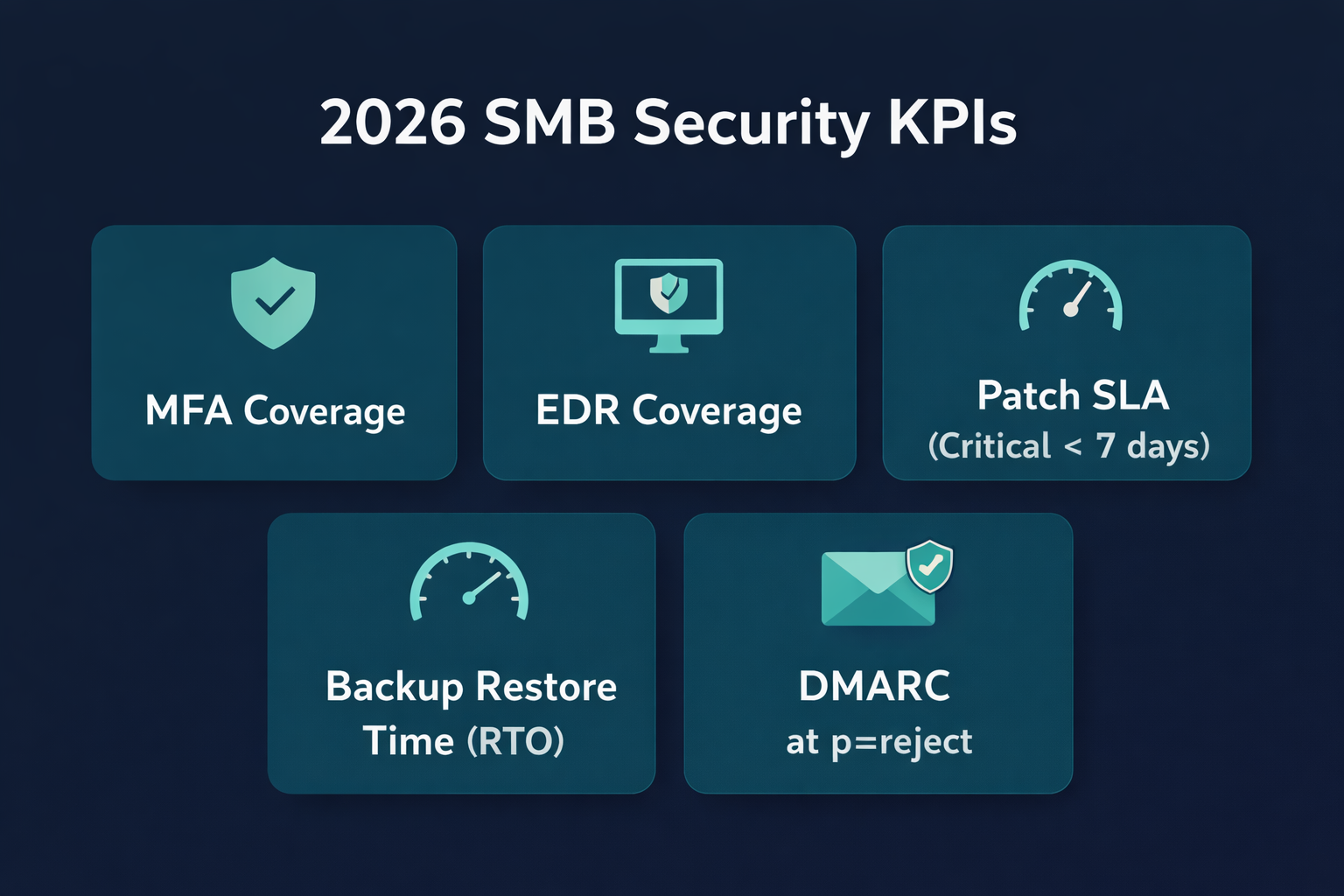
Boards don’t want endless dashboards; they want trend lines that tie to risk. Keep your scorecard small and defensible:
- MFA coverage (% workforce on phishing-resistant methods)
- EDR coverage (% endpoints active and reporting)
- Phishing report-to-remediate time (campaigns closed < 4 hours)
- Patch SLA adherence (critical within 7 days; exceptions documented)
- Backup restore time (RTO) (verified for a critical app monthly)
- SaaS misconfigurations (count and severity trending down)
- Vendor assurance status (% Tier-1 vendors with current artifacts)
Reporting rhythm
- Monthly: Ops report with KPI deltas, notable incidents, and remediation status.
- Quarterly: Executive scorecard review, CSF-mapped roadmap update, and 90-day priorities.
- Annually: Insurance renewal evidence pack and customer diligence refresh.
Essential playbooks & checklists
PHISHING VERIFICATION PLAYBOOK
- Pause — No approvals or payments from email/chat alone.
- Verify — Use a trusted callback or new thread to a known contact; never reply in-thread.
- Proceed — Only after confirmation from a second factor (voice/video or approved workflow).
Ransomware restore drill checklist
- Pick a critical app; restore from immutable backups to a clean environment slice.
- Measure RTO and data integrity; document steps and blockers.
- Update runbooks; fix any dependency gaps uncovered during the drill.
SaaS hardening checklist
- Enforce SSO + MFA for Tier-1/2 apps; remove local authentication where possible.
- Review external sharing/guest access; require expiration dates for guest links.
- Audit admin roles; ensure least privilege and separation of duties.
- Turn on anomaly alerts and session timeouts; log to a central destination.
Privileged access quick start
- Separate admin identities; disable interactive sign-in for service principals where feasible.
- Implement JIT elevation; log approvals and time-box privileged sessions.
- Protect break-glass accounts with hardware keys; test access quarterly.
Common pitfalls in 2026 (& how to fix them)
Pitfall #1: Tool sprawl justified as “defense in depth”
Depth comes from layered controls, not overlapping products. Fix by tiering vendors, consolidating where coverage is sufficient, and documenting compensating controls for true gaps.
Pitfall #2: MFA coverage that isn’t phishing-resistant
SMS codes and push-accept-spamming remain vulnerable. Move to passkeys/platform authenticators and enable number-matching. Track coverage as a KPI.
Pitfall #3: Backups without restore evidence
If you haven’t restored it, you don’t have it. Run monthly drills for a critical app and verify RTO/RPO against your policy.
Pitfall #4: SaaS discovered, but not owned
Discovery is step one. Assign data owners, app admins, and review dates so decisions don’t stall. Record where sensitive data lives and why.
Pitfall #5: Playbooks that don’t survive contact with reality
Tabletop with the real decision-makers. Time your first-day actions and adjust roles to remove bottlenecks. Practice notification flows and internal comms.
FAQs
Where should SMBs start?
Identity, email, and endpoints. If those are strong, most opportunistic attacks fail. Then expand into backups, data governance, and vendor risk based on your data sensitivity and ecosystem.
Do we need “zero trust” to be complete?
Zero trust is a principle, not a product. Focus on steady progress: phishing-resistant MFA, conditional access, verified devices, least privilege, and segmentation for critical systems.
Which metrics should the board see?
Pick six to eight outcome measures: MFA and EDR coverage, phishing report-to-remediate time, patch SLA adherence, backup restore time, SaaS misconfigurations, and vendor assurance status.
How do cyber insurance requirements influence the roadmap?
Treat the questionnaire as a gap list. Close non-starter controls first, then maintain a reusable evidence folder to speed up renewals and customer audits.
How do we keep momentum with a small team?
Run a monthly “spend and risk” cycle: license reclamation, backup drills, SaaS hardening, and a short digest of wins and risks. Automate anything you do more than twice.
Why Cyber Advisors for 2026 SMB Cybersecurity
Cyber Advisors helps SMB and mid-market organizations turn best practices into measurable outcomes. Our team brings hands-on expertise in identity-first security, SaaS hardening, endpoint maturity, ransomware resilience, incident readiness, and risk-based program design aligned to NIST CSF 2.0. We meet you where you are—simplifying stacks, prioritizing quick wins, and building the evidence that boards, customers, and insurers expect. Whether you need a rapid gap assessment, help operationalizing controls, or a pragmatic roadmap the whole business can support, we translate security into results without slowing the work your people do every day.