

Manufacturing leaders rarely ask, “Are we perfectly secure?” The real question is, “How resilient are we when something goes wrong—and how quickly can we recover without stopping production?”
That’s what cybersecurity maturity measures: how consistently and effectively your organization identifies risk, protects critical operations, detects threats, responds under pressure, and restores normal business when disruption happens. In manufacturing, maturity must reflect both IT (email, endpoints, servers, cloud apps) and OT (PLCs, HMIs, SCADA, industrial control networks)—because downtime, safety, and quality are always on the line.
This guide walks you through a practical, manufacturing-specific maturity assessment you can run internally. You’ll get:
- A simple maturity scoring model (1–5)
- Eight domains tailored for manufacturing IT/OT environments
- “What good looks like” for each domain at higher maturity levels
- A 30/60/90-day roadmap to turn findings into action
If you’re responsible for operations, technology, or risk in a plant environment, this is the framework you can use to evaluate where you stand today—and what to prioritize next.
What “cyber maturity” means in a manufacturing environment
Cybersecurity maturity is the degree to which your security practices are repeatable, measurable, and continuously improved. It’s not a single tool you buy. It’s how well your organization executes the basics—consistently—across people, process, and technology.
In manufacturing, maturity has a different center of gravity than many office-only businesses. You’re balancing:
- Availability: production uptime is critical, and unplanned outages can be expensive in minutes.
- Safety and quality: disruptions can affect safety outcomes, product integrity, and regulatory exposure.
- Legacy systems: older OS versions, vendor-managed platforms, and hard-to-patch OT devices are common.
- IT/OT convergence: business systems and plant floor networks are increasingly connected.
- Third-party access: OEMs and integrators often require remote access for maintenance and troubleshooting.
Mature manufacturing security programs aren’t “perfect.” They are well-governed, well-instrumented, and well-practiced—especially around incident response and recovery.
Why a standard IT assessment alone misses OT risk
Many organizations do a traditional IT risk assessment and assume they’re “covered.” But OT brings constraints and risks that don’t show up in typical IT checklists:
- Patching limitations: you may not be able to patch or reboot a control system on demand.
- Flat networks: IT and OT may still be connected with minimal segmentation.
- Shared accounts: local admin passwords and shared credentials are common on production systems.
- Remote access sprawl: unmanaged VPNs, remote desktop tools, and vendor accounts are frequent attack paths.
- Limited monitoring: visibility into OT traffic and endpoints is often weak or nonexistent.
A manufacturing maturity assessment must evaluate both IT and OT realities—without recommending changes that put production at risk.
A practical framework: NIST CSF (with an OT overlay)
To keep this assessment practical, use the core ideas of the NIST Cybersecurity Framework (CSF)—Identify, Protect, Detect, Respond, and Recover—and apply them to manufacturing with an OT overlay inspired by industrial best practices (such as segmentation by zones and tightly controlled conduits).
You don’t need to turn this into a compliance exercise. The goal is to score maturity honestly, identify gaps, and build a roadmap that reduces downtime risk.
The five NIST functions (manufacturing interpretation)
- Identify: Do you know what you have (IT + OT), what’s critical, and where the real risks are?
- Protect: Are access, segmentation, and hardening in place to prevent disruption?
- Detect: Will you know quickly when something abnormal happens—especially in OT?
- Respond: Can your team contain an incident without chaos, confusion, or unsafe decisions?
- Recover: Can you restore operations fast enough to meet your production and business requirements?
The maturity model below maps to these functions through eight domains that are easy to score and act on.
The manufacturing cyber maturity scoring model (1–5)
Use this 1–5 scale to score each domain. The goal isn’t to “get all 5s.” The goal is to score accurately and prioritize improvements that reduce business risk.
- 1 — Ad Hoc: Practices are inconsistent, reactive, undocumented, or dependent on individuals.
- 2 — Repeatable: Basic practices exist and are performed similarly, but coverage is incomplete.
- 3 — Defined: Standard processes are documented, assigned, and consistently followed across the scope.
- 4 — Managed: Practices are measured, monitored, tested, and improved using metrics and reviews.
- 5 — Optimized: Continuous improvement is embedded; controls are integrated and automated where appropriate, and are tightly aligned with business and plant objectives.
How to use it: Score each domain from 1–5 based on evidence. Then identify the 2–3 domains with the biggest risk impact (often segmentation, vendor access, monitoring, and recovery).
Tip: If you’re unsure between two scores, choose the lower one unless you can provide consistent evidence across your scope (plants, lines, and systems included).
Step-by-step: How to run a manufacturing cyber maturity assessment
Step 1 — Define scope (plants, lines, and crown jewels)
Start small enough to finish, but large enough to matter. A good initial scope is:
- One plant (or one critical production line)
- Key supporting systems (ERP/MES interfaces, remote access, backups)
- Representative OT assets (PLCs, HMIs, engineering workstations, historians)
Identify “crown jewels”—systems and processes that, if disrupted, cause the most operational impact. Examples include:
- MES/SCADA and production scheduling systems
- Engineering workstations used for programming PLCs
- Plant network connectivity to corporate IT
- Remote access solutions used by vendors/OEMs
- Backup repositories and recovery tooling
Step 2 — Build a combined IT/OT asset inventory
Maturity scoring fails if the inventory is incomplete. Build a baseline inventory that includes:
- IT: endpoints, servers, network devices, identity systems, cloud apps, email platforms
- OT: PLCs, HMIs, SCADA servers, historians, industrial switches, engineering laptops, remote I/O, safety systems (as applicable)
At minimum, capture:
- Owner (IT, OT, vendor, shared responsibility)
- Location (plant/line/cell) and criticality
- OS/firmware version, where feasible
- Network connectivity (what it talks to and how)
- Remote access dependencies
Step 3 — Score eight maturity domains (1–5)
Use the domains below. For each domain, review evidence and score 1–5. The next section includes “what good looks like” by domain.
- Governance & Risk Management
- Asset Management & Visibility (IT/OT)
- Identity & Access Management (including vendor access)
- Network Segmentation & Architecture (zones/conduits)
- Vulnerability & Patch Management (including compensating controls)
- Security Monitoring & Detection
- Incident Response & Ransomware Readiness
- Backup, Recovery & Operational Resilience
Step 4 — Validate with evidence (not just policy)
Manufacturing environments often have policies that say the right things and realities that look different on the floor. Use evidence checks such as:
- MFA enforcement screenshots and conditional access policies
- Firewall rules or segmentation diagrams showing IT/OT separation
- Remote access logs and vendor account reviews
- Backup job success logs and restore test results
- EDR/MDR coverage reports and alert/ticket samples
- Vulnerability scan results (IT) and OT discovery outputs (as feasible)
Step 5 — Summarize the score & prioritize risk reduction
Add up scores and look at the pattern. In manufacturing, a “good enough” IT maturity score can still mask major risks in OT. Focus on the domains that most directly reduce:
- Likelihood of disruption (segmentation, access controls, hardening)
- Time to detect (monitoring, logging)
- Time to contain (response preparedness)
- Time to restore production (recovery readiness)
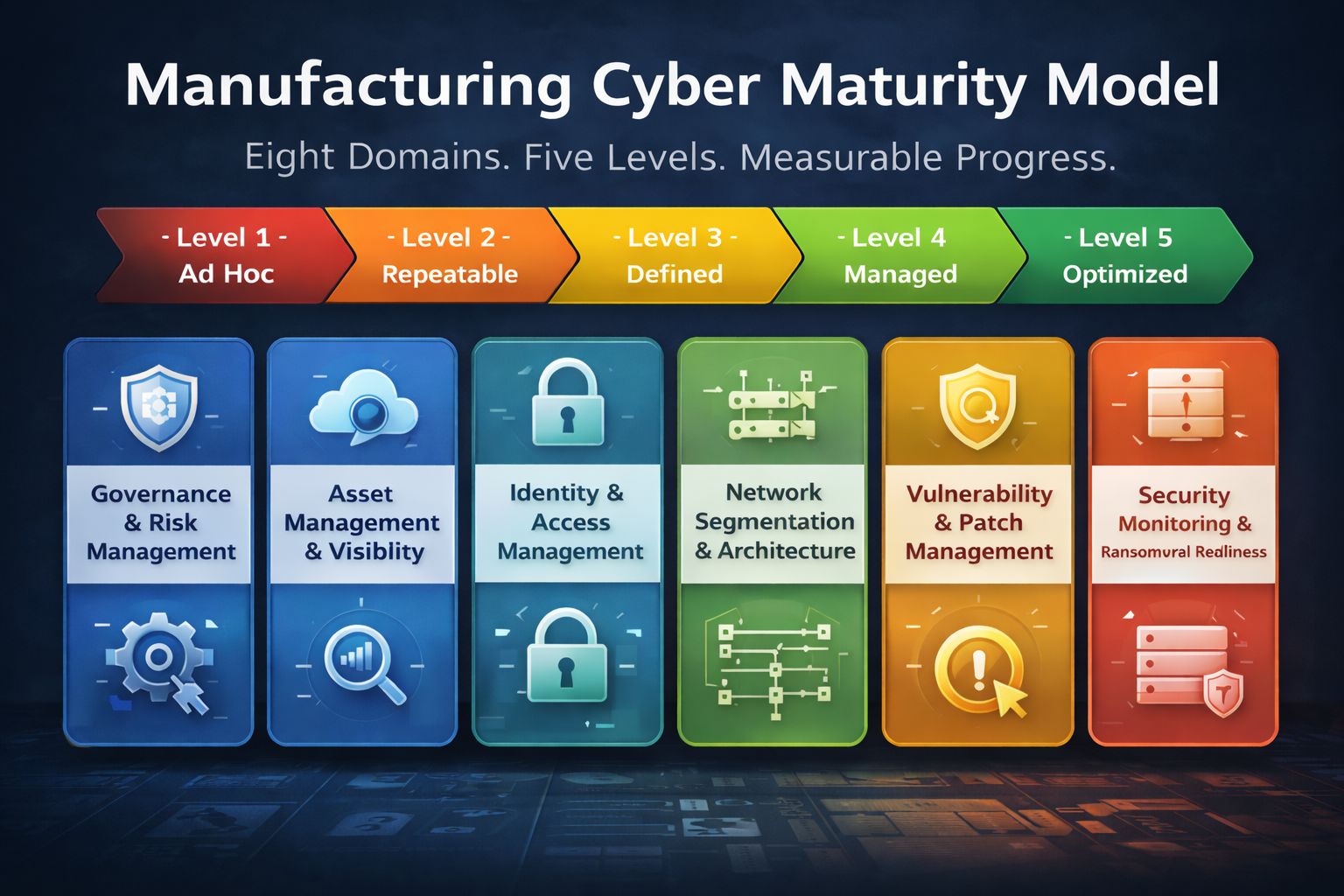
The scoring model written out: “What good looks like” per domain
Below are the eight domains with maturity guidance. Use the descriptions to score your current state and identify the next practical step up.
Domain 1: Governance & Risk Management
What this domain covers: leadership ownership, policies and standards, risk decisions, budget alignment, and recurring review cadence across IT and OT.
- Level 1 (Ad Hoc): Security decisions are reactive. Roles are unclear. Risk is discussed after incidents or audits.
- Level 2 (Repeatable): Basic policies exist (acceptable use, passwords, backups), but OT governance is informal and inconsistent.
- Level 3 (Defined): Clear ownership exists for IT and OT security responsibilities. Risks are tracked in a risk register, and priorities are tied to business impact (downtime, safety, quality).
- Level 4 (Managed): Regular risk reviews occur (quarterly or monthly, depending on environment). Exceptions are documented with compensating controls. Leadership dashboards track maturity and remediation progress.
- Level 5 (Optimized): Risk management is embedded into change management and capital planning. OT security standards are integrated with engineering and maintenance workflows. Continuous improvement is routine.
What good looks like (practical indicators):
- Named accountability for IT security and OT security collaboration
- A risk register that includes OT systems and vendor access
- Budget and roadmap tied to quantified downtime risk
Domain 2: Asset Management & Visibility (IT/OT)
What this domain covers: knowing what assets exist, where they are, who owns them, what they run, and what they connect to.
- Level 1: Inventory is incomplete or outdated. OT asset knowledge lives in people’s heads or scattered spreadsheets.
- Level 2: IT inventory is fairly consistent; OT inventory exists but lacks depth (versions, connectivity, criticality).
- Level 3: A combined IT/OT inventory exists for scoped plants/lines with ownership, criticality, and connectivity mapping.
- Level 4: Inventory is maintained through recurring processes and tooling. Changes are tracked. Critical assets are tagged and prioritized for protection/monitoring.
- Level 5: Near-real-time visibility exists for IT and OT, where feasible. Asset intelligence feeds vulnerability, monitoring, and response workflows.
What good looks like:
- Documented crown jewels by plant/line/cell
- Known engineering workstations and programming pathways
- Connectivity map that shows IT/OT interfaces and remote access routes
Domain 3: Identity & Access Management (including vendor access)
What this domain covers: MFA, least privilege, account lifecycle, privileged access, shared accounts, remote vendor access, and access approvals.
- Level 1: Shared accounts are common. MFA is inconsistent. Vendor access is “always on” and minimally controlled.
- Level 2: MFA exists for key systems (email, VPN), but privileged access is inconsistent. Vendor accounts are not reviewed regularly.
- Level 3: MFA is broadly enforced. Access is role-based. Vendor access is time-bound and approved. Local admin sprawl is reduced, and critical systems use separate privileged accounts.
- Level 4: Privileged access is managed with stronger controls (auditing, just-in-time access where feasible). Vendor sessions are logged and monitored. Regular access reviews occur.
- Level 5: Identity becomes the control plane: conditional access, device trust, strong auditing, and rapid deprovisioning are mature. Vendor access is highly governed and measurable.
What good looks like:
- MFA enforced for email, VPN, remote access tools, and admin portals
- Vendor access requires approval, is limited by role and time window, and is logged
- Privileged accounts are separated from daily user accounts
Domain 4: Network Segmentation & Architecture (zones/conduits)
What this domain covers: separation between IT and OT, segmentation within OT, controlling east-west traffic, secure remote access paths, and firewall rule hygiene.
- Level 1: Flat networks are common. IT and OT share pathways with minimal filtering. Remote access lands broadly inside the environment.
- Level 2: Some segmentation exists (VLANs, basic firewalling), but rule sets are permissive and not aligned to critical process boundaries.
- Level 3: IT/OT separation is established with controlled conduits. Critical OT areas are segmented (e.g., by line or cell). Remote access is routed through controlled entry points.
- Level 4: Segmentation is maintained with documented standards. Firewall rules follow the principle of least privilege and are reviewed. OT traffic baselines exist to support monitoring and anomaly detection.
- Level 5: Architecture is resilient and well-governed. Micro-segmentation is used where feasible. Changes are controlled, validated, and continuously improved without disrupting production.
What good looks like:
- Clear demarcation between corporate IT and plant OT networks
- Remote vendor access terminates in a controlled zone, not directly on the plant floor
- Firewall rules reflect “only what’s needed” for production workflows
Domain 5: Vulnerability & Patch Management (including compensating controls)
What this domain covers: vulnerability scanning (where safe), patching cadence, end-of-life tracking, configuration hardening, and compensating controls for systems that can’t be patched quickly.
- Level 1: Patching is irregular and reactive. OT vulnerabilities are largely unknown. End-of-life systems are unmanaged.
- Level 2: IT patching is scheduled, but OT patching is inconsistent. Known EOL systems exist without documented mitigation.
- Level 3: Patch management is defined for IT, and OT follows a risk-based process aligned to production constraints. EOL systems are identified and controlled using compensating measures.
- Level 4: Vulnerabilities are tracked with SLAs based on risk. Hardening baselines exist. OT compensating controls (segmentation, allowlisting, restricted access) are applied consistently.
- Level 5: Vulnerability management is integrated with asset intelligence, change management, and monitoring. Continuous improvement reduces exposure without harming uptime.
What good looks like:
- Documented patch windows and approval process that respects production schedules
- EOL systems tracked with clear mitigation plans
- Compensating controls are specific and verified (not just “we’re careful”)
Domain 6: Security Monitoring & Detection
What this domain covers: centralized logging, alerting, endpoint detection and response (EDR), managed detection and response (MDR), and OT-aware monitoring where feasible.
- Level 1: Minimal logs are collected. Alerts are inconsistent. Detection depends on users noticing issues.
- Level 2: Some systems are centrally logged (email, firewalls), and EDR is in place in parts of IT, but OT detection is limited.
- Level 3: Centralized logging and alerting are established. EDR/MDR coverage is consistent across scoped IT assets. High-risk pathways (remote access, admin actions) are monitored.
- Level 4: Detection is tuned, measured, and tested. Response workflows are integrated with ticketing. OT network visibility is piloted or deployed in critical areas without disrupting operations.
- Level 5: Monitoring is mature across IT and OT, where feasible. Baselines, anomaly detection, and continuous tuning reduce noise and improve time-to-detect.
What good looks like:
- Clear alert priorities for ransomware behaviors (credential theft, lateral movement, mass encryption signals)
- Monitoring of vendor sessions and privileged actions
- Documented escalation paths and response SLAs
Domain 7: Incident Response & Ransomware Readiness
What this domain covers: playbooks, roles/responsibilities, communication plans, IT and OT containment strategies, tabletop exercises, and decision-making under operational pressure.
- Level 1: Response is improvised during incidents. Contacts and responsibilities are unclear. OT response is undefined.
- Level 2: Basic incident response steps are in place. Key contacts are known, but plans are not regularly tested with plant stakeholders.
- Level 3: Documented playbooks exist for ransomware and common scenarios. OT considerations are included (safe shutdown, isolation strategy, vendor coordination). Tabletop exercises are performed.
- Level 4: Response is practiced and measured. Lessons learned drive improvements. Communications and decision-making are rehearsed with leadership and plant operations.
- Level 5: Response readiness is highly mature. Drills are realistic and recurring. Containment and recovery are executed with confidence and minimal disruption.
What good looks like:
- A ransomware playbook that includes OT isolation decisions and safety/quality considerations
- Known “shutdown vs. isolate vs. continue” criteria for production environments
- Pre-defined vendor and cyber insurance contact process
Domain 8: Backup, Recovery & Operational Resilience
What this domain covers: backup coverage, immutability/offline copies, restore testing, recovery objectives (RTO/RPO), and the ability to restore operations—not just data.
- Level 1: Backups exist but are unverified. Restores are rare. Recovery time is unknown.
- Level 2: Backups run regularly for key IT systems, but OT/plant systems are incomplete. Restore tests are occasional.
- Level 3: Backup coverage is defined across scoped systems. Restore testing is scheduled. Recovery objectives are documented for critical business and production systems.
- Level 4: Backups are resilient against ransomware (immutable/offline where appropriate). Restore testing is frequent and measured. Recovery processes are documented and practiced.
- Level 5: Recovery is optimized: restore times meet operational requirements. Dependencies are mapped (identity, DNS, networking). Resilience planning is continuous.
What good looks like:
- Regular restore testing with documented results and improvements
- Immutable or offline backup strategy for ransomware resilience
- Recovery plans aligned to production needs (not just IT convenience)
Common manufacturing gaps that keep maturity low
In real-world manufacturing environments, maturity often stalls due to a few recurring issues. Here are the most common—and the practical moves that raise maturity without disrupting production.
Gap 1: Vendor remote access is uncontrolled
Vendor access is a necessary business reality. It’s also one of the most common ransomware entry points when systems are always on, poorly monitored, or protected by weak credentials.
- Fix: Require MFA, approvals, time-bound access windows, and session logging.
- Maturity domains impacted: Identity & Access, Monitoring & Detection, Segmentation
Gap 2: IT/OT network is too flat
Flat networks make lateral movement easy. In a plant environment, this can turn a single compromised system into widespread downtime.
- Fix: Implement clear IT/OT separation and, where feasible, segment critical OT zones by line/cell. Control conduits carefully.
- Maturity domains impacted: Segmentation & Architecture, Monitoring & Detection, Incident Response
Gap 3: Backups exist, but restores aren’t tested
A backup you haven’t restored is a hope—not a plan. Ransomware recovery depends on tested restores and known recovery times.
- Fix: Schedule restore tests, document results, and align RTO/RPO to production requirements.
- Maturity domains impacted: Backup/Recovery & Resilience, Governance & Risk
Gap 4: OT asset visibility is incomplete
You can’t protect what you can’t see. Lack of OT visibility drives low scores across multiple domains.
- Fix: Build a practical OT inventory baseline, starting with crown jewels and expanding from there.
- Maturity domains impacted: Asset Management, Vulnerability Management, Monitoring
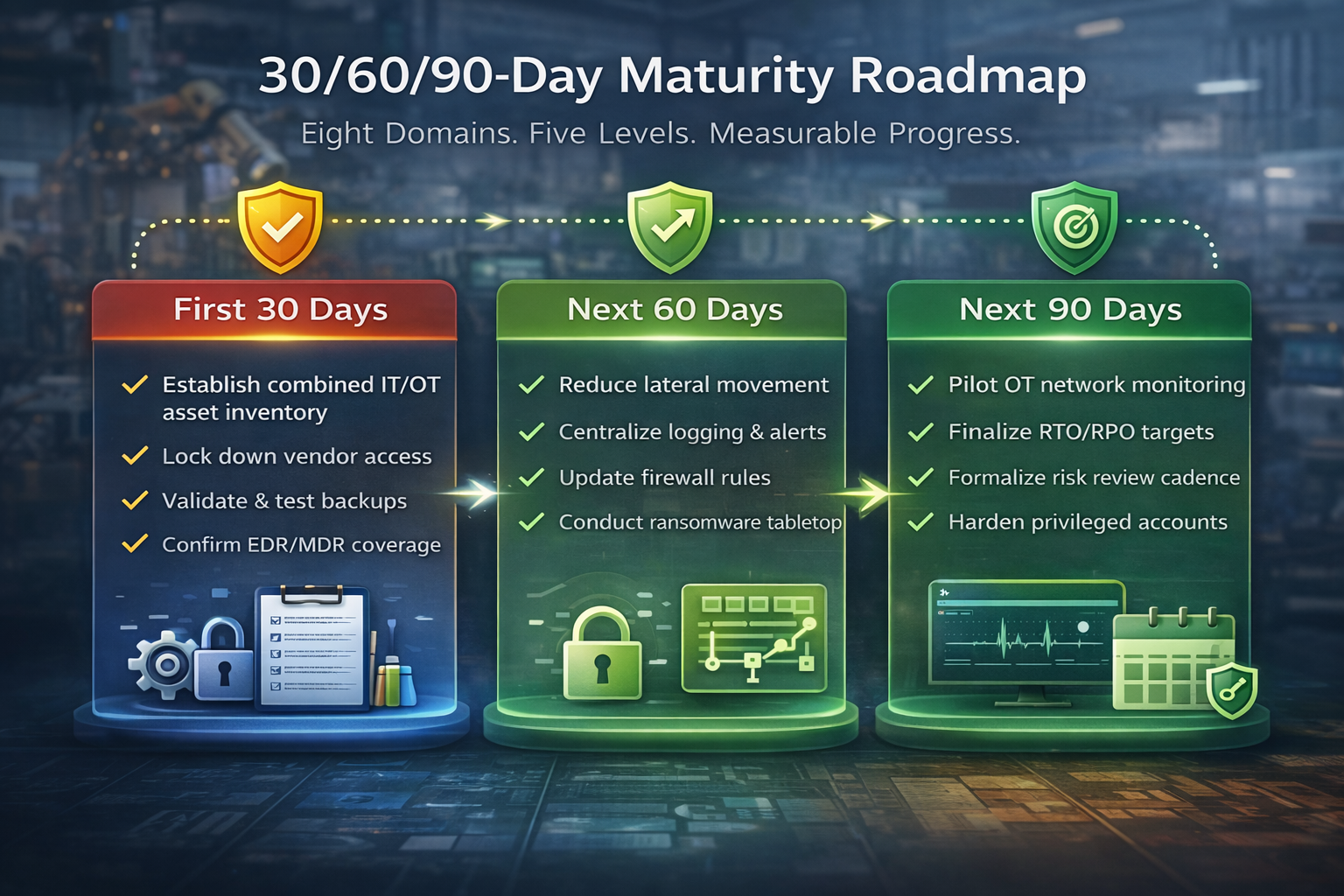
Turn your assessment into a 30/60/90-day maturity roadmap
Once you’ve scored your eight domains, convert the results into an execution plan. Here’s a practical 30/60/90 structure that works well for manufacturing organizations.
First 30 days: stabilize the biggest risk pathways
- Establish/update the combined IT/OT inventory baseline for your scoped plant/line
- Lock down vendor access: MFA, approvals, time-bound access, and session logging
- Validate backups and complete at least one meaningful restore test
- Confirm EDR/MDR coverage across all in-scope IT endpoints and servers
Next 60 days: reduce lateral movement & improve detection
- Implement IT/OT separation improvements and “quick win” segmentation changes
- Review firewall rules and restrict conduits to only necessary traffic
- Centralize key logs and ensure alerting priorities for ransomware behaviors
- Run a ransomware tabletop exercise with plant and leadership stakeholders
Next 90 days: formalize, test, & measure
- Pilot OT monitoring in critical zones (non-intrusive, production-safe)
- Document RTO/RPO for crown jewel systems and validate feasibility
- Build a recurring risk review cadence and track remediation progress
- Harden privileged access workflows and complete an access review cycle
If you’re unsure what to prioritize first, start with the domains most likely to quickly reduce downtime risk: vendor access controls, segmentation, monitoring, and recovery readiness.
When to bring in help & What to ask for
Many manufacturing organizations can run a baseline maturity assessment internally. But it often makes sense to involve a partner when:
- You lack OT visibility tools or OT security expertise
- You need a neutral, evidence-based maturity score for leadership, insurers, or customer requirements
- You want a prioritized roadmap tied directly to downtime risk and budget constraints
- You need to implement segmentation, secure remote access, or monitor changes safely
If you engage a partner, ask for:
- IT + OT combined approach: not a generic IT-only checklist
- Evidence-based scoring: scoring tied to real configurations and coverage
- Roadmap deliverable: a 30/60/90 plan with longer-term phases and budget ranges
- Operational sensitivity: recommendations that respect uptime, safety, and maintenance windows
maturity is measurable—and improvable
Cybersecurity maturity in manufacturing isn’t about checking boxes. It’s about reducing the likelihood of disruption and ensuring you can recover quickly if an incident occurs. With a simple scoring model and eight domains tailored to IT/OT realities, you can assess where you are today and build a roadmap to improve resilience without jeopardizing production.
The most successful manufacturers treat maturity as a journey: consistent governance, controlled access, safe segmentation, better visibility, practiced response, and tested recovery.
Ready to quantify your manufacturing cyber maturity?
If you want an evidence-based assessment across both IT and OT—with clear scoring, real-world findings, and a prioritized roadmap your leadership team can actually fund and execute—Cyber Advisors can help. Our manufacturing-focused team will work with your operations, engineering, and IT stakeholders to:
- Evaluate your current maturity against the eight domains outlined in this guide
- Validate strengths and gaps with on-the-ground evidence from your plants and critical lines
- Quantify downtime, safety, and quality risk in business terms your executives care about
- Build a practical 30/60/90-day plan, plus longer-term recommendations, aligned to budgets and maintenance windows
The result is a defensible maturity baseline and a focused improvement plan that reduces downtime risk, strengthens resilience, and keeps production running safely.
Request a Manufacturing Cyber Maturity Assessment (IT + OT)