

Most SMBs don’t need a 200-page incident response manual—they need a repeatable way to make fast, defensible decisions when something breaks. The difference between a “bad day” and a business-threatening outage usually comes down to three things you can control before an incident:
- Who is allowed to decide what (so you don’t debate authority mid-crisis)
- What actions do you take first for the incidents you’re most likely to face (so you move fast)
- Who you can call when the situation crosses the line from “IT problem” to “legal, insurance, and brand risk” (so you’re not hiring help during the outage)
This post lays out a right-sized incident response (IR) program for small teams. You’ll learn how to define roles and decision rights, build five practical runbooks, create a communication and escalation plan, pre-negotiate retainers with counsel/forensics, integrate your MSP/MDR and tooling, and run tabletop exercises that actually improve outcomes.
If you want help pressure-testing your program, book a call with Cyber Advisors to identify gaps, clarify responsibilities, and make sure your playbooks fit your real environment.
Why Small Teams Need a Right-Sized IR Program
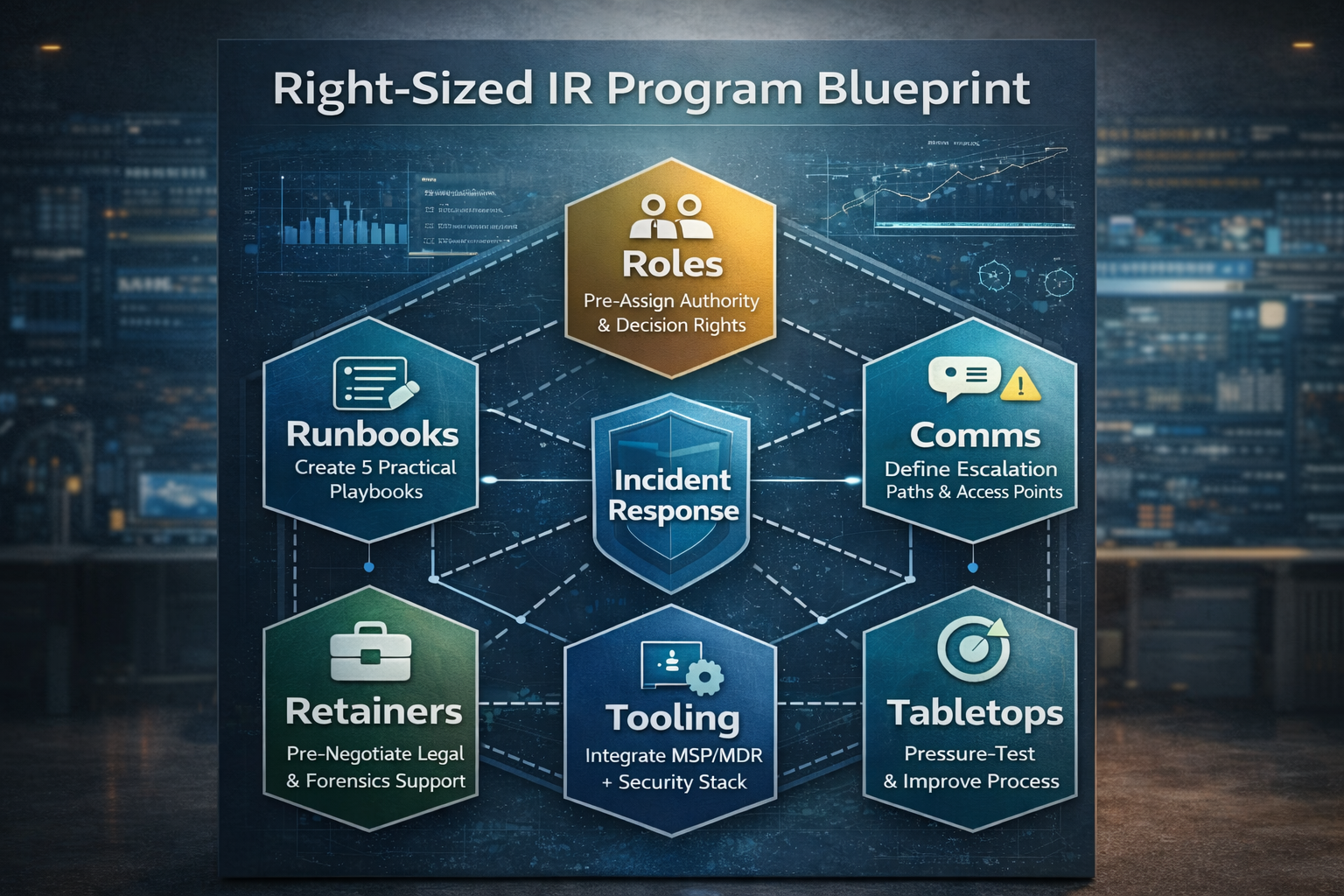
Incident response isn’t a binder. It’s an operating model: people, process, and partners that turn chaos into a sequence of decisions and actions. Large enterprises can staff specialized teams for legal, PR, identity, network, cloud, and endpoint response. Small and mid-sized organizations can’t—yet they still face the same core incident categories:
- Phishing and business email compromise (BEC)
- Ransomware
- Lost or stolen devices
- Microsoft 365 (Entra) account takeover
- Third-party compromise (vendors, SaaS, partners)
A right-sized program doesn’t mean “less serious.” It means “usable.” It’s built around your most likely scenarios and emphasizes speed, clarity, and evidence so you can:
- Stop the bleeding: contain quickly and prevent spread
- Preserve evidence: support decisions and meet legal/insurance needs
- Communicate safely: avoid rumors, misinformation, and unnecessary liability
- Restore operations: recover without reintroducing risk
- Improve continuously: learn and harden after each event
Material impact & business priorities
Before you write runbooks, align leadership on what matters most during an incident. Common priorities include:
- Protecting sensitive data (PII/PHI, payment data, confidential client records)
- Maintaining uptime for revenue-driving systems (ERP, scheduling, production, portals)
- Preventing fraud and unauthorized payments
- Meeting contractual SLAs and regulatory requirements
- Preserving trust with customers and partners
Translate priorities into a short list of “crown jewels” plus rough recovery tolerances. A one-page “impact map” is enough for most SMBs:
- Top 5 systems: what breaks first if they go down?
- Top 5 data sets: what’s most damaging if exposed?
- Dependencies: identity, DNS, backups, VPN, vendor access
- “Acceptable downtime” (ballpark): 4 hours, 1 day, 3 days?
- Owners: who can make tradeoffs when there’s no perfect option?
Define Roles & Decision Rights
In small teams, one person may wear multiple hats. That’s fine—if you label the hats. Confusion arises when roles are assumed rather than assigned, or when multiple people believe they’re authorized to make the same decision.
A simple RACI model keeps things clean:
- Responsible: does the work
- Accountable: owns the outcome and approves key decisions
- Consulted: provides input
- Informed: receives updates
Start with your “top 10 decisions” (incident declaration, disabling accounts, isolation, firewall blocks, restores, engaging vendors, insurer notification, etc.) and assign accountability.
Core roles for small teams
- Incident Commander (IC): coordinates response, assigns actions, tracks decisions, and escalates.
- IT / Infrastructure Lead: executes containment and restoration across endpoints, servers, the network, backups, and the cloud.
- Security / MDR Lead: confirms what’s real, scopes impact, and recommends containment/eradication.
- Executive Sponsor: approves high-impact business decisions, resources, and external statements.
- Legal / Privacy (often outside counsel): advises on obligations, privilege strategy, evidence handling, and safe communications.
Common “as needed” roles include finance/controller, HR/people ops, and a communications lead.
Treat MSP/MDR as part of the team
If you rely on an MSP and/or MDR provider, document:
- Who is on-call and how to reach them after hours
- What authority they have (disable accounts, isolate devices, block traffic, rotate credentials)
- What evidence should they preserve before disruptive actions (when time allows)
- What they need from you quickly (admin access, logs, diagrams, contact list)
Create 5 Core Runbooks
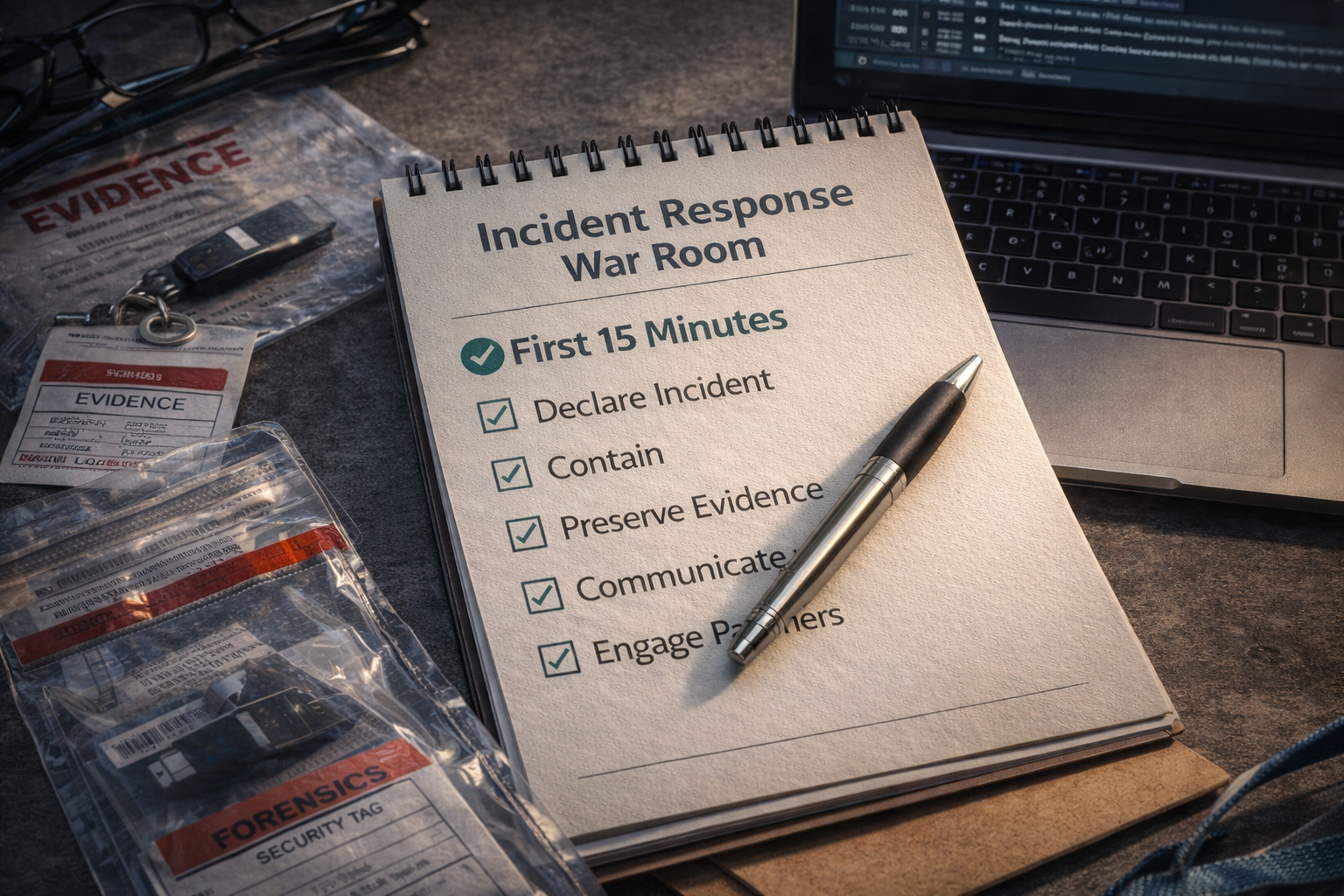
Runbooks convert intent into action. Keep them short, specific, and written for the people who will use them under stress. Each runbook should include triggers, first-15-minute actions, minimum viable evidence, decision points, recovery checks, and common mistakes.
Runbook 1: Phishing & Business Email Compromise (BEC)
Common signals: suspicious logins, new inbox rules/forwarding, urgent wire requests, repeated MFA prompts, vendor invoice fraud indicators.
First 15 minutes: preserve the message, revoke sessions, reset credentials, remove malicious rules/forwarding and suspicious OAuth consents, freeze payments and start bank recall if fraud is possible.
Evidence: email headers/content, sign-in/audit logs, mailbox changes, fraud trail.
Hardening: MFA enforcement, conditional access, vendor payment verification procedures, email authentication and anti-phishing controls.
Runbook 2: Ransomware
First 15 minutes: declare the incident, isolate impacted endpoints/servers, disable compromised accounts, protect backups, block obvious spread vectors if safe.
Evidence: EDR telemetry, affected system list and timeline, identity and firewall/VPN logs, ransom note details.
Recovery: confirm containment, rotate privileged credentials, patch exploited paths, restore from known-good backups, and validate integrity before production.
Runbook 3: Lost or Stolen Device
First 15 minutes: confirm device and last check-in; remote lock/wipe per policy; revoke sessions/tokens; reset credentials if warranted.
Evidence: MDM status and post-loss sign-in logs.
Runbook 4: Microsoft 365 (Entra) Account Takeover
First 15 minutes: block sign-in if confirmed, revoke tokens/sessions, reset password, remove suspicious MFA methods, check for inbox rules/forwarding, OAuth consent, and admin role changes. If admin compromise is suspected, activate break-glass procedures.
Evidence: Entra sign-in and audit logs; mailbox audit logs where available.
Hardening: conditional access, least privilege, stronger MFA, alerting on role changes and risky sign-ins.
Runbook 5: Third-Party Compromise
First 15 minutes: identify vendor access paths, restrict access if warranted, rotate credentials/tokens, increase monitoring, document vendor communications and scope claims.
Communication & Escalation Plan
A right-sized communications plan answers: who must be notified, what channels to use if systems are down, who can speak externally, and what gets documented.
Separate two streams:
- Operations stream: technical work, hypotheses, evidence
- Communications stream: confirmed facts, approved messaging, stakeholder updates
Define escalation triggers (ransomware, admin/finance compromise, fraud, regulated data exposure, critical downtime). Maintain a call tree that works even during outages.
When to call counsel & insurer
Call counsel if regulated data may be involved, external notifications are possible, or you need privilege/communications guidance. Call your cyber insurer early if the incident may lead to a claim, if you need insurer-approved vendors, or if extortion/fraud is suspected.
Evidence preservation basics
- Preserve first, remediate second (when feasible)
- Capture screenshots, affected system list, timestamps, and observers
- Export logs early
- Isolate systems rather than wiping unless safety requires it
Retainers: Legal, Forensics, & IR Support
Retainers reduce response time. Pre-identify outside counsel, a DFIR firm, and IR support surge capacity. At minimum, pre-negotiate contacts, after-hours process, secure access methods, spending approvals, and insurer coordination.
Integrate With MSP/MDR & Security Tooling
Without coordination, teams risk restoring services into an environment that’s still compromised. Align in writing on detection handoffs, containment authority, restoration rules, and shared documentation.
Standardize evidence handling with a checklist. If you’re unsure whether your controls support response, a maturity assessment can help prioritize the most impactful improvements.
Tabletops & Continuous Improvement
Tabletops build muscle memory and reveal friction: missing owners, unclear authority, access gaps, and runbooks that are too vague to execute. Use a 60–90 minute agenda focused on one scenario and track metrics like time to declare, time to contain, and action-item completion rate.
A right-sized IR program quick checklist
- IC and executive sponsor named (with backups)
- MSP/MDR escalation paths and authority documented
- Legal counsel + insurer contacts and requirements reviewed
- Call tree stored offline and kept current
- Five runbooks drafted and accessible
- Decision log format and evidence checklist defined
- Retainers/partners pre-identified and tabletop scheduled
Cyber Advisors' services & next steps
Small teams can absolutely run effective incident response—if roles, runbooks, and retainers are in place before the breach. When your plan is clear, you move faster under pressure, contain threats earlier, reduce downtime, and make decisions you can defend later.
Cyber Advisors helps SMB and mid-market organizations design and validate incident response programs that work in the real world. Our Incident Response Readiness Assessment is built to quickly identify gaps and turn them into a practical, executable plan—aligned with your MSP/MDR, your Microsoft 365 environment, and your business priorities.
Ready to pressure-test your incident response program before an attacker does?
Book an Incident Response Readiness Assessment with Cyber Advisors.