

Modern infrastructure supports growth with standardized platforms, resilient networks, and measurable service levels. When well designed, IT infrastructure becomes a strategic driver that boosts performance, enhances security, and allows for predictable scalability.
If your business is growing, your infrastructure either helps you scale or silently burdens every department with delays, outages, and risks. The difference is rarely due to one “big” system; it’s the result of many architecture choices: how your network is segmented, how identities are managed, how endpoints are protected, how cloud and on-premises resources are monitored, and how quickly you can recover when issues arise.
This guide explains what “reliable infrastructure” truly means for SMB and mid-market organizations, how to build it, and how to modernize without disrupting business operations.
Why infrastructure modernization matters to business growth
Infrastructure modernization involves redesigning and upgrading IT systems, networks, security controls, compute environments, and operational processes to meet current business needs. It’s more than just updating hardware. Modernization means adopting infrastructure that is resilient, flexible, secure, and capable of supporting ongoing innovation.
Many organizations underestimate how closely business growth is linked to infrastructure maturity. Every strategic initiative relies on dependable IT: onboarding new employees, opening additional locations, launching digital products, supporting a hybrid workforce, or enhancing customer experience. Your ability to succeed depends on how well your infrastructure is constructed.
When done effectively, infrastructure modernization results in faster performance, lower risk, and improved scalability. When done poorly, it can hinder productivity and cause constant firefighting for IT.
Reducing operational friction
Operational friction is one of the most overlooked business costs. It appears as slow logins, lagging applications, inconsistent Wi-Fi, choppy VPN performance, and systems that behave differently across offices. Even small delays build up over time, quietly reducing productivity and employee morale. Modern infrastructure minimizes friction by standardizing platforms, optimizing networks, and eliminating single points of failure. Staff experience a consistent, reliable system whether they are in the office, remote, or traveling. Help desk ticket volume drops because the underlying systems simply function the way people expect.
Improving uptime & business continuity
Downtime is one of the most visible results of weak infrastructure. When critical systems fail, employees can’t work, customers can’t be served, and leadership begins to ask tough questions. Even brief outages can cause lasting damage to reputation. Reliable infrastructure lowers the risk of downtime through standardized setups, redundant network paths, virtualization, and cloud-based resilience. Monitoring tools identify issues early, and documented runbooks help IT teams respond precisely when incidents happen. Modernization also strengthens the connection between business continuity planning and technical capabilities. Recovery time objectives (RTOs) and recovery point objectives (RPOs) become achievable targets instead of unrealistic goals.
Strengthening security & reducing risk
Legacy infrastructure is inherently hard to secure. Older operating systems, unsupported hardware, flat networks, and limited logging create an ideal environment for attackers. Even well-meaning teams struggle to protect systems that were never built for modern threats. A modernized infrastructure incorporates security-by-design principles. It employs concepts like Zero Trust, least-privileged access, network segmentation, and strong identity management to minimize the attack surface. Multi-factor authentication (MFA) becomes standard. Patch management is automated whenever possible, and event visibility is centralized through SIEM or managed detection and response (MDR) services. Instead of adding security tools to fight a fragile foundation, the infrastructure itself helps in reducing risk.
Enabling scalability & future growth
As organizations grow, small flaws in outdated infrastructure become unavoidable obstacles. New office locations increase bandwidth demands, revealing bottlenecks. Growing teams require stronger identity and access management. As SaaS platforms expand, storage and compute performance are strained by increasing data volumes and concurrent workloads. Aging infrastructure cannot scale smoothly and becomes a barrier to agility.
A modern, elastic infrastructure overcomes these limitations. Virtualization, cloud-native technologies, and modular network architectures enable capacity expansion and allow the integration of new apps without disruptive re-architecture. Enterprise governance ensures that new tools are integrated securely and consistently—rather than forming a patchwork of unsupported systems.
Reducing complexity & total cost of ownership
At first glance, modernization might seem like an extra expense. However, legacy environments are often much more costly to operate. Aging systems increase manual effort, depend on outdated processes, and require specialized expertise that is difficult (and expensive) to find. The overall effect is significant: IT teams spend more time troubleshooting, devising workarounds, and maintaining compatibility — all at the expense of innovation.
Modernization shifts this dynamic by standardizing platforms, consolidating vendors, and adopting automation. Routine updates can be scheduled and tested. Integrations become more seamless. Ongoing support is simplified through unified management tools. The business gains predictability, and IT recovers time to focus on strategic initiatives.
Improving visibility & decision-making
You can’t manage what you can’t see. In fragmented environments, teams face blind spots in network performance, end-user experience, and security events—causing slow, reactive troubleshooting. Modern infrastructure consolidates visibility through monitoring, centralized logging, application performance monitoring, endpoint analytics, and cloud telemetry.
Unified dashboards offer insights into latency, bandwidth, error rates, and unusual activity. Leaders can prioritize investments based on usage, fix bottlenecks before they impact users, and reduce risk with early detection of misconfigurations.
The hidden signals that you’ve outgrown your infrastructure
Most organizations don’t wake up and decide to “modernize infrastructure.” They experience symptoms:
- Projects take longer because environments vary by location or business unit.
- New hires can’t be onboarded quickly due to manual identity and device provisioning.
- SaaS adoption is high, but performance varies, and visibility is limited.
- Security controls are added separately, causing user frustration and alert fatigue.
- Backups are in place, but leadership is unsure if recovery targets are realistic.
- Costs steadily increase—more licenses, more appliances, more point solutions—without clear improvements.
- Key systems “work” until they fail, making incidents feel unpredictable.

“If any of these sound familiar, you don’t just need more tools—you need a better foundation.”
What “reliable infrastructure” means in practice
Reliable infrastructure is not simply “newer” infrastructure. It is infrastructure that:
- Delivers a consistent user experience across locations, devices, and work modes.
- Prevents common failure modes through redundancy, segmentation, and standardization.
- Detects problems early through telemetry and meaningful alerting.
- Limits blast radius by design (security, segmentation, least privilege).
- Recovers quickly because backups, DR, and runbooks match business requirements.
- Scales with predictable cost and operational effort.
To achieve that, you need to design infrastructure as a system—where each layer supports the others.
How to design a secure & scalable infrastructure foundation
Building a reliable infrastructure for growth starts with four principles: standardization improves reliability; visibility enables faster resolution; security-by-design reduces risk; and capacity planning prevents bottlenecks.
Below is how to translate those principles into real architecture decisions.
1) Standardization improves reliability
Standardization forms the foundation of infrastructure maturity. It involves using consistent hardware models, operating systems, configurations, and management practices throughout the environment. Instead of a patchwork of unrelated components, the environment functions as a unified system.
Standardization provides:
- More predictable performance and fewer surprises
- Easier troubleshooting due to consistent system behavior
- Less training time for new IT staff
- More accurate capacity planning and budgeting
- Improved security with fewer exceptions and edge cases
For a growing organization, this might mean:
- A defined “gold standard” for endpoints (models, OS versions, security baselines)
- A consistent identity strategy (one primary directory, one SSO approach, one MFA policy)
- Reference architectures for branch networking and Wi-Fi
- A standardized server and cloud landing zone pattern
- Repeatable deployment methods (infrastructure as code, templates, automation)
2) Visibility enables faster resolution
Even the best-designed infrastructure will experience issues. What separates high-performing organizations is how quickly they detect and resolve those issues before they impact users.
Full-stack visibility includes:
- Network performance monitoring and alerts
- Application performance insights and transaction tracing
- Endpoint health and patch status
- Cloud telemetry and cost analytics
- Centralized security event logging and correlation
Visibility is not “more dashboards.” It’s the right telemetry and the right thresholds tied to business outcomes. For example:
- Alert on rising authentication failures because it predicts service desk spikes.
- Track Wi-Fi retransmits and roam failures, not just access point “up/down.”
- Monitor core business app transaction time, not just CPU.
3) Security-by-design reduces risk
Security-by-design treats every component—network, endpoint, server, cloud resource, and identity—as part of an integrated defense strategy.
Core elements include:
- Zero Trust principles that verify users, devices, and applications
- Network segmentation and micro-segmentation to limit lateral movement
- MFA and strong identity governance for all users and administrators
- Hardened configurations and regular vulnerability scanning
- Endpoint detection and response (EDR) integrated with SOC/MDR
- Encryption of data in transit and at rest
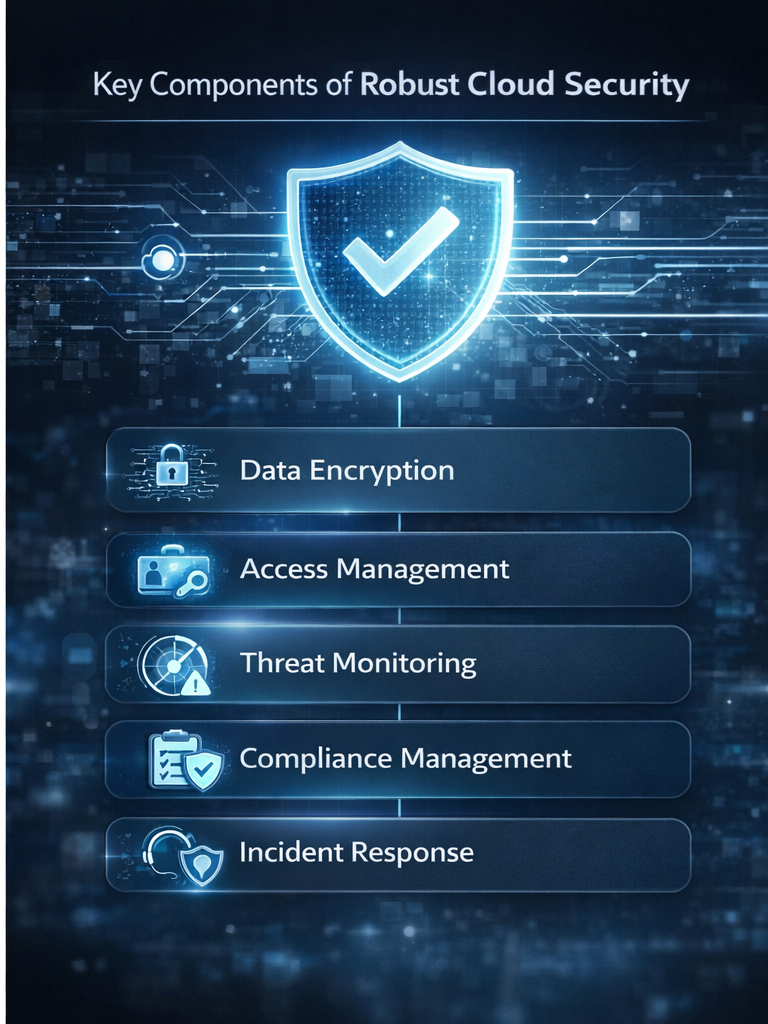
“Designing for security reduces the number of compensating controls you need later—and lowers business friction…”
Designing for security decreases the need for compensating controls later and reduces business friction. When identity is strong and networks are segmented, you can often simplify legacy VPN patterns, cut down on firewall rule sprawl, and get rid of risky “everyone has access” file shares.
4) Capacity planning prevents bottlenecks
Growth without capacity planning eventually reaches a limit. Systems that accommodated 50 employees may struggle at 150. New applications, data volumes, and remote work habits push networks and servers to their breaking points. Aging infrastructure cannot scale smoothly and becomes a barrier to agility.
Effective capacity planning depends on:
- Baseline performance metrics and historical trends
- Regular review of compute, storage, and network utilization
- Forecasting based on growth scenarios
- Cloud and on-premise right-sizing
- Refresh cycles aligned with support windows
Capacity planning is also a financial discussion. The goal isn’t to buy “bigger everything.” It’s to understand which resources your business truly needs and to align the platform accordingly.
A practical reference architecture for growth
The most dependable infrastructure programs evolve across different layers. Here’s a practical way to understand each layer, what “good” looks like, and what to focus on first.
Layer 1: Identity & access (your control plane)
For most organizations, identity is the new perimeter. If identity is weak, everything else becomes more difficult.
Priorities include: centralizing identity where possible to avoid multiple directories that don’t synchronize well; enforcing MFA everywhere, especially for administrative actions; implementing conditional access based on device health, location, and risk; establishing privileged access management (PAM) practices for administrators; and using single sign-on (SSO) for SaaS to reduce password sprawl and streamline offboarding
Reliability outcomes encompass faster onboarding and offboarding, fewer account lockout incidents and password resets, decreased risk of account takeover, and clear audit trails for compliance.
Layer 2: Endpoint standards (where work actually happens)
Endpoints serve as the frontline for performance and security—and are the most common source of friction when inconsistencies occur.
Priorities:
- Standardize device images or adopt modern provisioning methods (e.g., autopilot/zero-touch)
- - Establish configuration baselines (CIS or equivalent) aligned with business needs
- EDR with managed response, not just alerts
- Automate patching for OS and third-party applications
- - Use disk encryption and enforce strong local admin controls
- - Define a lifecycle for devices (replace, redeploy, retire)
Reliability outcomes:
- - Reduce "this only happens on my laptop” tickets
- - Enable faster remediation when issues arise
- - Ensure predictable replacement budgeting
- - Improve resilience against phishing and ransomware
Layer 3: Network & Wi-Fi (your business circulatory system)
If the network is slow or unstable, every application appears “broken.” Modern network reliability depends on architecture and operations.
Priorities:
- Simplify and standardize site designs (switching, routing, Wi-Fi patterns)
- Segment networks by purpose (users, servers, guests, IoT, OT, clinical, etc.)
- Design redundancy where it is important (WAN paths, core switching, firewall HA)
- Use SD-WAN when suitable to enhance performance and resilience
- Implement QoS intentionally for voice/video and key business applications
- Monitor experience: latency, jitter, packet loss, and wireless health
Reliability outcomes:
- - Reduced downtime from single points of failure
- - Increased security through segmentation
- - Improved performance for cloud and real-time collaboration
- Easier expansion to new locations
Layer 4: Compute & storage (on-prem, cloud, and hybrid)
You might not need a data center, but reliable compute and storage are essential.
On-premises priorities:
- Virtualization or hyperconverged platforms with redundancy
- Storage optimized for performance and failure tolerance
- Documented patching and firmware management
- Hardware supportability and refresh planning
- Clear separation between production and test/development environments, where applicable
Cloud priorities:
- Build a secure “landing zone” with standardized networking, logging, and policies
- Design for high availability (multi-zone, where necessary)
- Use managed services to reduce operational overhead
- Tag resources and enforce cost governance to prevent sprawl
- Implement identity-based access controls and least privilege principles for cloud resources
Hybrid priorities:
- Determine which workloads stay local for latency or regulatory reasons
- Ensure integration points are resilient (VPN/ExpressRoute equivalents, DNS, identity)
- Standardize monitoring across all environments
Reliability outcomes:
- - Ensure performance stability for business applications
- Reduce firefighting caused by storage bottlenecks
- - Enable predictable scaling for growth or seasonal demands
- Lower risk from unsupported hardware
Layer 5: Observability & operations (where reliability is enforced)
Infrastructure reliability is fundamentally an operational discipline.
Priorities:
- Centralized monitoring with actionable alerts
- Centralized logging for security and troubleshooting
- Documented runbooks for common incidents
- Change management that balances speed and stability
- Clear ownership of responsibilities and response times
- Regular health checks and post-incident reviews
Reliability outcomes:
- Faster incident resolution (reduces MTTR)
- Less repeated downtime from the same root causes
- Enhanced stakeholder confidence in IT
Layer 6: Backup, disaster recovery, & continuity (your safety net)
Reliable organizations anticipate failures and plan recovery accordingly.
Priorities:
- Separate backup domains from production (prevent ransomware from encrypting both)
- - Use immutable backups whenever possible
- - Conduct regular restore tests (not just “backup success” reports)
- Document RTO/RPO for each system
- DR runbooks and an incident communication plan
- - Ensure alignment with cyber insurance requirements and regulatory standards
Reliability outcomes:
- Faster recovery times when systems fail
- - Reduced business disruption and reputational damage
- Clear evidence for auditors and insurers
Layer 7: Governance & vendor strategy (how you keep it clean)
As you scale, governance prevents the environment from devolving into “whatever we bought last quarter.”
Priorities:
- Architecture standards and review processes
- Approved vendor lists and lifecycle management
- SaaS intake procedures (security review, integration requirements)
- Asset management and CMDB accuracy
- Documentation that is maintained and regularly updated
- Financial governance: renewals, true-up planning, and consolidation opportunities
Reliability outcomes:
- Fewer surprises at renewal time
- Less tool sprawl and inconsistent controls
- Stronger compliance and audit readiness
- Better long-term cost management
Blueprint for infrastructure modernization (a roadmap that works)
A successful modernization journey follows a structured roadmap rather than a series of ad-hoc projects. While each organization is unique, most high-performing programs progress through five phases: assessment and discovery; stabilization and remediation; modernization and optimization; standardization and governance; and continuous improvement and capacity planning. Use this blueprint to sequence efforts and minimize risk.
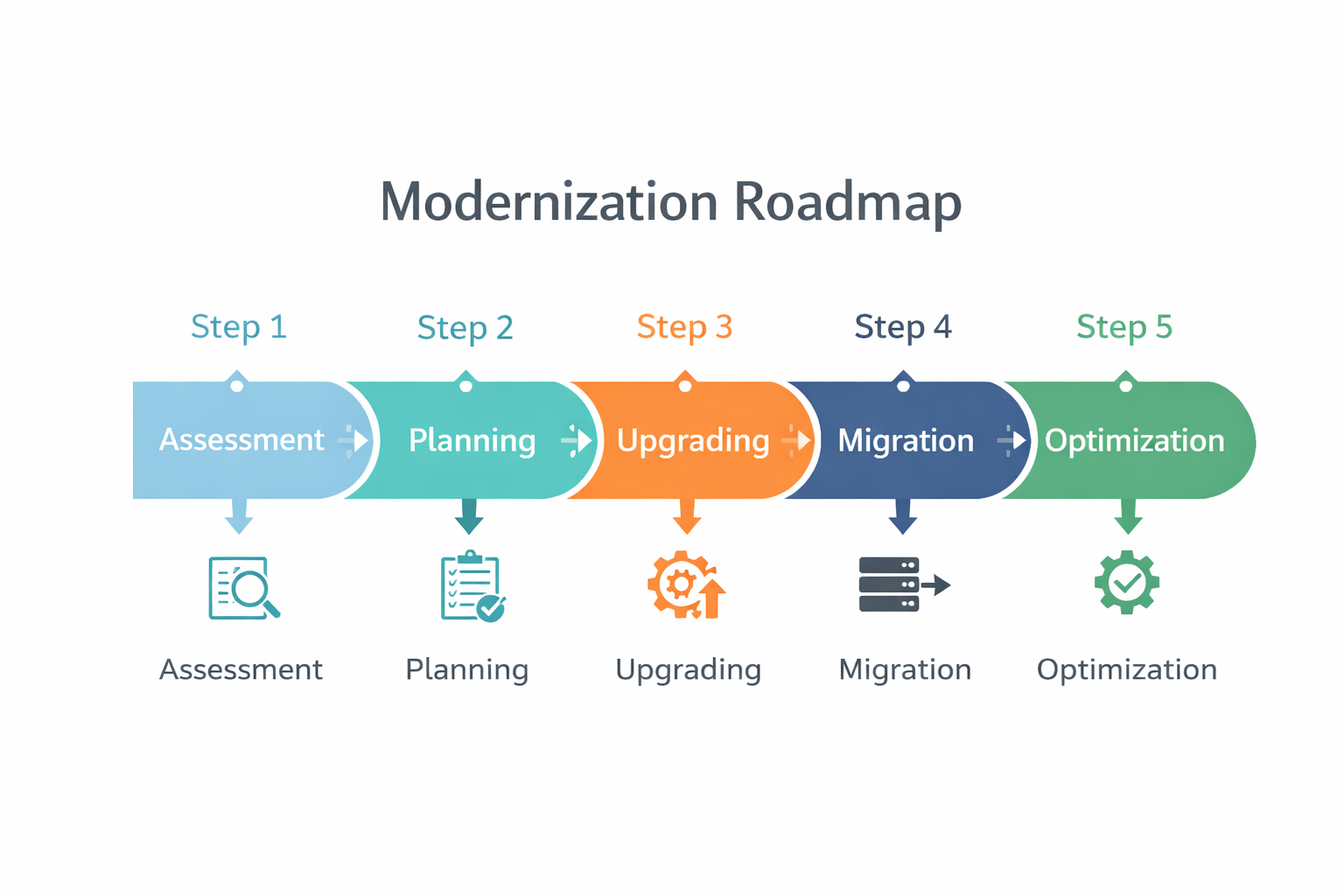
A practical five-step roadmap to modernize infrastructure with less risk and more predictable outcomes.
Phase 1: Assessment & discovery
The journey starts with understanding the current state. This involves cataloging infrastructure, documenting network topology, reviewing security controls, and gathering performance data. Interviews with IT staff and business stakeholders help identify pain points and objectives.
What to produce:
- A current-state architecture map (network, identity, cloud)
- An asset inventory with support status (EOL/EOS)
- A risk register (security, continuity, operational)
- Performance baselines (network, endpoints, key apps)
- A prioritized modernization roadmap aligned with business goals
Quick wins often emerge here—misconfigurations, patch gaps, unsupported systems, and “low effort / high impact” changes that immediately reduce noise.
Phase 2: Stabilization & remediation
Before developing new capabilities, it is essential to address critical issues that impact uptime, security, or user experience. This may include replacing failing hardware, fixing misconfigurations, resolving Wi-Fi problems, patching high-risk systems, and strengthening basic security controls.
The aim is to stop the problems from worsening and provide the organization with a more stable foundation to build upon.
What to prioritize:
- “Red” infrastructure risks (unsupported firewalls, failing switches, unpatched servers)
- Identity hardening (MFA enforcement, admin account cleanup)
- Backup validation (restore tests for critical systems)
- Monitoring deployment for early detection
Phase 3: Modernization & optimization
With stability established, teams can focus on strategic improvements such as network redesign, adoption of cloud services, upgrading core infrastructure, and implementing automation. This is when organizations shift from reactive firefighting to proactive, engineered solutions.
What to prioritize:
- Network segmentation and modernization
- Endpoint standardization and automated provisioning
- Cloud landing zone and governance foundations
- EDR plus managed response integration
- Application performance enhancements and SSO rollout
During this phase, focus on simplicity. Retire legacy applications where possible. Consolidate vendors whenever practical. Replace “tribal knowledge” with repeatable automation and thorough documentation.
Phase 4: Standardization & governance
Long-term success relies on governance. Standards are documented, change management is formalized, and policies ensure new deployments match the desired architecture. Cloud governance, identity frameworks, and vendor strategies are integrated here.
What to prioritize:
- Reference architectures and baseline configurations
- A formal change process (not bureaucracy—risk control)
- Patch and vulnerability management SLAs
- Documentation and asset management discipline
- Regular security reviews and tabletop exercises
Phase 5: Continuous improvement & capacity planning
Modern infrastructure is not a "set it and forget it" situation. Regular reviews, health checks, roadmap updates, and security assessments ensure the environment remains aligned with business needs. Capacity planning guarantees growth is supported without unexpected constraints.
What to prioritize:
- Quarterly reliability reviews (incidents, trends, root causes)
- Ongoing optimization (performance, cost, security posture)
- Vendor and renewal planning
- Annual DR testing and maturity updates
- A rolling 12–18 month modernization roadmap
Common mistakes that derail modernization
- Modernizing Without a Clear Business Outcome.
If the “why” is unclear, projects risk becoming endless. Align each initiative with a measurable goal: reduced downtime, faster onboarding, enhanced security, or better application performance. - Treating security as an afterthought.
If you modernize the network but maintain flat access, you improve performance but not resilience. Incorporate segmentation, identity governance, and logging into the design. - Buying tools without operational readiness.
A monitoring tool doesn’t provide true visibility unless alerts are properly tuned and ownership is assigned. EDR doesn’t lower risk unless response procedures are practiced and managed. - Skipping documentation and standards.
Growth increases complexity. Standards help prevent this complexity from turning into chaos. - Overlooking the human aspect of change.
Infrastructure updates impact every user. Communicate early, plan staged changes carefully, and enhance support visibility during transitions. - Underestimating backup and recovery realities.
If you haven’t recently restored a system, you don’t really understand your RTO/RPO. Test and validate continuously.
What reliable infrastructure delivers
Organizations that invest in infrastructure modernization consistently report reduced downtime and fewer critical incidents, faster end-user experiences, lower security risks, and an improved compliance posture. They also see increased productivity, reduced help desk volume, predictable scalability, and more accurate budgeting, resulting in a lower total cost of ownership.
To make those outcomes tangible, track metrics such as:
- Help desk tickets per user per month (trend down)
- Mean time to resolution (MTTR) for priority incidents (trend down)
- Patch compliance within SLA (trend up)
- MFA coverage (trend up)
- Backup restore success rate and restore time (trend up / trend down)
- Network latency/jitter thresholds for key sites (trend stable)
- Cloud spend vs. budget with tagging coverage (trend stable/controlled)
An infrastructure readiness checklist for leaders
Use this quick checklist to identify gaps and set priorities:
Identity & access
- Do all users and admins have MFA enforced?
- Do you have conditional access based on device health and risk?
- Can you offboard a user fully in minutes, not days?
Endpoints
- Are devices provisioned and secured consistently?
- Do you have EDR + managed response?
- Is patching automated and measured?
Network
- Is your network segmented by purpose?
- Do you have redundancy for key sites and systems?
- Is Wi-Fi reliable across all locations?
Compute & cloud
- Are critical systems on supported platforms?
- Do you have a secure cloud landing zone and policies?
- Do you have visibility across hybrid resources?
Operations
- Are monitoring alerts actionable and owned?
- Do you have runbooks for common incidents?
- Are changes controlled and documented?
Backup & Disaster Recovery
- Are backups immutable or protected from ransomware?
- Do you test restores regularly?
- Are RTO/RPO defined and realistic?
Governance
- Do you have architecture standards?
- Can you quickly answer “what do we have and when does it renew?”
- Do new tools go through security and integration review?
If you answered “no” to several areas, your best next step is an assessment that produces a prioritized roadmap—not a list of random upgrades.
Why organizations trust Cyber Advisors for modern infrastructure
Cyber Advisors offers decades of hands-on expertise in designing, modernizing, and managing infrastructure environments for organizations of all sizes—from fast-growing startups to large, multi-size enterprises. Our team has extensive experience across manufacturing, healthcare, financial services, government, retail, and professional services, allowing us to customize modern infrastructure solutions to each client’s workflows, risk profile, compliance needs, and growth plans. We assist organizations:
- Benchmark infrastructure maturity and identify quick wins
- Modernize networks and Wi-Fi for secure performance across locations
- Build security-by-design with identity governance, segmentation, and managed detection
- Standardize endpoint platforms and automate provisioning and patching
- Design hybrid and cloud architectures that scale with governance and cost control
- Improve reliability through monitoring, runbooks, and operational discipline
- Strengthen backup and disaster recovery so you can recover with confidence
Ready to benchmark your infrastructure for growth?
Reliable, modern infrastructure doesn’t happen by accident. It starts with an honest assessment of where you stand today and a clear roadmap to where you need to be.
Book a 30-minute Infrastructure Strategy Call