
Salt Lake City’s become a pretty serious hub for cybersecurity folks and organizations in the Mountain West. The tech sector’s been growing, and with big employers and solid schools nearby, there’s a real ecosystem for cyber talent here.
Organizations in the Salt Lake City area face evolving cyber threats that require comprehensive security strategies, from protecting cloud infrastructure to maintaining compliance with industry regulations. Local security operations centers, consulting firms, and in-house teams are all working overtime to fight off ransomware, data breaches, and all sorts of sophisticated attacks—nobody’s really immune, whether you’re a startup or a big player.
There’s no shortage of pathways for cybersecurity pros here, either. Certification programs, networking events, and career options pop up all over, and honestly, knowing the local scene is a big deal for both companies and job seekers.
Key Takeaways
- Salt Lake City hosts a growing cybersecurity ecosystem with major employers, consulting firms, and educational resources
- Local organizations must address diverse security challenges including cloud protection, incident response, and regulatory compliance
- The region provides strong career opportunities and professional development pathways for cybersecurity specialists
Threat Landscape in Salt Lake City
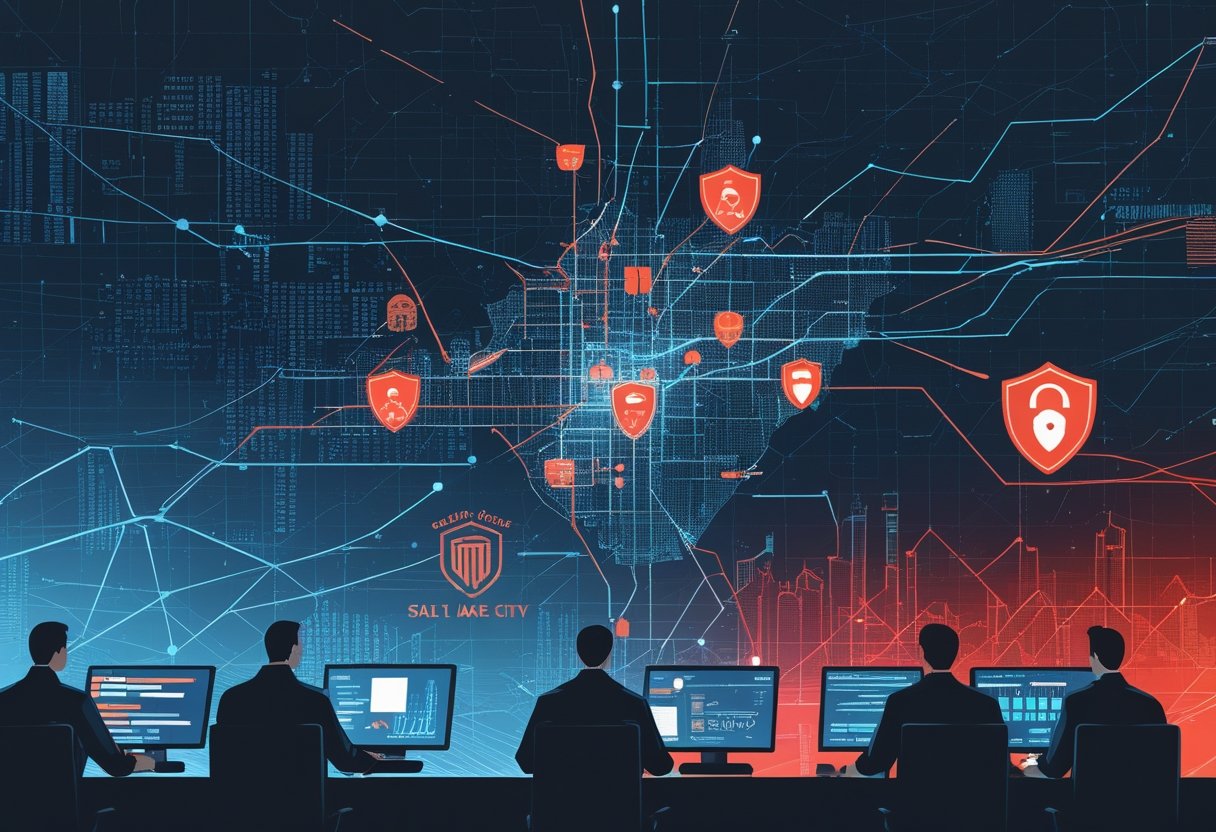
Salt Lake City’s organizations deal with a whole spectrum of cyber threats—ransomware, phishing, and those notorious APT groups with new tricks up their sleeves. There’s been a pretty clear spike in attacks on healthcare, financial services, and tech companies lately.
Common Cyber Attacks Targeting Local Organizations
Ransomware has been a real headache for small and midsize businesses here. Healthcare providers saw a 34% jump in ransomware incidents in 2025, which isn’t exactly comforting if you’re in that sector.
Phishing is still the main way attackers get in. On average, about 23% of employees end up hit by credential theft through spear-phishing emails each year. Business email compromise (BEC) has drained over $18 million from Utah businesses in 2025 alone.
DDoS attacks have battered Salt Lake’s e-commerce and financial outfits. The FBI’s local office reported a 41% increase in DDoS incidents against regional banks and credit unions in just the first quarter of 2026.
Trends in APT Activity & TTPs
APT29 and APT41 have been poking around Salt Lake’s tech and aerospace sectors. They’re getting sneakier—using so-called “living-off-the-land” tricks, like abusing PowerShell and WMI, instead of dropping obvious malware.
Cloud infrastructure is looking more vulnerable, too, especially when it’s misconfigured. Supply chain attacks are creeping up, with threat actors targeting trusted software vendors and managed service providers to hit multiple victims at once.
The FBI’s even sent out advisories warning about APTs going after local MSPs. It’s a cat-and-mouse game, and the stakes keep rising.
Emerging Threats in the Region
AI-powered attacks are starting to show up—attackers using machine learning to automate recon and crank out scarily convincing phishing messages. The scale is something else.
IoT vulnerabilities are another sore spot. Researchers found over 47,000 exposed IoT devices around Salt Lake, many with default credentials or old firmware. That’s a lot of open doors.
As Utah’s blockchain scene grows, cryptocurrency-related threats are getting nastier. Attackers are going after exchanges, wallets, and mining operations with some pretty advanced malware and social engineering moves.
Security Operations Centers: Local Focus
Security Operations Centers (SOCs) in Salt Lake City are the nerve centers for cybersecurity—monitoring, detecting, and responding to threats in real time. There’s a mix of cutting-edge tech and people with sharp instincts working together.
Role & Functions of SOCs
SOCs are where all the action is when it comes to defending an organization’s digital perimeter. Teams keep an eye on network traffic, dig into security alerts, and chase down anything that looks off—24/7, no breaks.
Analysts use all sorts of specialized tools to spot malware, unauthorized access, and other sketchy activity. They triage incidents, coordinate responses, and keep the security infrastructure—firewalls, IDS, endpoint protection—running smoothly.
There’s a ton of documentation and reporting, too. Every event gets logged, and compliance reporting is a never-ending part of the job.
Deployment & Monitoring Strategies
Some organizations run their own SOCs on-site, while others go with managed security service providers. On-prem means more control, but managed services can be a lot more cost-effective, especially for smaller teams.
Common monitoring approaches include:
- Network traffic analysis for anomalous patterns
- Endpoint detection and response (EDR) systems
- Security information and event management (SIEM) platforms
- Threat intelligence feeds integration
Layered monitoring is the name of the game—automated detection plus human analysis. Analysts constantly tweak alert thresholds to avoid overload. Threat hunting is a regular part of the routine, looking for stuff that automated tools might miss.
Collaboration With Law Enforcement
SOC teams keep close ties with the FBI’s Cyber Division and local law enforcement. When cyber incidents cross into criminal territory or national security, quick info sharing is crucial.
If there’s a big breach, SOCs help law enforcement preserve evidence and dig into investigations—think technical details, logs, forensic data. The FBI’s InfraGard program connects SOC pros with government resources, and industry ISACs help keep everyone in the loop on the latest threats.
Cloud Security and IT Infrastructure Protection
Protecting cloud environments and IT infrastructure is non-negotiable. The best strategies blend proactive controls, infrastructure hardening, and compliance frameworks—no shortcuts.
Best Practices for Cloud Security
Cloud security’s a two-way street: providers handle some stuff, customers handle the rest. Multi-factor authentication (MFA) should be everywhere, and least-privilege access is just common sense.
Encryption is a must—data at rest, data in transit, all locked down with strong protocols like AES-256 and TLS 1.3. No excuses here.
Key security measures include:
- Regular security assessments and penetration testing
- Continuous monitoring of cloud resources and access logs
- Automated backup solutions with geographic redundancy
- Network segmentation through virtual private clouds (VPCs)
Security groups and NACLs should only allow what’s necessary. Keeping an up-to-date inventory of cloud assets and automating patch management saves a lot of headaches down the road.
IT Infrastructure Hardening Techniques
Hardening infrastructure means cutting out unnecessary services and tightening up configurations. Disable unused ports, get rid of default accounts, and patch systems within two days if you can swing it.
Critical hardening steps:
| Technique | Implementation |
|---|---|
| Network Segmentation | Separate critical systems using VLANs and firewalls |
| Endpoint Protection | Deploy anti-malware and host-based intrusion detection |
| Access Controls | Implement role-based access control (RBAC) |
| Configuration Management | Use tools like Ansible or Puppet for consistent security policies |
Deploy intrusion prevention systems at the network edge, and use application whitelisting for critical servers. Regular vulnerability scans help spot problems before attackers do.
SIEM and log management tools give visibility into what’s happening across the infrastructure. Spotting unusual patterns early can make all the difference.
Data Governance & Compliance
Data governance is about setting clear rules for collecting, storing, and managing information. Classify data by sensitivity and lock down the most critical stuff first.
Compliance frameworks like SOC 2, ISO 27001, and GDPR come with their own checklists. If you’re in healthcare or payments, add HIPAA or PCI DSS to the mix—there’s no way around it.
Essential governance components:
- Data retention policies aligned with legal requirements
- Regular compliance audits and remediation tracking
- Privacy impact assessments for new systems
- Incident response plans with defined escalation procedures
Keep your security policies documented and hang onto those audit logs. Training staff is essential—everyone needs to know the rules and their part in keeping data safe.
Cybersecurity Education & Professional Certifications
Salt Lake City’s got some great options for cybersecurity education. There are degree programs, certification tracks, and plenty of ways for pros to level up—CISSP and CISA are especially popular around here.
Top Cyber Security Degree Programs
The University of Utah offers a Bachelor of Science in Computer Science with a cybersecurity focus. Students get hands-on with network security, cryptography, and threat analysis, plus research projects and internships with local firms.
Westminster College runs a Bachelor of Science in Cybersecurity that leans into practical skills—pen testing, digital forensics, policy development. Small class sizes make it easier to get personal attention.
Salt Lake Community College has an Associate of Applied Science in Cybersecurity—a solid, affordable entry point. It’s geared toward entry-level jobs and covers CompTIA Security+ prep.
CISSP & CISA Training Opportunities
There are plenty of CISSP boot camps in Salt Lake, usually running five to seven days and covering all eight domains. Study groups meet at local tech hubs—prepping for the exam is a bit less lonely that way.
CISA training happens quarterly through professional development centers, focusing on IT governance, risk, and compliance. A lot of local employers will even reimburse the cost if you pass.
Online platforms help fill in the gaps with flexible schedules, practice exams, and study materials. Pass rates for folks who train locally are actually higher than the national average, which says something about the quality here.
ISACA Community Engagement
The Salt Lake City ISACA chapter holds monthly meetings with industry speakers and workshops. Members can rack up CPE credits for CISA and CISM, and there are plenty of networking events to connect pros across sectors.
ISACA’s got mentorship for newcomers, and the annual conference is a big draw for regional experts. They also run a job board focused on Utah cybersecurity roles.
Students get discounted memberships, and there are scholarships each year for those enrolled in local programs.
Key Cyber Security Employers & Consulting Firms
Salt Lake City’s got a growing mix of cybersecurity employers, from established consulting giants to scrappy tech startups. These organizations are always on the lookout for new security talent and work with local businesses to shore up IT infrastructure all over the region.
Leading Cybersecurity Companies in SLC
There are some big names with real cybersecurity operations in Salt Lake City. Pluralsight runs training platforms and hires security pros to craft industry-focused educational content. Ivanti is another local heavyweight, offering IT security management solutions and keeping a solid presence here.
Cybereason has a regional office that’s all about endpoint protection and threat detection. SecurityMetrics is known for compliance and vulnerability scanning, helping businesses across different sectors stay secure. Booz Allen Hamilton is in the mix too, providing consulting to both government and private clients.
You’ll also find offices for Deloitte, PwC, and KPMG—all offering cybersecurity consulting. They’re hiring for roles like analysts, pen testers, and security architects. Local tech players like Domo and Qualtrics keep their own security teams busy protecting cloud platforms and customer data.
Career Opportunities for Security Professionals
Security folks in Salt Lake City have options across a bunch of specialties. Entry-level gigs include security analyst, compliance specialist, and IT auditor.
Mid-level jobs often mean penetration tester, security engineer, or incident responder. Senior roles might be security architect, CISO, or consultant. Most employers want to see certifications like CISSP, CEH, or Security+.
The financial sector especially craves pros who know regulatory compliance and risk management inside out. With remote work, local firms are now fishing from a much bigger talent pond. Salaries? You’ll see anything from $65K at the low end to north of $180K for leadership spots.
Collaboration With Local Businesses
Cybersecurity firms here team up with local businesses to tackle specific IT vulnerabilities. These partnerships usually mean risk assessments, network security rollouts, and training programs for employees.
Small and mid-sized companies often hire consultants for managed security services. Financial institutions turn to security pros to meet strict regulations and protect data. Healthcare organizations lean on experts for HIPAA compliance and patient privacy.
Retailers work with security firms to tighten up payment card standards. Local consultants are busy doing regular pen tests, vulnerability scans, and jumping in for incident response when attacks happen.
Industry Events & Networking Opportunities
Salt Lake City’s cybersecurity community is anything but quiet. There are conferences, hands-on technical challenges, and casual meetups that bring security pros together all over the valley.
Cybersecurity Conferences & Summits
The Utah Cyber Center puts on quarterly summits, drawing in industry leaders, government types, and practitioners. You’ll usually hear keynotes from heavy hitters in tech and security.
BSidesSLC is a staple—an annual conference packed with technical talks and workshops. The focus is on new threats, defensive moves, and offensive tricks. Tickets range from free to pro-level packages, and they tend to go fast.
The Mountain West Cyber Summit pulls in folks from all over the Intermountain West. It’s a multi-day event with vendor booths, training, and cert prep. You can even pick up continuing ed credits at some sessions.
Workshops & Capture the Flag Challenges
Universities and security groups host monthly workshops on everything from pen testing to incident response and secure coding. These are hands-on, so you actually get to play with the tools and techniques.
DC801, Salt Lake’s DEF CON crew, runs regular Capture the Flag events. These challenges cover cryptography, reverse engineering, web exploits, and forensics. There’s room for both newbies and seasoned hackers here.
The Intermountain Healthcare Security Team sometimes puts on CTFs focused on medical infrastructure. These simulate real-world scenarios you’d run into in healthcare environments.
Community-Driven Networking
There are monthly meetups through Meetup.com and local forums—usually at tech offices, coworking spaces, or universities. These are pretty informal and good for making connections.
The Utah Information Security Community has a Slack with over 1,200 members. It’s a lively spot for job leads, mentoring, and deep-dive technical chats. People share threat intel, talk about new vulnerabilities, and even organize cert study groups.
Local ISSA and ISC2 chapters run evening networking sessions that mix learning with socializing. It’s a great way for newcomers to meet people and for veterans to expand their networks in the SLC cybersecurity scene.
Incident Response & Digital Forensics
Security pros need a solid plan for handling breaches and digging into digital evidence. SOC teams usually coordinate the response, while forensics experts figure out what happened and how deep it went.
Process for Managing Security Incidents
Most organizations follow a six-phase incident response cycle: preparation, identification, containment, eradication, recovery, and lessons learned. Preparation means setting policies, building response teams, and rolling out monitoring tools.
During identification, SOC analysts keep an eye on alerts from SIEMs, IDS platforms, and endpoint tools. They sort incidents by severity and escalate big threats—like APTs—to senior staff.
Containment comes in two flavors: short-term (isolate affected systems fast) and long-term (apply fixes while keeping things running). Here are a few key response activities:
- Evidence preservation and documentation
- Threat actor behavior analysis
- Stakeholder communication protocols
- Regulatory reporting requirements
Penetration Testing & Ethical Hacking
Pen testing is all about simulating attacks so you can find vulnerabilities before the bad guys do. Security pros follow frameworks like PTES, OWASP, or OSSTMM to test networks, web apps, and even physical security.
Ethical hackers start with reconnaissance—gathering info on targets, scanning for open ports, and hunting for outdated software or misconfigurations. Then comes exploitation, where they see which vulnerabilities are actually exploitable.
Tools like Metasploit, Burp Suite, and custom scripts help testers validate weaknesses without breaking things. Afterward, they assess what a real breach might have done. Organizations use black box (no info), white box (full info), or gray box (some info) testing, depending on their goals.
Computer Forensics Investigations
Digital forensics is about examining electronic evidence to piece together incidents and support legal cases. Investigators make forensic images of systems, capturing everything bit-for-bit without touching the original data.
They dig into volatile data (RAM, live network connections, running processes) and non-volatile stuff (drives, logs, backups). Tools like EnCase, FTK, and Autopsy help recover deleted files, analyze malware, and build attack timelines.
Registry entries, browser history, and emails can all provide clues for tracing attackers. Chain of custody is critical—investigators log who handled evidence, when it changed hands, and what was done to it, so it holds up in court.
Careers in Cyber Security: Pathways and Insights
Cybersecurity offers a ton of career paths, each with its own technical demands and opportunities in both private and public sectors. You could start as a technical analyst or end up in federal law enforcement—there’s a lot of room to choose your adventure.
Roles & Responsibilities in Cybersecurity
Security professionals fill all sorts of specialized roles to keep organizations safe from digital threats. Some are analysts, watching networks for weird activity, investigating breaches, and rolling out protections. Pen testers act like attackers, poking holes in defenses before someone else does.
Security architects design secure networks and build frameworks to weave security through the whole tech stack. Security engineers are the hands-on folks, maintaining firewalls, intrusion detection, and encryption.
CISOs set the big-picture strategy and lead teams, making sure incident response plans are ready and risks get communicated to the top brass. Incident responders jump in during breaches to contain threats and recover systems.
Job Requirements & Skills in High Demand
Most roles want a bachelor’s in computer science, IT, or something similar. Entry-level jobs might accept an associate degree if you’ve got relevant certs.
CISSP is the gold standard for experienced pros. CISA shows you can audit and control info systems. CompTIA Security+ is a common starting point for newcomers.
Employers are looking for skills in:
- Network security and architecture
- Cloud platforms (AWS, Azure, GCP)
- SIEM tools
- Programming (Python, Java, C++)
- Risk assessment
Analytical thinking and problem-solving are a must. Security pros need to keep learning—new threats pop up all the time, and what worked last year might not cut it now.
FBI & Other Federal Opportunities
The FBI hires cybersecurity specialists to investigate cybercrime and protect national infrastructure. Their cyber teams include special agents and computer scientists focused on digital forensics. You’ll need U.S. citizenship, a clean background, and usually a relevant degree.
The Department of Defense, NSA, and DHS also have cyber roles—think pen testing, threat intel, and SOC work. Federal gigs tend to offer stability, solid benefits, and the chance to tackle high-stakes security issues.
The military has cyber warfare units too. Service members can pick up training and certs, then move into civilian cybersecurity jobs after their service.
Policy, Compliance, & Legal Considerations
Salt Lake City organizations have to juggle federal rules, state laws, and industry standards—plus manage risk and keep things ethical as they go about their cybersecurity business.
Local & Federal Cybersecurity Regulations
Utah’s cyber rules are a mix of state and federal laws. The Utah Data Breach Notification Law says companies need to alert people if their personal info gets compromised—within 45 days of finding out, no less.
Federal regulations depend on your industry. HIPAA covers healthcare, demanding tight controls for patient data. The Gramm-Leach-Bliley Act makes financial institutions protect customer info with a combo of admin, tech, and physical safeguards.
The FBI works with local businesses through its SLC field office to address cyber threats and enforce federal computer crime laws. The Computer Fraud and Abuse Act is the backbone for prosecuting unauthorized access. If you contract with the feds, NIST SP 800-171 compliance is a must for protecting controlled unclassified information.
Risk Management Strategies
Good cybersecurity risk management starts with figuring out what assets you’ve got and what threats you face. Regular vulnerability scans and pen tests are key. The NIST Cybersecurity Framework breaks things down into: Identify, Protect, Detect, Respond, and Recover.
ISACA’s COBIT framework helps align IT security with business goals. Risk matrices let you prioritize vulnerabilities by likelihood and impact. Every org should have an incident response plan with clear roles and communication steps.
Managing third-party risk means vetting vendors before they get access. Regular audits check whether security policies are working and point out where things could be better.
Ethical Standards in Information Security
Professional ethics in information security call for transparency, accountability, and a real respect for privacy. Security folks constantly juggle the need to protect organizations with the rights of individuals—privacy and data sovereignty matter, even when it’s inconvenient.
The ISACA Code of Professional Ethics lays out principles that support both the security and privacy of stakeholders. Ethical practitioners steer clear of conflicts of interest and stick to responsible disclosure when they find vulnerabilities.
They won’t cross the line into unauthorized access, no matter how tempting or easy it might be. Organizations should really have whistleblower protections in place for employees who speak up about security issues.
Security teams need to get proper authorization before running penetration tests or assessments. Any data collection or monitoring has to align with employee privacy expectations and, obviously, legal requirements.
Advancements & Future Directions in SLC Cyber Security
The cybersecurity scene in Salt Lake City is anything but stagnant. Tech innovation and collaboration between security professionals keep pushing things forward.
Machine learning and automated response systems are quietly changing how threats get detected and handled. The pace of change is pretty wild at times.
Innovations in Threat Detection
Security teams in SLC now use behavioral analytics that spot oddities in network traffic in just milliseconds. These systems figure out what “normal” looks like for users, then flag anything that seems off—stuff old-school signature tools would totally miss.
Modern detection methods include:
- User and Entity Behavior Analytics (UEBA) - Tracks login patterns, data access habits, and application usage
- Deception technology - Creates honeypots and decoy assets to lure attackers
- Extended Detection and Response (XDR) - Consolidates data from endpoints, networks, and cloud environments
SOC teams are seeing up to a 60% drop in false positives compared to the clunky legacy systems. Regional threat intelligence feeds add local context, helping analysts focus on what matters most.
Integration of AI & Automation
AI-powered platforms are now handling all sorts of routine tasks that used to eat up analyst hours. Automated playbooks kick off the first steps of incident response, contain threats, and collect forensic data before a human even gets involved.
Machine learning models sift through millions of security events every day, picking out sophisticated attack chains. These systems keep learning, adapting to new threats without someone having to update rules by hand.
Many organizations say their mean time to detection is 40-50% faster when AI is in the mix. That’s a big deal for teams trying to keep up.
Key automation areas:
- Patch management and vulnerability remediation
- Security alert triage and enrichment
- Compliance reporting and audit preparation
AI and automation aren’t replacing people—they’re giving security pros more breathing room to focus on threat hunting and the tricky investigations.
Building a Resilient Security Community
SLC’s security professionals make a habit of sharing info through local threat intelligence networks and industry forums. This kind of collaboration means they can spot new attack campaigns targeting local organizations much faster.
There’s a big push to help current security staff level up in cloud security, DevSecOps, and incident response. Monthly workshops and capture-the-flag events are pretty common, giving SOC analysts a chance to sharpen their skills in a hands-on way.
Cross-sector partnerships—think finance, healthcare, and government—help build coordinated defense strategies. When everyone’s working together, it’s just easier to bounce back from big security incidents.
Frequently Asked Questions
SLC stands for Salt Lake City, Utah—a tech hub that’s been growing like crazy. Cybersecurity careers here are on the rise, with local employers looking for people who’ve got the right certifications. Salaries? They’re all over the map, depending on your background and specialty.
What does the acronym SLC mean in the context of cybersecurity?
SLC is short for Salt Lake City, Utah’s capital and a growing tech center in the Mountain West. The city’s become a real player in cybersecurity, with tech companies, government contractors, and security firms all setting up shop.
People sometimes call it “Silicon Slopes” because of the tech boom. It’s a draw for cybersecurity pros—lower cost of living than the coasts, plus it’s close to federal installations that need security expertise.
What kinds of cybersecurity jobs are most in demand in the Salt Lake City area?
Security analysts and engineers are always near the top of the list in Salt Lake City. Companies need folks who can keep an eye on networks, jump on incidents, and tighten up security controls.
Cloud security specialists are seeing more demand as companies move to the cloud. Penetration testers and ethical hackers are also in the mix—organizations want to find weaknesses before the bad guys do.
Governance, risk, and compliance roles are important for navigating regulations. And security operations center analysts are still crucial for 24/7 monitoring and response.
What cybersecurity certifications are most valued by employers in Utah?
CISSP (Certified Information Systems Security Professional) is still a big deal for Utah employers, especially for senior roles. It covers a lot of ground and often shows up as a requirement.
CompTIA Security+ is common for entry-level gigs and government contracts. CEH (Certified Ethical Hacker) and OSCP (Offensive Security Certified Professional) are popular with employers who want penetration testing skills.
CISM and CISA certifications matter for governance and compliance jobs. Cloud certs from AWS, Azure, and Google Cloud are becoming must-haves as more companies get serious about cloud security.
How much do cybersecurity roles typically pay in Utah across experience levels?
Entry-level analysts in Utah usually make between $55,000 and $75,000 a year. These jobs typically want 0-2 years of experience and a Security+ cert or a related degree.
Mid-level folks with 3-5 years under their belt can expect $80,000 to $110,000. That covers roles like security engineers, incident responders, and specialized analysts.
Senior professionals and managers with more than five years’ experience can pull in $115,000 to $160,000 or higher. Chief Information Security Officers and senior architects at bigger companies sometimes break the $180,000 mark in total compensation.
Which major cybersecurity conferences & summits in 2026 are most relevant for professionals in the region?
The RSA Conference in San Francisco is set for April 27-30, 2026, and it’s still one of the biggest events in the field. Black Hat USA is happening August 1-6, 2026, in Las Vegas, with technical training and research talks that draw crowds.
BSides Salt Lake City is a local, grassroots conference just for Utah’s cybersecurity crowd. DEF CON 34 follows Black Hat in Vegas from August 6-9, 2026, and it’s all about hands-on hacking and workshops.
There are also regional options like the SANS Cyber Threat Intelligence Summit and the Rocky Mountain Information Security Conference. These are great for networking and connecting with peers and employers across the Mountain West.
Is cybersecurity still a growing career field, & what trends are shaping demand right now?
Cybersecurity's still one of the fastest-growing career fields out there. Job growth projections keep outpacing most other occupations, which is honestly kind of wild if you think about it.
With cyberattacks getting more frequent and sneaky, skilled professionals are needed pretty much everywhere. It's not just tech companies—everyone's in on this now.
Cloud security skills are a must these days, especially as businesses wrap up their digital transformations. Zero trust architecture is another big deal, and folks who get identity management, network segmentation, and continuous authentication are in high demand.
AI and machine learning are shaking things up, too, opening up new areas to specialize in. And after some high-profile supply chain attacks, that area has gotten a lot more attention.
On top of all that, privacy regulations keep expanding, so compliance pros aren't going anywhere. It's a lot to keep up with, honestly.