

When your business experiences growth, your IT infrastructure should act as a catalyst, powering your momentum rather than restraining it. With a tailored, proactive managed services approach, your technology environment doesn't just keep pace—it anticipates needs, scales resources intelligently, and delivers enterprise-grade capabilities regardless of business size. This model transitions your organization away from the stresses of reactive troubleshooting, towards a future where IT is an enabler, not a bottleneck. Whether you’re a fast-growing SMB entering new markets or a mid-sized enterprise expanding your footprint with additional remote sites, your technology framework must adapt seamlessly—providing secure, reliable connectivity and operational efficiency everywhere you do business. By aligning IT strategy with ongoing business evolution, managed services ensure that every stage of growth is supported with robust, cost-effective solutions, allowing your team to focus on innovation and long-term success.
This post explores how scalable, proactive managed IT services enable growth while keeping your business secure, efficient, and ready for what’s next. You’ll learn how a modern managed service provider (MSP) model supports 24/7 operations, strengthens cybersecurity, and controls costs—all while aligning IT priorities to your evolving business strategy.
Why a Proactive Managed Services Model Improves Reliability, Security, & Cost Control
Most organizations start by managing IT tasks internally, finding this approach both practical and budget-friendly initially. Yet, as operations scale, IT environments rapidly evolve in complexity—resulting in more users, a broader array of business applications, and an increased reliance on digital infrastructure. This growing complexity quickly outpaces ad hoc approaches and stretches internal teams to the limit. Simultaneously, cyber threats are evolving in both frequency and sophistication, with ransomware attacks, spear phishing campaigns, and advanced persistent threats putting constant pressure on traditional defenses.
Under these circumstances, operating in a reactive mode—where IT support is deployed only after disruptions or failures—proves unsustainable. Downtime becomes a recurring challenge, eroding productivity and customer trust. Performance issues linger, creating bottlenecks that restrict growth and innovation. Hidden costs and unpredictable repair expenses further strain budgets, making IT expenditures difficult to forecast and control. Ultimately, the absence of a proactive IT management strategy increases exposure to security risks and compliance failures, turning technology into a liability rather than a competitive asset. To drive ongoing business growth, organizations need a forward-thinking IT approach that anticipates issues, secures assets, and aligns technology with evolving business goals.
The Shift from Reactive to Proactive IT
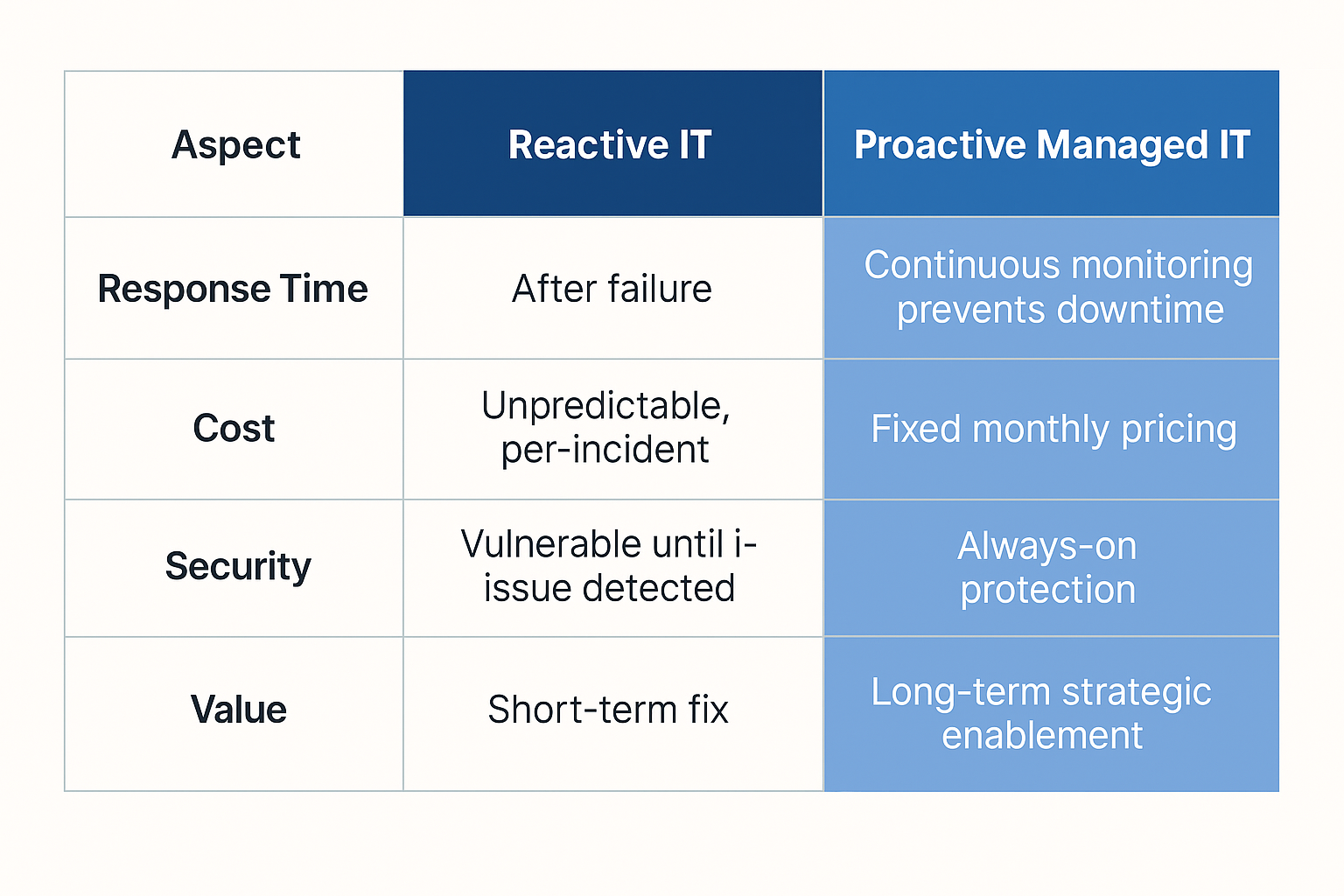
Traditional “break-fix” support only kicks in when something goes wrong. This model is costly, unpredictable, and leaves businesses vulnerable to unnecessary risk and downtime. By contrast, a proactive managed IT services approach transforms technology management—intervening before issues impact your users or your business continuity, and systematically driving stronger security and operational efficiency.
Here’s how a proactive managed IT model stands apart:
- 24/7 Monitoring and Rapid Response: Continuous monitoring detects and addresses emerging problems in real time, often resolving incidents before they escalate or disrupt critical workflows. This vigilance extends to every endpoint, server, and network device, ensuring nothing slips through the cracks—day or night.
- Automated Patching and Security Updates: Keeping software and systems up to date is one of the most effective ways to defend against cyber threats. Automated patching ensures that vulnerabilities are closed quickly, reducing exposure to ransomware, malware, and zero-day exploits, while relieving internal teams of the burden of manual update cycles.
- Standardized Environments for Greater Uptime: By leveraging standardized configurations and best practices across your IT estate, managed services eliminate common points of failure and compatibility issues. This not only streamlines support and troubleshooting but also enhances system uptime, resulting in smoother daily operations and fewer interruptions for your users.
- Strategic, Data-Driven IT Alignment: Proactive IT management leverages analytics, performance dashboards, and metrics to give clear visibility into asset health and usage. With this information, decision-makers can align IT spending with business priorities, optimize technology investments, and validate ROI—ensuring technology becomes a competitive asset, not a sunk cost.
What’s the real impact? With continuous improvement and preventative maintenance built into every aspect of the service, downtime is minimized and issues are resolved behind the scenes—freeing your team to focus on business strategy, operational growth, and customer value, instead of firefighting IT disruptions. Ultimately, a proactive managed IT partnership delivers a technology foundation built for reliability, resilience, and sustained success.
Reliability Built for Growth
As your company scales, system reliability becomes non-negotiable. Managed IT services drive the consistency and predictability your business needs, whether you’re onboarding ten new users or a hundred, supporting a single location or a distributed, hybrid workforce. Modern managed service providers proactively monitor every endpoint, automate the resolution of emerging issues, and standardize device configurations—ensuring that systems remain stable under changing demands.
Here’s how reliability improves through managed IT:
Unified device management: Endpoint standardization minimizes configuration drift, reduces the risk of compatibility conflicts, and simplifies support. This enables the rapid deployment of devices and applications, seamless onboarding of new team members, and a consistent user experience throughout your organization.
Automated alerting: AI-powered monitoring tools provide around-the-clock oversight, immediately detecting anomalies and potential failures before users are affected. Automated remediation can address common issues instantly, while escalation workflows ensure that critical incidents receive rapid expert intervention. This continuous vigilance ensures that operations run smoothly, reducing unscheduled downtime.
Disaster recovery planning: Comprehensive backup and recovery strategies are implemented, routinely tested, and validated against real-world scenarios to ensure business continuity. Managed IT services include systematic assessments to identify potential vulnerabilities, enabling your organization to respond to disruptions with confidence and recover quickly, regardless of the cause.
This predictability doesn’t just improve uptime—it establishes a foundation that empowers growth and innovation. When technology runs reliably, executive leadership can move forward confidently with bold initiatives, explore new markets, and embrace digital transformation strategies knowing that IT will keep pace every step of the way. With a resilient and well-managed technology environment, your organization is well-positioned to seize new opportunities and drive sustained success.
Security: Always-On Protection for a 24/7 World
Cyber threats don’t take weekends off—and neither should your defenses. Cyber Advisors’ managed IT services are built for a 24/7 world, delivering around-the-clock monitoring, advanced vulnerability management, and layered endpoint protection. Every device, server, and user—whether onsite or remote—is continuously guarded to ensure your business remains resilient at all times.
Proactive cybersecurity within our managed IT offering goes beyond the basics by incorporating:
- Ongoing vulnerability scanning and automated patch management, eliminating entry points for attackers and minimizing your exposure to emerging threats.
- Managed detection and response (MDR/XDR) driven by real-time analytics and expert analysts, enabling swift identification and containment of suspicious activity before it can disrupt operations.
- Comprehensive controls across email, endpoints, and cloud applications, reducing the risk of phishing, business email compromise, and malware by actively blocking threats at every attack surface.
- Integrated data backup and disaster recovery strategies tailored to your environment, so critical business information is continually protected and quickly recoverable in the event of an incident.
This relentless vigilance achieves more than just reassurance; it actively curtails risk, quantifiably lowers your organization’s total cost of cybersecurity, and preserves operational continuity. By maintaining strict adherence to leading industry regulations—including HIPAA, PCI-DSS, and CMMC—Cyber Advisors delivers compliance as an integrated part of your security posture, allowing you to stay ahead of evolving standards while keeping your focus on core business growth.
Cost Control Through Predictable Pricing
Unplanned downtime and unexpected hardware failures are major cost drivers. A proactive managed IT model replaces those unpredictable expenses with a fixed monthly rate.
Benefits of predictable pricing include:
-
Easier budgeting with no surprise repair costs.
-
Reduced operational overhead through automation and remote management.
-
Scalability—adding or removing users, locations, or services without costly overhauls.
-
Transparent reporting to track ROI and performance metrics.
For SMBs and mid-market firms, this cost predictability turns IT into a strategic lever—not a sunk cost.
How to Align Managed IT Scope & SLAs to Evolving Business Priorities
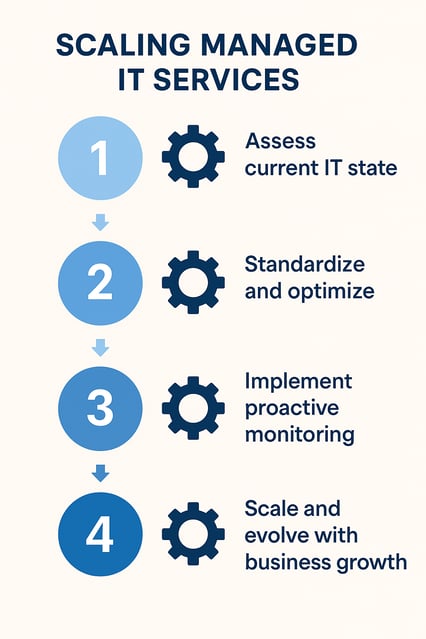
Every organization’s technology roadmap is different. The key is ensuring your managed IT provider evolves with you—aligning service scope, SLAs, and technology standards to your current and future goals. A strong partnership goes beyond initial implementation; your managed service provider should operate as a strategic ally, proactively assessing your business needs and making recommendations as your organization expands, adapts to new regulations, or integrates emerging technologies. This evolution means regularly reviewing and updating service agreements, compliance requirements, and security frameworks to ensure maximum value and ongoing resilience. By keeping your IT strategy flexible and aligned with your business objectives, you position your organization not just to keep pace with change, but to drive innovation and achieve sustainable growth.
1. Define Business Outcomes First
Before setting technical SLAs, identify the outcomes your organization values most:
-
Improved uptime and user experience?
-
Faster project delivery?
-
Strengthened security posture?
Your MSP should translate those priorities into measurable service commitments that evolve over time.
2. Scale Services Up or Down Quickly
When market conditions change, agility matters. Scalable managed IT lets you add capacity fast—whether you’re opening new branches, integrating acquisitions, or supporting a hybrid workforce.
-
Cloud infrastructure enables rapid provisioning.
-
Virtual desktops support remote collaboration.
-
Modular service packages let you scale without overpaying.
3. Standardize for Performance & Efficiency
Standardization may sound limiting, but it’s the opposite. By consolidating tools, vendors, and configurations, your business gains:
-
Faster troubleshooting and fewer compatibility issues.
-
Simplified compliance audits.
-
Better user experiences and reduced downtime.
Cyber Advisors’ approach to managed IT emphasizes enterprise-grade consistency—delivered through scalable, automated systems that work for both SMBs and mid-sized enterprises.
4. Continuous Improvement Through Data & Partnership
A mature MSP relationship isn’t just about keeping the lights on. It’s about ongoing optimization. Through quarterly business reviews (QBRs) and proactive performance reporting, Cyber Advisors ensures your IT strategy keeps pace with your business evolution.
This partnership model delivers:
-
Strategic insights from experienced vCISOs and IT consultants.
-
Benchmarking against industry peers.
-
Roadmaps that tie IT investments to tangible business outcomes.
Your IT infrastructure becomes a growth enabler—an agile system that scales with your success.
Key Takeaways
Scale services up or down fast with a right-sized MSP. When your business needs change—whether you’re expanding, consolidating, or simply adjusting resources—a flexible managed service provider enables you to increase or decrease IT capacity quickly, without the delays of traditional procurement or the risks of overinvestment. This agility ensures that your technology stays aligned with business priorities and supports initiatives such as branch rollouts, M&A activity, or workforce changes—all while maintaining operational continuity.
Continuous monitoring helps reduce incidents and improve reliability. Advanced monitoring tools offer real-time oversight of your infrastructure, enabling the identification of potential issues before they disrupt your operations. Automated alerts, incident detection, and root cause analysis help IT teams proactively resolve vulnerabilities and performance bottlenecks. The result is fewer outages, shorter recovery times, and a stable platform for everyday productivity and long-term innovation.
Standardization boosts performance and security. By unifying your IT environment—using consistent hardware, software, and security protocols—you create efficiencies that streamline management, simplify support, and reduce the risk of misconfigurations. Standardized systems make compliance audits easier, accelerate user onboarding, and deliver predictable experiences for both your workforce and your customers.
Predictable pricing improves budgeting and cost control. With a managed services agreement, you trade unpredictable, break-fix expenses for a clear, fixed monthly rate. This budgeting certainty eliminates unwelcome surprises, making it easier to plan for growth, invest in new initiatives, and demonstrate IT value to leadership. Transparent reporting provides visibility, enabling you to track spending and measure return on investment across your entire IT estate.
Together, these elements form the backbone of a proactive, scalable IT strategy that adapts as your organization grows. By combining flexibility, always-on monitoring, standardization, and financial predictability, your IT environment becomes an engine for business agility—supporting your goals today and evolving seamlessly for what comes next.
Partner with Cyber Advisors: Your IT Growth Multiplier
Cyber Advisors has decades of experience helping organizations transition from reactive IT management to proactive, scalable strategies that fuel growth. We work with clients across industries—from manufacturing and healthcare to finance and education—to design managed IT solutions that reduce risk, enhance performance, and deliver measurable ROI.
Our team provides:
-
24/7 monitoring and response
-
Cloud and hybrid infrastructure management
-
Comprehensive cybersecurity
-
IT lifecycle and asset management
-
Strategic consulting to align IT and business goals
No matter where your organization is on its digital journey, Cyber Advisors helps you build an IT environment that’s secure, scalable, and future-ready.
Request a Managed IT Readiness Assessment today and see how Managed IT Services can help your business on its path to success.