

If you’re an IT leader, security leader, or business executive in a growing organization, you’ve probably felt this tension: you know vulnerability management matters, you’re paying for scanners and reports, and yet risk still feels… stubbornly high. Tickets pile up. Findings repeat. Priorities change every week. And when leadership asks, “Are we safer than last quarter?” the most honest answer is often, “We have more data.”
That gap between “we scan” and “we reduce risk” is exactly why you’re hearing more about Continuous Threat Exposure Management (CTEM). CTEM is not just another tool category. It’s a different operating model—one that treats vulnerability management as an ongoing, threat-informed cycle that blends exposure discovery, prioritization, remediation, validation, and monitoring into a continuous loop.
Traditional vulnerability management (TVM) still has a place. But it was built for a world where infrastructure changed slowly, perimeters were clearer, and patch windows were predictable. Today, cloud services, SaaS, remote work, and fast-moving adversaries make static, periodic approaches less effective.
In this guide, we’ll break down what CTEM is, how it compares to traditional vulnerability management, and how to decide which approach your organization needs. You’ll also get practical steps to modernize your program without trying to rebuild everything overnight.
Quick definitions
Traditional vulnerability management (TVM) is the classic “scan, report, remediate” process. A tool (or set of tools) scans systems on a schedule—weekly, monthly, or quarterly—identifies known vulnerabilities (often mapped to CVEs), and produces findings and severity scores. Security and IT teams then triage, assign remediation tasks, and rescan later to confirm fixes.
Continuous Threat Exposure Management (CTEM) is an approach that continuously measures and reduces exposure to real-world threats by combining:
- continuous or near-continuous discovery of assets and exposures,
- threat-informed prioritization (including exploitability and business impact),
- structured remediation workflows,
- validation that fixes are effective,
- monitoring that adapts to changes in assets, threats, and business priorities.
Think of TVM as periodic health checkups, and CTEM as a combination of continuous monitoring, risk-based triage, and ongoing care planning.
Why the “traditional” model struggles in modern environments
TVM was designed when:
- Most assets lived on-premises.
- Change control was slower.
- Fewer devices were internet-facing.
- Patch cycles were more predictable.
- Security teams had clearer ownership boundaries.
But modern environments introduce challenges that break the assumptions behind TVM.
1) Your asset inventory is never truly “done”
If you don’t know what you have, you can’t protect it. In many organizations, asset inventories lag reality because:
- cloud resources spin up and down dynamically,
- SaaS apps proliferate across departments,
- remote endpoints move between networks,
- M&A introduces shadow IT and inherited risk.
- contractors and vendors connect to critical workflows.
Traditional programs often rely on a static inventory or scan targets defined months ago. That means blind spots—assets that aren’t scanned aren’t managed.
2) Severity scores alone don’t reflect your actual risk
Most TVM programs still lean heavily on CVSS scores. CVSS is useful, but it’s a generic measure. It doesn’t know:
- whether the vulnerable asset is internet-facing,
- whether an exploit exists in the wild,
- whether attackers are actively targeting the vulnerability,
- whether compensating controls reduce real-world exposure,
- whether the asset supports a critical business process.
That’s why teams end up chasing “high severity” issues that may not be urgent, while missing “medium severity” issues that are actively exploited.
3) The remediation queue becomes unmanageable
When scan reports produce hundreds or thousands of findings, teams often fall into a cycle:
- triage quickly,
- patch what’s easy,
- accept risk on what’s hard,
- repeat next cycle.
Over time, you end up with a backlog that becomes “normal.” The program exists, but it’s not measurably reducing exposure. It’s generating work.
4) Point-in-time scans don’t match the pace of threat change
A vulnerability can go from “newly disclosed” to “actively exploited at scale” in days. If you scan monthly and patch quarterly, you’re operating on a timeline that attackers can outrun.
5) Validation is inconsistent
Many organizations treat “patched” as the end state. But in practice:
- patches fail,
- configurations drift,
- dependencies reintroduce issues,
- exceptions accumulate,
- teams close tickets without proof.
Without consistent validation, your reporting can look better than your reality.
What CTEM changes
CTEM is not magic. It does not eliminate vulnerabilities. What it does is shift your program from a compliance-oriented reporting cycle to a risk-reduction engine.
Here are the biggest differences.
1) CTEM starts with continuous visibility, not periodic discovery
Traditional VM:
- Scans on a fixed schedule.
- May miss transient assets or assets outside scan scopes.
- Asset inventory is often maintained separately from scanning.
CTEM:
- Continuously discovers assets across networks, cloud, identities, endpoints, and external exposure.
- Flags changes quickly (new systems, new ports, new SaaS apps, new cloud instances).
- Treats “unknown assets” as a high-priority risk.
Why it matters: you can’t remediate what you can’t see. CTEM reduces the time between “asset appears” and “asset is governed.”
2) CTEM prioritizes by exploitability & business impact, not just severity
Traditional VM:
- Prioritization often equals CVSS + age of finding.
- Business context is applied manually, if at all.
CTEM:
- Incorporates threat intelligence signals: exploit availability, known exploitation, attacker interest, ransomware correlations, and exploit kit adoption.
- Adds environmental context: internet exposure, privilege level, segmentation, compensating controls.
- Adds business context: system criticality, data sensitivity, regulatory exposure, operational impact.
Why it matters: CTEM focuses your limited remediation capacity on the issues most likely to cause harm.
3) CTEM is workflow-driven, not report-driven
Traditional VM:
- Produces a report.
- Teams manually sort, assign, and chase closure.
- Progress is measured by the number of vulnerabilities fixed.
CTEM:
- Uses workflow automation and integration with ITSM tools (like ServiceNow, Jira, or ticketing platforms).
- Creates structured remediation campaigns tied to risk reduction goals.
- Measures progress by risk reduction and exposure reduction, not raw counts.
Why it matters: the difference between a “security program” and a “security operation” is a repeatable, measurable workflow.
4) CTEM includes continuous validation & control testing
Traditional VM:
- Rescans later and assumes closure if vulnerability is no longer detected.
- Validation is periodic and often incomplete.
CTEM:
- Validates remediation continuously.
- Tests controls where possible (segmentation effectiveness, patch compliance, configuration baselines).
- Detects drift and reintroduced exposures quickly.
Why it matters: a closed ticket is not the same as reduced risk. Validation bridges that gap.
5) CTEM broadens the definition of “vulnerability” to “exposure”
Traditional VMs primarily focus on missing patches and known CVEs.
CTEM treats risk as a broader “attack surface exposure,” including:
- misconfigurations (cloud permissions, open storage, insecure defaults),
- identity issues (stale accounts, weak MFA enforcement, privilege sprawl),
- externally exposed services,
- risky SaaS integrations,
- insecure endpoints,
- third-party connections.
Why it matters: many modern breaches start with misconfigurations or identity weaknesses—not just unpatched systems.
Side-by-side comparison: CTEM vs traditional vulnerability management
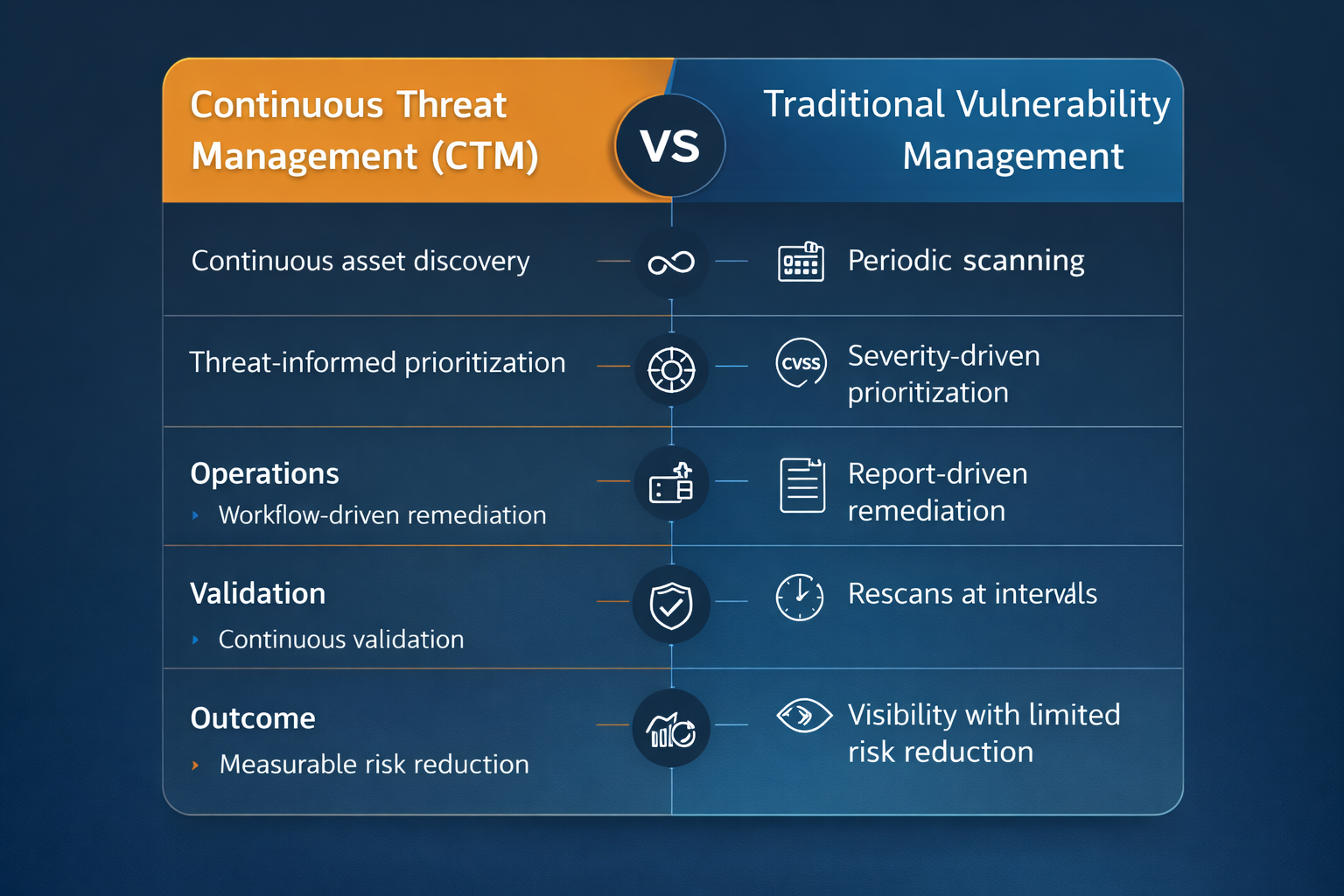
- Scope
TVM: primarily known CVEs on scanned systems.
CTEM: CVEs plus misconfigurations, identity exposures, external attack surface, and control gaps. - Cadence
TVM: periodic (weekly/monthly/quarterly).
CTEM: continuous or near-continuous. - Prioritization
TVM: severity-driven, manual context.
CTEM: threat-informed + context-aware + business-impact-driven. - Operations
TVM: report-driven, reactive.
CTEM: workflow-driven, proactive, metrics-based. - Validation
TVM: rescans on schedule.
CTEM: continuous validation and drift detection. - Outcome
TVM: compliance and visibility; limited risk reduction when resources are constrained.
CTEM: measurable exposure reduction and improved resilience.
The practical benefits of CTEM for SMB & mid-market organizations
CTEM is often associated with large enterprises, but mid-market firms may benefit even more because resources are more constrained. When you have limited staff and time, prioritization and automation matter.
- Faster reduction of the most dangerous risks
Instead of “fix the top 100 criticals,” CTEM aims for “fix the issues most likely to be exploited against your environment.” - Better alignment between security and IT
CTEM’s workflow focus helps reduce friction between teams. IT gets clearer priorities and context. Security gets consistent remediation outcomes. - Fewer recurring findings and less audit pain
Because CTEM includes validation and governance, teams are less likely to see the same issues show up repeatedly. That improves audit readiness and reduces “last-minute scramble” behavior. - More defensible reporting to leadership
Executives don’t want vulnerability counts. They want risk answers: Are we reducing exposure? Are we addressing what attackers are using right now? Where are we still vulnerable—and why? CTEM produces metrics aligned to those questions. - Reduced the likelihood of ransomware and breach pathways
CTEM helps close common attack pathways: exposed remote services, exploitable edge devices, unpatched VPNs and firewalls, privilege-escalation flaws, and weak identity controls.
Common misconceptions about CTEM
- Misconception 1: CTEM means “scan everything all the time.”
CTEM is about continuous visibility and prioritization, not endless scanning that overwhelms systems. Many CTEM programs use lightweight telemetry, integrations, and targeted scanning based on change signals. - Misconception 2: CTEM replaces all traditional scanning
Most CTEM programs still use vulnerability scanners. The difference is how the results are interpreted and operationalized. - Misconception 3: CTEM is only for mature security teams
CTEM actually helps teams become mature by providing structure and prioritization. The key is implementing it in phases. - Misconception 4: CTEM is just a marketing term
Some vendors use “continuous” loosely. The real test is whether your program continuously discovers new exposure, prioritizes based on threat and context, drives remediation through workflow, validates outcomes, and measures risk reduction.
How to transition from traditional vulnerability management to CTEM
You don’t need to rip and replace your tools to move toward CTEM. Most organizations evolve.
Step 1: Fix asset visibility first
Start by answering:
- What assets do we own or operate?
- Which are internet-facing?
- Which hold sensitive data or support critical processes?
- Which systems are unmanaged or unknown?
If you can’t confidently answer those, CTEM will be limited. Build a living asset inventory by integrating endpoint management, cloud accounts, directory/identity systems, network discovery, CMDB (if you have one), and external attack surface monitoring.
Step 2: Add context to prioritize
Create a simple prioritization model that blends exploitability, exposure, privilege impact, business criticality, compliance, and data sensitivity. Even if you do this manually at first, it will instantly improve outcomes.
Step 3: Operationalize remediation with clear ownership
Define ownership across servers/patching, endpoints, network devices, cloud configurations, and identities/access—then integrate the findings into the systems teams already use (ticketing and change management). CTEM fails when it becomes “security email reports.”
Step 4: Build remediation playbooks & SLAs
Create repeatable standards tied to risk tiers, not just CVSS, for example:
- internet-facing critical exploited = fix within X days,
- internal critical with exploit = fix within Y days,
- high-risk misconfiguration = fix within Z days.
Step 5: Validate & measure
Add validation checkpoints, track metrics leadership cares about (time-to-remediate for exploited vulnerabilities, reduction of externally exposed services, percentage of critical assets covered, recurrence rate, backlog aging), and use those metrics for continuous improvement.
Step 6: Continuous improvement
CTEM is a loop. Review outcomes monthly: What did we reduce? What keeps coming back? Where are we blocked? What needs automation, tooling, or staffing? Over time, the program becomes more predictable and effective.
CTEM & vulnerability management modernization in the real world
Imagine two organizations with similar tools.
Organization A (Traditional VM)
- Runs monthly scans.
- Produces a report with 1,200 findings.
- Security team filters by “critical and high.”
- IT patches what’s easy; exceptions accumulate.
- Next month: 900 findings remain, many repeated.
- Leadership sees a “mountain of vulnerabilities” and requests additional tools.
Organization B (CTEM operating model)
- Has continuous asset visibility and flags new internet-facing systems.
- Prioritizes findings based on exploitation signals and business criticality.
- Launches a 30-day campaign to close the top exploitable risks on critical assets.
- Uses ticketing integration and clear ownership.
- Validates, fixes, and tracks the reduction of external exposure.
- Next month: fewer repeat findings; time-to-remediate improves; leadership sees measurable progress.
The tools may overlap, but outcomes differ because the operating model differs.
Where CTEM fits with other security programs
CTEM works best when it’s integrated with MDR/SOC, patch management, identity and access management, incident response planning, and security awareness. CTEM is not a standalone silo. It’s connective tissue linking visibility, remediation, and resilience.
When traditional vulnerability management is “good enough”
Traditional VM may be sufficient if your environment is small and stable, patch discipline is strong, most assets are consistently scanned, external exposure is minimal, and risk appetite/regulatory pressure is lower.
CTEM becomes necessary when your environment changes frequently (cloud, SaaS, remote work), you have distributed endpoints or multiple sites, backlog growth is a concern, leadership wants defensible reporting, incidents occur, or you operate in regulated or ransomware-targeted sectors.
A CTEM starter checklist for IT & security leaders
Visibility
- We can identify all endpoints, servers, and cloud resources.
- We know what is internet-facing.
- We can tag critical systems and sensitive data locations.
Prioritization
- We incorporate exploitability signals into triage.
- We consider business impact and system criticality.
- We have a clear “top risks” list that changes as threats change.
Remediation operations
- Findings flow into a ticketing or workflow system.
- Ownership is clear across IT teams and vendors.
- We have SLAs tied to risk tiers.
- We track exceptions and compensating controls.
Validation and metrics
- We validate remediation, not just ticket closure.
- We track time-to-remediate for high-risk issues.
- We track exposure reduction (especially external).
- We review results regularly and adjust.
If more than a few boxes are unchecked, you’re not alone—and you’re also a strong candidate for a CTEM modernization roadmap.
The anatomy of a high-performing CTEM program
A CTEM program is easiest to understand when you break it into the same lifecycle that attackers follow. Attackers look for exposure, exploit a weakness, gain privileges, move laterally, and impact systems or data. CTEM aims to interrupt that chain earlier—by continuously shrinking the set of exploitable opportunities.
Asset discovery & classification
CTEM begins with a living inventory that updates automatically. But inventory alone isn’t enough—you need classification. Mature programs classify assets by business function, data sensitivity, criticality, exposure level, and control coverage.
Exposure discovery beyond CVEs
In CTEM, “exposure” includes the types of weaknesses attackers actually chain together: misconfigured cloud storage, exposed remote management interfaces, privileged accounts without MFA, stale VPN appliances on end-of-life firmware, and insecure SaaS integrations with excessive permissions.
Threat-informed prioritization
A practical model blends three signals:
- Likelihood (is it exploited? exploit available? reachable?)
- Impact (RCE? credential access? affects critical assets?)
- Control effectiveness (segmentation, MFA, EDR, backups)
This creates a defensible priority list that teams can execute, and leaders can understand.
Remediation orchestration & engineering discipline
CTEM requires clear ownership, standardized baselines, automation where possible, and exception handling with compensating controls and review dates. Mature CTEM treats remediation as engineering work to reduce exposure, including replacing unsupported systems and improving segmentation and identity controls.
Validation & continuous assurance
Validation is assurance that controls work as intended: confirming an exposed service is no longer reachable, verifying patch coverage across the fleet, testing MFA enforcement, and ensuring backups restore within recovery targets.
Key metrics that show CTEM is working
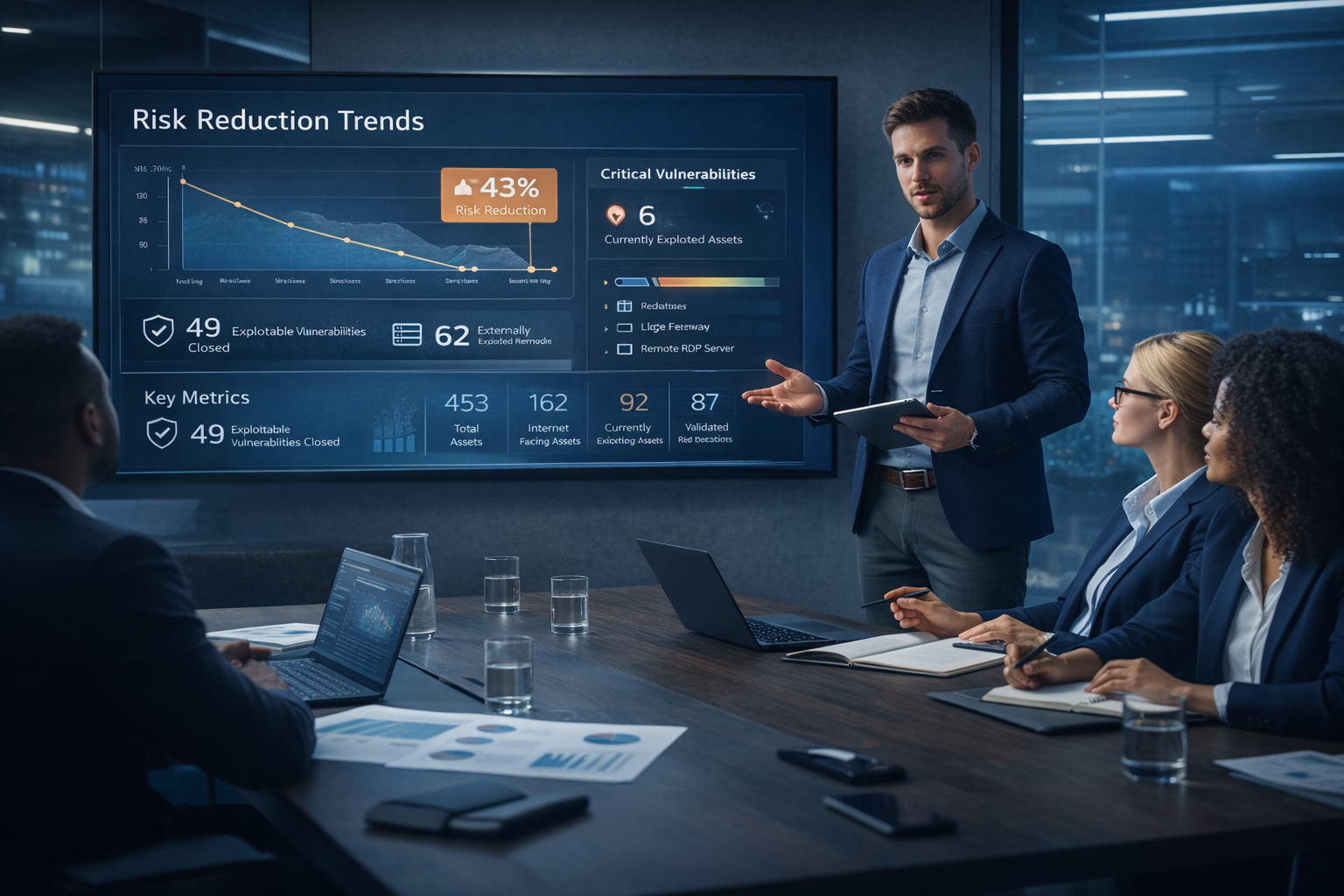
- Speed: MTTR for exploited/exploit-available vulnerabilities; time from asset discovery to governance.
- Exposure: trend of internet-facing assets/services; coverage gaps on critical assets.
- Backlog health: vulnerability aging; recurrence rate; exception review compliance.
- Risk reduction: reduction of top exploitable pathways and high-risk “toxic combinations.”
Practical pitfalls to avoid when adopting CTEM
- Treating CTEM as a tool purchase: It’s an operating model.
- Ignoring identity and cloud exposure: Identity is often the true perimeter.
- No exception governance: Permanent exceptions are a silent risk growth.
- Overloading IT with unprioritized findings: Context and focus matter.
- Measuring success by counts: Prioritize exposure reduction and MTTR.
Frequently asked questions
Is CTEM the same as “Continuous Vulnerability Management”?
You’ll see both terms. The real test is whether your program incorporates threat signals, business context, workflow, and continuous validation.
Do we need 24/7 monitoring for CTEM?
Not always, but CTEM is stronger when integrated with a SOC or MDR because detection insights improve prioritization.
How quickly can we see results?
Many organizations see meaningful improvement within 60–90 days by focusing on asset visibility, reducing external exposure, and addressing the top exploitable risks to critical systems.
Can CTEM help with compliance?
Yes. CTEM strengthens evidence and supports ongoing risk management requirements.
How Cyber Advisors helps you move from “scanning” to “risk reduction”
At Cyber Advisors, we help organizations build vulnerability and exposure management programs that actually reduce risk—without overwhelming your teams.
Our approach is practical and business-aligned:
- Assess your current vulnerability management maturity, tooling, and asset visibility.
- Identify the exposures that matter most based on real-world threat signals and your business context.
- Implement a CTEM-informed operating model: workflow, SLAs, ownership, and validation.
- Integrate exposure management with MDR/SOC, patch management, identity, and cloud governance.
- Provide ongoing guidance, reporting, and continuous improvement—so the program stays effective as you grow.
Cyber ADVISORS' Services
If your vulnerability backlog keeps growing—or if leadership wants proof that security investments are reducing risk—let’s talk. Cyber Advisors can help you implement a Continuous Threat Exposure Management approach that prioritizes what attackers are exploiting right now, reduces your external attack surface, and builds a repeatable remediation engine across your environment.
Next step: Schedule a CTEM & vulnerability management strategy session with Cyber Advisors.
Schedule a Consultation