

Healthcare organizations don’t have a “cybersecurity technology problem.” Most have a “cybersecurity culture problem.”
That’s not a knock on IT or security teams. It’s a reality of how healthcare works: fast-paced clinical environments, complex vendor ecosystems, legacy medical devices, rotating staff, high turnover in certain roles, and an always-on mission where patient care can’t pause for patching windows. In that context, even the best tools—EDR, email security, SIEM, backups, MFA—can be undermined by inconsistent behaviors, unclear ownership, and an organizational mindset that treats security as an IT issue rather than a patient-safety issue.
Cybersecurity maturity is what closes that gap. It’s the ability to prevent, withstand, respond to, and recover from cyber events with discipline and confidence. And maturity is built as much through people and processes as through technology. In healthcare, where ransomware can divert ambulances, interrupt surgeries, and delay diagnostics, a mature security culture becomes part of clinical resilience.
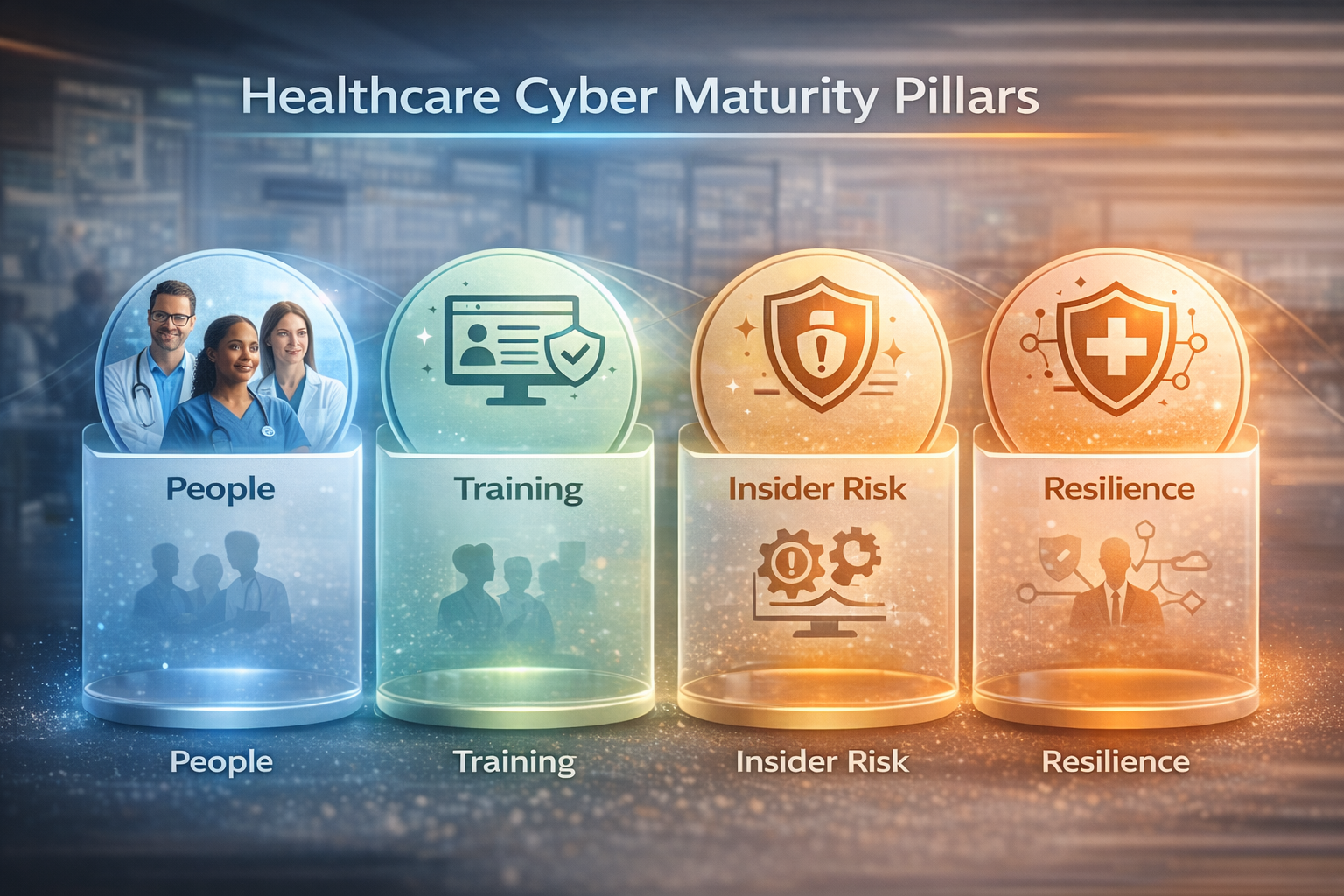
This guide explains how healthcare leaders can build a culture of cybersecurity maturity—starting with staff roles, moving through effective training programs, addressing insider threats, and finishing with practical resilience-building. Along the way, you’ll find awareness campaign ideas, real-world examples, and actionable steps you can implement this quarter.
The Role of Staff in Cyber Maturity
When leadership teams talk about cybersecurity, the conversation often starts with systems: “Do we have MFA?” “Are backups immutable?” “Is our firewall modern?” Those are important questions—but the more powerful question is: “How do our people behave when faced with risk, ambiguity, and pressure?”
Cyber maturity requires the entire organization to participate. Every role—clinical, administrative, IT, and executive—has a different relationship to risk and a different set of daily constraints. A strong security culture acknowledges those realities and designs controls, education, and workflows that fit how staff actually work.
Why staff behavior matters more than you think
A large percentage of healthcare incidents still start with human-driven entry points: phishing, credential theft, business email compromise, misdirected data, insecure passwords, or the use of unapproved tools to “get the job done.” Attackers understand healthcare’s operational pressures. They craft lures around payroll, benefits, EHR access, medical deliveries, and urgent clinical documentation. They target finance teams with wire fraud and supply chain teams with invoice manipulation. They target clinicians with login prompts and “shared document” links, knowing that a busy shift and a small screen are a dangerous combination.
Staff behavior becomes the control that either blocks those tactics—or enables them.
But “behavior” isn’t a simple training issue. It’s shaped by:
- Clarity: Do people know what’s expected?
- Convenience: Is the secure way also the easiest way?
- Reinforcement: Are good behaviors recognized and repeated?
- Consequences: Do risky shortcuts feel tolerated or even rewarded?
- Trust: Do people report mistakes quickly without fear of blame?
Cyber maturity depends on building an environment where secure behavior is normal, supported, and reinforced.
Leadership sets the tone & the incentives
Culture follows incentives. If leaders measure teams only on speed and throughput, staff will choose shortcuts. If leaders treat security as a blocker, people will find ways around controls. If leaders communicate that security protects patients, staff, and the organization’s mission, the mindset shifts.
- Leaders participate in security communications rather than delegating them.
- Managers discuss security expectations during onboarding and team meetings.
- Departments have “security champions” who act as a bridge to IT.
- Executives treat incident readiness as a business requirement, not an audit item.
- Projects include security early, not at the end.
For healthcare organizations, the strongest framing is patient safety and continuity of care. A phishing click can lead to delayed treatment. A stolen credential can expose PHI. A ransomware incident can cause downtime that impacts clinical outcomes.
Define roles & responsibilities clearly
One of the quickest ways to improve maturity is to clarify ownership. Many organizations have security tasks that “belong to everyone,” which often means they belong to no one.
- Executives: Risk acceptance decisions, funding, and accountability for resilience.
- Clinical leadership: Workflow alignment, device usage standards, escalation paths.
- HR and training: Onboarding, annual training cadence, policy reinforcement.
- Finance and procurement: Vendor risk management, invoice fraud controls.
- IT and security: Technical controls, monitoring, incident response, standards.
- Department managers: Reinforcement, team-specific coaching, and reporting.
Even a simple RACI matrix (Responsible, Accountable, Consulted, Informed) for common security activities—access requests, incident escalation, vendor onboarding, device approvals—reduces confusion and accelerates response during real events.
Make reporting safe & easy
- Promote “report, don’t delete” for suspicious emails.
- Provide a one-click reporting button in email.
- Use non-punitive language around accidental clicks.
- Share anonymized lessons learned after incidents.
- Follow up with quick feedback: “Thanks—this was malicious.”
When reporting becomes a habit, detection improves dramatically.
Awareness campaigns that make staff part of the solution
Awareness campaigns aren’t posters on a wall. They’re consistent, practical micro-interventions that reinforce the behaviors you want to see.
Campaign idea: “Pause Before You Enter Your Password”
- Short messages reminding staff to check URLs, domain names, and prompts.
- Reinforced by quick “spot the fake login page” examples.
Campaign idea: “Protect the Chart”
- Focused on PHI handling and minimizing accidental disclosure.
- Clear “what to do if it happens” steps.
Campaign idea: “Two Minutes to Safer Work”
- A monthly micro-tip that takes less than two minutes to read or watch.
- Delivered through the channels staff already use.
Campaign idea: “Clean Desk, Clean Screen”
- Quick reminders in shared clinical areas.
- Reinforces screen locking and removal of printed PHI.
Training Programs That Actually Change Behavior
Most healthcare organizations do “security training.” Far fewer do training that measurably changes behavior.
Cyber maturity requires continuous, role-based, scenario-driven training reinforced through practice.
What effective training looks like in healthcare
- Role-based learning tailored to clinical, administrative, finance, executive, and IT roles.
- Scenario-driven content that asks “What would you do?” and explains the correct action.
- Short, frequent reinforcement through microlearning.
- Practice through simulations (phishing, tabletop, drills).
- Measurement and improvement using click rates, report rates, and time-to-report.
Build a baseline program: the essentials
- Onboarding training within the first week.
- Annual core training for compliance.
- Monthly role-based microlearning.
- Quarterly phishing simulations with coaching follow-ups.
- Clear policies and a visible reporting mechanism.
Awareness campaigns embedded into training
In mature programs, awareness campaigns reinforce training topics and create repetition across channels.
Real-world examples you can use without fear-mongering
Example: “The urgent EHR message” — credential theft through a fake login link.
- Never enter credentials through emailed links.
- Use bookmarks or known portals.
- Report suspicious prompts immediately.
Example: “The vendor invoice update” — payment diversion through social engineering.
- Require out-of-band verification for payment changes.
- Use internal contact records, not email-provided numbers.
- Implement dual approval for high-risk transactions.
Example: “The shared workstation problem” — open sessions in clinical spaces.
- Enforce automatic screen locks and quick lock habits.
- Use proximity badge solutions where possible.
- Make secure behavior easy in workflows.
Insider Threats in Healthcare: Reducing Risk Without Killing Trust
Most insider incidents in healthcare are unintentional. Cyber maturity reduces insider risk through training, policy, monitoring, and access controls—without creating a culture of suspicion.
Understand the types of insider risk
- Negligent/accidental insiders (mistakes, shortcuts).
- Compromised insiders (stolen credentials).
- Malicious insiders (rare but high impact).
Design controls that reduce insider risk
- Identity/access: MFA, conditional access, least privilege, PAM, automated deprovisioning.
- Data handling/DLP: approved sharing methods, secure alternatives for PHI workflows, auditing exports.
- Logging/monitoring: anomaly alerts, impossible travel, mass downloads, suspicious forwarding rules.
- Policy/reinforcement: clear policies aligned to workflows and consistent coaching.
Awareness campaigns that address insider risk without blame
- “Secure Sharing, Simple Steps”
- “Lock It Like You Mean It”
- “See Something, Say Something (Cyber Edition)”
Real-world examples of insider risk in healthcare
Curiosity look-up: inappropriate chart access.
Spreadsheet export: PHI moved to unapproved storage or emailed without protection.
Former employee account: delayed access removal creates exposure.
[Internal Link Placeholder: Insider Threat Prevention]
Building Resilience: Training for the Moment You Didn’t Plan For
Even mature organizations can’t prevent every incident. Resilience is the ability to keep care moving, reduce impact, and recover quickly.
Define what “resilience” means for your organization
- EHR, imaging, lab, pharmacy, scheduling, telehealth
- Email/communications and identity services
- Internet/WAN connectivity
Define RTO, RPO, and downtime procedures—and test them.
Practice: tabletop exercises & downtime drills
- Ransomware with extortion and potential PHI exposure
- Third-party breach notifications and scope validation
- Executive email compromise
- EHR outages during peak hours
Operational resilience: the “boring” controls that save the day
- Immutable, tested backups with restore priorities
- Segmentation to prevent lateral spread
- Strong identity controls
- Patch management and monitoring
- Runbooks and clear escalation paths
Awareness campaigns that reinforce resilience
- “Report Fast, Reduce Impact”
- “Downtime Ready”
- “Verify Before You Trust”
Real-world examples of resilience in healthcare
Ransomware near-miss: early reporting + fast containment prevents spread.
EHR outage: practiced downtime procedures keep care moving.
Third-party breach: rehearsed response reduces chaos and reputational damage.
Putting it all together: a practical 90-day plan
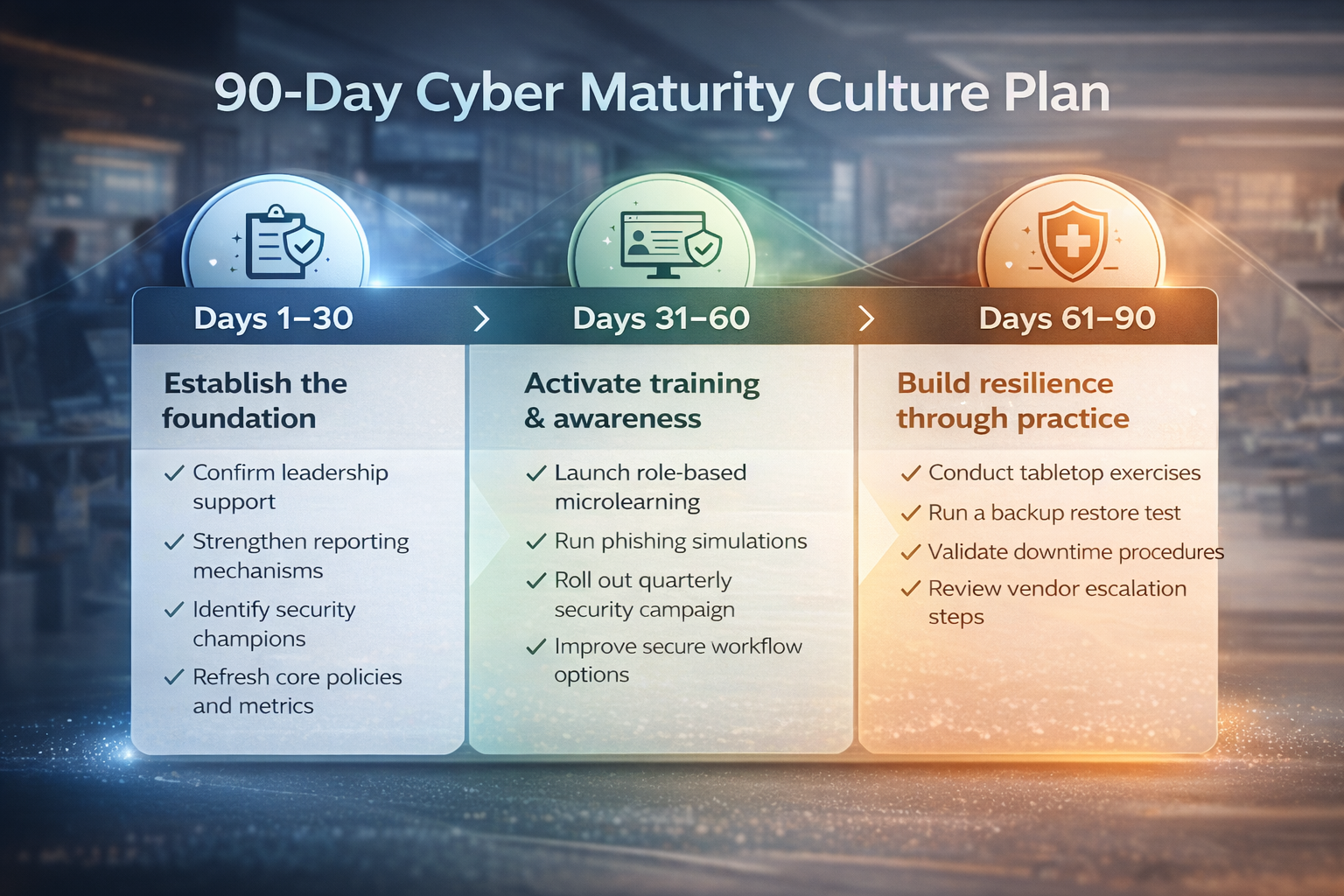
Days 1–30: Establish the foundation
- Confirm leadership sponsorship and messaging.
- Strengthen reporting mechanisms and feedback loops.
- Identify departmental security champions.
- Refresh policies and baseline metrics.
Days 31–60: Activate training & targeted awareness
- Launch role-based microlearning.
- Run phishing simulations with coaching (not blame).
- Start a quarterly theme campaign and improve secure workflow options.
Days 61–90: Build resilience through practice
- Run a tabletop exercise (ransomware or EHR outage).
- Complete a restore test and document the results.
- Validate downtime procedures and vendor escalation steps.
Let Cyber Advisors help you increase YOUR cyber maturity
Building a culture of cybersecurity maturity in healthcare takes more than a training platform. It requires a strategy that aligns leadership, staff behavior, operational workflows, and technical controls—while respecting the realities of patient care.
Cyber Advisors helps healthcare organizations strengthen cyber maturity through:
- Security awareness training tailored to clinical and administrative roles
- Insider threat risk reduction through identity and access governance
- Resilience planning: incident readiness, tabletop exercises, downtime workflow support
- Security program assessments and roadmaps tied to continuity of care
If your organization is ready to move from “security as an IT task” to “security as an operational capability,” we’re here to help.
Start the conversation with a Cyber Maturity Culture Assessment to identify where behavior, process, and controls are misaligned—and receive a practical roadmap you can execute.